Christ chose the church as his bride, but perhaps it’s time to take away the microphone from the drunken Best Man

Ephesians: 5: 25-27 

The Genesis Fix.

Husbands, love your wives, as Christ loved the church and gave himself up for her, 26 that he might sanctify her, having cleansed her by the washing of water with the word, 27 so that he might present the church to himself in splendor, without spot or wrinkle or any such thing, that she might be holy and without blemish.

The romantic notion that the Church is the bride of Christ has many meanings. As Ephesians states, it is a sanctified relationship, a model for behavior on both a personal and corporate level. 

There’s just one problem with this marriage and its interpretation over the ages. It appears the marriage has been hijacked by people who consider themselves the Best Man. 

You know the type: They get all caught up in the moment and start to think they’re the most important person at the wedding. Then they grab a microphone and start rambling on about their relationship with the groom or whatever and won’t shut up or sit down. Everyone in the room starts to get uncomfortable. The Best Man drones on, bragging about all the things they’ve done together, and this tale or that tale emerges that are more than just a little embarrassing. 

Everyone at the wedding knows the talk has gone on far too long. But wanting to show respect, people hold tight and refuse to interrupt the blathering fool with the microphone. That can only last so long, however. 

Every long wedding talk must come to an end. Sooner or later the power-drunk Best Man has to stand down, stand aside and let the actual marriage begin. 

That’s where we find ourselves in an age when so-called Traditional Christianity is being challenged to give up the microphone and take a seat. The entirely aggressive enterprise of claiming you’re the absolute Best Friend of Jesus and that no one else in the room has a clue what he’s really like has gotten old. Very old. 

Next generation Christians, especially progressive and liberal Christians, are advocating a whole different relationship with Jesus that isn’t based on timeworn tales that miss the nuance of the deeper meaning of the marriage that is true faith. 

Oh sure, the Best Man has his schtick down pat, what with all that patriarchal Guy Talk and Confessional Language designed to make it seem like there’s only one way to be married to Christ in this world. But bragging about the Good Times you’ve had together and the laws you’ve laid down about how to live does not necessarily help the marriage. In fact it leads to unhealthy, unbalanced relationships. 

A real marriage with Christ takes real communication. Real consideration. 

It also means not taking everything in the relationship literally. One could argue that Jesus set the tone for the whole Bride of Christ scenario as he collaborated with his disciples. They were taught to listen and read the nuance and symbolism in his stories. It was not all macho crap and black and white and God Said It So I Believe It. That’s not how Jesus taught at all. If he had agreed with that philosophy he’d never have challenged the religious leaders of his day. They were plenty good at that kind of power-mongering, money-grubbing, Follow the Law kind of religion. Jesus hated that crap. That’s what he came to destroy. 

But it has persisted because people who consider themselves the Best Man always want to grab the microphone and brag about how well they know the Groom (or the bride.) They can’t help themselves and they like to make it sound like there’s no doubt they’re the Best Friend of Jesus. 

Even Jesus must be a little embarrassed and frustrated by now. The habits of his so-called Best Man are nothing like he wants for the marriage between himself and the church. For one thing, the Best Man has always seemed to think that women have no real place of leadership in the church. But women are as important if not more important to the whole of the church than men. 

Jesus also taught that family comes first. But that family was not just conceived as a man and a woman and two kids, as we are so often told to believe by the blathering Best Man.

On many occasions Jesus admonished those around him that family is comprised of those who support each other, who show kindness to strangers and who do not use political or economic divisions to determine who should be considered part of the church. Compare the statements below to the contentions of one who has stood so long at the pulpit damning those who do not hew to conservative tradition, castigating people who do not vote for the Right party or who do not accept a literal interpretation of Scripture espousing patriarchal worldviews and a hatred for modern knowledge, science and social progress on grounds that it corrupts the mind. Jesus did not like that brand of faith…

Then Jesus said to his host, “When you give a luncheon or dinner, do not invite your friends, your brothers or sisters, your relatives, or your rich neighbors; if you do, they may invite you back and so you will be repaid.
 
“The King will reply, ‘Truly I tell you, whatever you did for one of the least of these brothers and sisters of mine, you did for me.’
 
“If anyone comes to me and does not hate father and mother, wife and children, brothers and sisters—yes, even their own life—such a person cannot be my disciple.”
 
Of course Jesus frequently used hyperbole and parable to make his most urgent points.
 
It’s like he stood before his own wedding and told the Best Man, “Dude, you’re way off base here. Because before you go around calling me your Best Friend you need to know a few things. My marriage is one of equality. My marriage is one of love and acceptance. My marriage does not hew to the Old Stories you like to tell about the Early Days. The Early Days are over, Dude. The New Days are here.” 
 
“Because when I did things and told you stories––Dude––you seem to have missed the point of our relationship entirely. I had to ask my disciples all the time why they didn’t get the meaning of my stories, and you’re no better than them. In fact I would not call you my Best Man at all. Not based on what I’ve heard you say or seen you do. You know, this wedding isn’t about you. It’s about everyone here. The same people you’ve bored with your manic attempt to prove you’re the Best Man are waiting for you to sit the hell down and shut the hell up. Because the existentialists were right about one thing, and you’ve absolutely proven it today. Hell really is Other People. But especially the Best Man who thinks it’s all about Him. Take a seat, Bro, your time’s up.”

It’s Rapture versus Rupture in modern day Christianity

Acts 1:18 —With the payment he received for his wickedness, Judas bought a field; there he fell headlong, his body burst open and all his intestines spilled out.

IMG_5827The Gospel narratives are full of predictions, prophecies (fulfilled and unfulfilled) and warnings against behavior that could lead one away from God. That makes the character known as Judas one of the most interesting, portentous enigmas in all the Bible.

Judas was a close disciple of Jesus. He saw everything his teacher did. He was present for the miracles and witness to the teachings. No doubt he also received admonishment from Jesus when the disciples failed to learn the lessons of spirituality from the parables.

Mark 4:13 shows one of many instances in which Jesus showed concern that his disciples just just didn’t get it. “Then Jesus said to them, “Don’t you understand this parable? How then will you understand any parable?”

Some people bristle under guidance like that. They don’t like having their intellect questioned, or their belief systems challenged. In fact they often think they have it all figured out.

Yet it appears the disciples struggled to understand the true mission of Jesus on many levels. Acts 6:7 shows them asking questions about what type of kingdom Jesus sought to bring.

Acts 1:6 When they therefore had come together, they asked of Him, saying, “Lord, wilt Thou at this time restore again the kingdom to Israel?”

Acts 1: 7 And He said unto them, “It is not for you to know the times or the seasons which the Father hath put in His own power.”

Statements like that must have really pissed off Judas. Those were desperate times in Israel. Roman occupation was cruel and dismissive of anyone that did not fall in line with worshipping the Emperor and the state. Many in Israel thought there must be a better way. They longed for an earthly king and a nation of their own to rule. They wished a bloodthirsty king like David might return to smite the foe. The entire Book of Revelation is a secretive song of hope for just such a result.

Yet too often the purpose and meaning of Revelation is forgotten. The opening lines of the prophetic book lay it out clearly enough.

Revelation 1:1The revelation from Jesus Christ, which God gave him to show his servants what must soon take place. He made it known by sending his angel to his servant John, 2 who testifies to everything he saw—that is, the word of God and the testimony of Jesus Christ. 3 Blessed is the one who reads aloud the words of this prophecy, and blessed are those who hear it and take to heart what is written in it, because the time is near.”

It all came true soon enough through Jesus. The Roman empire was ultimately vanquished, much by its own making. Christianity was then adopted as the ruling religion through Constantine. It took a few hundred years or so after the death of Jesus for all that to happen, but in classic style the opportunity for the kingdom of God was opened and revealed, like a seal you might say. And from then on the history of the world has been engaged and determined to some extent by the DNA of Christianity. For better or worse, the Book of Revelation came true.

But again, that’s not how some people see it. Judas was one of those people who wanted instant gratification. He wanted to see the Romans die. He wanted immediate victory over his oppressors. It apparently frustrated him that Jesus was not going to swing the mighty hammer of God and bring it all about.

In his frustration, Judas turned on Jesus and sold him out to some religious leaders who were eager foes of Jesus because he questioned their authority, their methods and their status in society. The Bible lays it out all so clearly, yet it is too easily forgotten today. All four Gospels and the entire Bible provide examples of people whose positions are threatened and are all too willing to take matters into their own hands when the opportunity presents itself.

That was also the case when Judas rolled over for the price of 30 coins and vented his frustration by betraying his teacher and friend. Thanks to Judas, Jesus was taken into custody, turned over to Roman authorities, causelessly judged, flogged and then crucified on a set of timbers with nails driven through his arms and legs. It was an ignominious death.

What happens next in the story of Judas is subject to a degree of interpretation. Some accounts say he hanged himself. The story in Acts suggests another scenario in which Judas purchases a field and in so doing, experiences anguish and stress to the point where he bursts apart, spilling his guts on the ground. It’s not impossible. Gastric distress has been known to cause bowel explosions. 

One might call that the Rupture. It is a symbolically significant but much ignored aspect of scripture. After all, it was Judas that pushed forward on gut instincts to betray Jesus. He wasn’t patient enough to wait around and find out what the entire scenario was supposed to mean. His gut told him that the kingdom he desired was not going to pan out. It pained him at a level of frustration and zealotry that could not be sustained. He couldn’t take the idea that vengeance and victory would not be his. His hated enemies the Romans were not going away any time soon. There would be no immediate war and no blood spilled on behalf of Israel. The Jewish state would not be enacted in his lifetime. In fact the opposite ultimately happened. The temple in Jerusalem was destroyed by the Romans. How could that have been part of God’s plan? 

There are similar themes going on in today’s world. Here in the United States we hear frequent claims that America was founded as a Christian nation. Lacking real proof, especially as it was successfully avoided in the drafting and approval of the Constitution, there are many that have endeavored to create a virtual Christian state by enacting laws that impose interpretations of so-called Christian values on the populace. They want a theocracy for America yet hate the notion that certain Muslim sects want to make a caliphate of the world. 

Still others take the prophetic approach. Television ministers like Pat Robertson blame all sorts of social ills on America’s unwillingness to bow before a highly conservative take on what a Christian America should look like. He has gone so far as to blame major weather events on America’s tolerance for homosexuality, or even sexuality in general.

But men like Robertson are little more than modern day version of Judas. One after another these fire and brimstone preachers are exposed for the angry, hypocritical zealots they really are. They seem to implode on the very ground they purchase with their 30 coins. 

One thinks of Jimmy Swaggart, the adulterous liar whose flock trusted his holiness and guidance only to find out he was a corrupt little fraud. People magazine carried this adroit bit of reaction to his downfall. ”I am indignant,” said a 47-year-old woman member of Swaggart’s Assemblies of God Church. “How could he stand up there in the pulpit and preach against adultery and promiscuity when he was doing that kind of thing all this time? I think he ought to stay out of the pulpit.” Angry as she was, she would not give her name, fearful of a fanaticism she’d had no cause to fear before.”

Yet Swaggart eventually swaggered right back into his game because every Judas has his or her fan club. There are plenty of other zealots willing to back the pattern of forcing the hand of God. They want to fix the results just like gamblers like to fix ballgames to guarantee the outcome.

The Republican Party has learned how to leverage all this angst and fury into votes for its candidates. So-called Values Voters fall in line with anyone promising a virtual theocracy in America. That’s also been an ugly scene, with one after another seemingly holy politician turning out to be a Judas in disguise. Sure enough, they’re forced to spill their guts sooner or later when the truth of their adultery, illicit relationships, money-laundering schemes and pay-for-play politics are exposed. Repression is a jealous mistress. The truth comes out sooner or later, rupturing careers and reputations. 

Yet they keep coming, these rapturous defenders of virtue, these zealots of social cues. But they can’t resist taking payment of 30 coins, more or less, from corporations or other big players to gain election. Then they are beholden to moneyed interests for the rest of their political career. It’s no secret that Judas was the keeper of the treasury for the disciples. Yet we all know that the love of money is the root of all evil. Don’t we? 

Judas found that out the hard way when he tried to force God’s hand that you ultimately can’t buy a kingdom here on earth any more than you can buy salvation in the hereafter. The things you find yourself doing to make it all happen are sooner or later revealed, discovered or destined to happen. Judas wanted to be rapturous about the fall of Rome. He didn’t get that. Jesus was bringing about a kingdom of the spirit that would counteract those forces given time. God’s time, that is.

Acts 1: 7 And He said unto them, “It is not for you to know the times or the seasons which the Father hath put in His own power.”

All these people longing for the Rapture had better (or best) concern themselves more with the Rupture. Too many Christians are selling themselves out to a forceful brand of faith that is not in line with God’s true plan for the kingdom of the spirit. There is no such thing as Left Behind. There is such a thing as spilling your guts for the wrong reasons. 

So let’s be clear. That kingdom of the spirit is composed of kindness, charity and love. It is not built on politics, power and culture wars based on angry interpretations of the Book of Revelation or any other symbolic text in the Bible. Either alternative of the forceful brand of faith are ugly and painful. Rapture or Rupture are essentially one and the same. 

Now let’s hear the Rapture people spill their guts about this one.

Coming to grips with life in the aggregate

By Christopher Cudworth

A closeup of an aggregate substance.

A closeup of an aggregate substance.

People of faith are accustomed to thinking of their God as their Rock, the solid foundation of their being. 

However so much of the world exists in aggregate that to appreciate its complexity requires a bit more thought to appreciate. 

Bending down to examine some concrete or asphalt along a public street, one finds our highways are not in fact solid in construction. Millions upon millions of smaller rocks are fused together to form the path on which we trod, ride, run or drive. We mash these pieces together to create a greater whole. Then we use oil and other binding material in hopes that our roads will last a long while. 

But of course they deteriorate eventually. Come apart. Get potholes. Everything made by the human race seems destined to such a fate.

Yet so, it turns out, is everything made by God. The earth and all of the universe is in a constant change of decomposition, change and reformation. Even the mighty mountains and largest rocks in the world eventually turn into sand. 

Some people believe that is the only direction in which change can move, toward destruction. Their worldview sees a perfect beginning and from there, the inevitable charge toward the end of all things and all time. They cannot imagine and choose not to believe that life could have come forward out of chaos. They demand the inference of a creator, a designer, a being that produced all beings. 

There is no lack of evidence. That could be true. But there is no proof. So we must explain it some other way, in practical terms, so that we can be good stewards of all that we survey here on earth. And that is where an appreciation for the aggregate must enter the picture. 

Our role in the aggregate

As one of the so-called higher life forms on earth, human beings play an important role in interpreting the past and determining the future of the planet.

At the most foundational level in terms of human behavior, people of faith consider our souls to be an intact part of their being. Yet it is quite hard to argue that our bodies, the temple for the spirit, are and were not assembled through an aggregation of cellular activity. We depend on DNA and an incredibly fine-tuned yet chaotic universe to contribute the materials from which we are made. It all gets organized through chemical reactions and what we call fertile conditions for life. We evolved from those conditions. They do not randomly happen to support our needs. 

We could not have evolved without oxygen. Life developed in concert with that element and all of life depends on it, with bold exception. Plants reverse the process, taking in carbon dioxide and emitting oxygen vital for all life other life forms. It was a small aggregate that began it all, yet it was an aggregation all the same. One still fills the need of another. 

Dependencies

All aggregations are symbiotic. That is, they depend on each other for survival. The stones that form the foundation for the cement do not hold together without some substrate, Portland cement for example, to bind them together. So it is with all forms of life and all things on earth. The aggregate is the true foundation of all things, which depend on relationships however dead or alive, for survival. 

Even the Bible, the Word of God, is more powerful and strong as an aggregate work of literature than it would be if all its books and words were forced to stand on their own. One cannot comprehend the meaning of Jesus Christ without the aggregate history and acts of his prophetic predecessors. The fact that Christ arrived to bring a new law is only comprehensible if you know the original laws he deigned to improve upon. His arrival was the aggregate of all the prophets and leaders who came before, from Adam and Eve to Abraham to David. All of history is an aggregation of events. We can yank out its parts but to properly understand them we must put them back in place to see how they fit, and where. 

The mark of man is sometimes used to dictate what we should believe about the aggregate.

The mark of man is sometimes used to dictate what we should believe about the aggregate.

The meaning of aggregation

What does it all mean, this aggregation? It means that forcing our imprint upon the cement can only fix a moment in time. It does not define the cement down the street, or anywhere around the world. It can help us understand the influence of man upon a moment, but it does not deliver any ultimatums. Even the 10 Commandments for all their reach and grasp in human values are not absolute. We still need to consider their meaning, measure their purpose and implement them in our lives. 

We know the difference between Thou Shalt Not Kill yet when wars come around, we find justice in the killing. 

We struggle knowing that the bible says that the love of money is the root of all evil, yet when used for charity or grace, money can be the greatest expression of love that there is. 

And when we hear people say that the world was created in seven days, it is tempting to think that those seven days were similar to the length of the days we now know. Yet the bible also uses the terms “day” and “ages” to loosely describe the aggregate sense that a day as we conceive it can also be an expression of awareness, not just a literal 24. When we describe ourselves as having embarked on a “new day” we certainly do not hope for a mere 24 hours of revelation or enlightenment. We hope our new day lasts forever. And ever. And ever. 

All of time and being and evolution are an aggregate expression of all that went before. And all that will be. What pain the Lord himself must feel when we do not attempt to understand these things as the whole of creation and limit ourselves to a surface take on what lies before us. 

Even the scales that form the pattern on a butterflies wings function as an aggregate, evolved through time to deliver a broad range of benefits from camouflage to sexual expression to protection from the elements. An aggregate creature.

Even the scales that form the pattern on a butterflies wings function as an aggregate, evolved through time to deliver a broad range of benefits from camouflage to sexual expression to protection from the elements. An aggregate creature.

The aggregate shared

We have evolved as individuals, yet composed of many aggregate organs and body parts whose development was forged in earlier iterations, our ancestors. We share our DNA with all living things on earth. Some more than others, but that is to be expected. They are simply different aggregates, evolved to perform different functions in the great aggregation that is nature. Many have also been lost to time. 99% of all forms of living things that once existed are now extinct. We still see that happening today. We see evidence of the past in the aggregate fossils found on the surface and deep within the layers of the earth. Sedimentary rock forms so much of the earth’s crust, formed by ancient seas and the massive depositions of life that turned into little more than mere patterns in the rock. But what a story they tell. 

To put a fine and human line on all this aggregation, and its role for people of faith, there is even a direct relationship between the words aggregation and congregation. The body of Christ, as expressed through the church, is most certainly an aggregate. We are all fused together as part of that body. It holds together so long as the cement of our being, that is love, is kept intact. 

Minus that binding element, the aggregate dissolves. Fraught by infighting, jealousy and fractional power-mongering, even the aggregate body of Christ will dissolve in time. 

Whether you are on the side of the aggregate or trying to force some wedge into the body of Christ with literal force and fearful desires for wealth or power is something everyone has to determine for themselves. The evidence of these divides is all around us. Whose side are you on, upholding the aggregate or splitting the perceived rock of your salvation for your own benefit? 

The Genesis Fix.

The Genesis Fix. A Repair Manual for Faith in the Modern Age. 

Who needs Left Behind when Right Behind is the more accurate theology?

IMG_8605If you’re familiar with Left Behind series of books authored by Tim LaHaye and Jeremy B. Jenkins, then you likely know there is a new movie coming out in theaters starring Nicholas Cage. In movie parlance having Nick Cage star in your movie is an opportunity to give real credibility to the story you are trying to tell. Or sell. 

The plot line of the new movie according to imbd.com goes like this: “A small group of survivors are left behind after millions of people suddenly vanish and the world is plunged into chaos and destruction.”

Interesting the generic description makes no mention of the notion that God is the destructive force behind the chaos. It also avoids mentioning the fact that the entire notion of the Rapture upon which the movie is founded was fabricated in the 1830s to give the Bible a more actionable relevancy at the dawn of an era when science would soon explain the very origins of life. It was both a fearful attempt at garnering followers that was simultaneously based on fear as it attractive feature.  

So the books and movies upon which the Left Behind series are based depend on a worldview conceived in the mid-1800s, and it hasn’t advanced one bit. Nor does it seem concerned with how it openly deceives people with its falsehoods based on highly literal interpretations of obviously symbolic imagery, a patent hunger for sensationalism and a myopic stance on the role of religion or Christ in history. It simply wants to sell itself off as the truth. 

The entire Left Behind series was contrived to market a competing worldview to that founded on science, humanism or even a rational Christianity. But we must be cognizant of the fact that the Rapture was an emotional concoction dreamed up to make the Bible a more scary and interesting book, thus creating converts. 

Here’s how the website Stormloader described the whole Rapture enterprise and its beginnings: 

“The theory of the rapture began in the early 1830s. It was invented by Margaret MacDonald of Scotland and promoted by Edward Irving. Margaret claimed to have had visions of the second and third coming of Christ. Irving, a Presbyterian preacher, promoted the idea that there was to be a restoration of spiritual gifts before Christ’s return. It was at that time, the 1830s and 1840s, when he expected Christ’s return to take place. The date for Christ’s return was set for 1844. The year came and Christ did not return. Nevertheless, many continued to follow the leadership of Irving. He emphasized the tongues (speaking in…) gift. This was not the genuine tongues of the Acts of the Apostles, but the phony tongues of speaking gibberish and claiming it to be a gift from God. The Presbyterian Church kicks him out as his movement began to slide into high gear.”

Since that period in the 1800s when the so-called Rapture was invented, there have been numerous attempts to cobble together similar scriptural narratives using both literal and highly fantastical elements of the Bible to predict the Second Coming. All of these efforts have failed of course.

The most recent high-profile predictions came from Harold Camping, a doomsday minister whose Family Radio talk show featured his threateningly deep voice and a patiently impatient method of teaching and correcting his listeners on scriptural meaning. His predictions that the world would end May 11, 2011 did not come true. The Fox News website describe’s Campings embarrassment and disillusionment when his calculations about the end of the world again failed. 

“Camping’s most widely spread prediction was that the Rapture would happen on May 21, 2011. His independent Christian media empire spent millions of dollars — some of it from donations made by followers who quit their jobs and sold all their possessions– to spread the word on more than 5,000 billboards and 20 RVs plastered with the Judgment Day message.

When the Judgment Day he foresaw did not materialize, the preacher revised his prophecy, saying he had been off by five months. The preacher, who suffered a stroke three weeks after the May prediction failed, said the light dawned on him that instead of the biblical Rapture in which the faithful would be swept up to the heavens, the date had instead been a “spiritual” Judgment Day, which placed the entire world under Christ’s judgment.

But after the cataclysmic event did not occur in October either, Camping acknowledged his apocalyptic prophecy had been wrong and posted a letter on his ministry’s site telling his followers he had no evidence the world would end anytime soon, and wasn’t interested in considering future dates.”

Of course he wasn’t interested in further predictions. Because by then he knew his worldview was false and contrived. He was dead wrong about the entire theology of the rapture and the end of the world. But Camping has been far from alone in being so wrong. Dozens of such predictions have been made over the ages and not one has come even close to being right. Even during turn of the millennium in the year 2000 when the world seemed ripe for a revelatory experience, there seems to have been on important entity that forgot to listen. That would be God, who failed to follow the instructions of all those earthly doomsday prophets and freakazoid survivalists stocking water and freeze-dried food in their basements. 

God seems content to ignore earthly profits as well. Which is why the creator of all things has not kept writers Timothy LaHaye and Jeremy B. Jenkins from leveraging an ugly take on prophetic scripture into millions of dollars in profits from their books and movies about the rapture. 

Frankly it’s not that hard to come up with a rapture narrative. Absent of historical context and its limiting scope, the Book of Revelation and the Book of Daniel and others can be mashed together into a thriller about the end of the world. Never mind that the real purpose of Revelation was to give hope to believers in the face of Roman persecution. But it is also a work of vengeful desires and prayers for deliverance. Hence its appeal to an American society where those two values seem to be everywhere in the politics of the politically conservative voters and believers. 

A broad segment of the evangelical and pentecostal Christian community still seems to view the interpretation of Revelation as the end of the world, and a fitting end to the Bible, itself a highly symbolic (though often literally interpreted) sequence of letters and narratives written to record and describe the faith community that built up around Yeshua, a wandering teacher and prophet whose words and actions inspired descriptions of him as the Son of God. 

When the Jewish man named Yeshua, or Jesus as he is popularly known, was crucified by the Romans for essentially disturbing the peace, the legend and religion that grew up around centered on his position as “The Christ,” the son of God. 

It was hard for many to believe that the son of God could be hung on a cross and bled to death. Yet the religion that grew out of his acts adopted these sacrifices as signs of acceptance and atonement. Christianity lived as an underground movement for quite a while before Rome and then history adopted its tale as encompassed in a carefully rigged book known as the Bible as doctrine. 

We use the term “rigged” intentionally, because there were competing versions of the Christian intent and purpose. These were ultimate quelled and culled from the Canon, but not the book Revelation. It was far too useful and fanatic a book to discard along with other mystic visions of life with Jesus and life beyond this earth. 

As time wore on, the context of Revelation was lost. Its angry accusations toward Rome and predictions that all hell would break loose for barbarians, whores and lustful emperors came to be regarded as something else entirely. The allusions and shared allegories for destruction were wrapped together with the Book of Daniel, from whom it inherited equal parts anger and hope for deliverance, to make a supposed whole. 

The idea that the Bible somehow works like tarot cards, or like a palm reader or an astrologist is so invited to some people that they actually buy into belief systems such as those advocated by End Times Theology or the Left Behind series. What makes this even more sad and distracting is the vengefulness of the narratives contained in these books and the movies that stem from them.

Why do so-called Christians not call the authors into accountability for the false and even evil nature of End Times theology? Because something in it truly appeals to the certainty they require of their religion. Everyone wants to find a certain thing when they wrestle with the notion of faith and God and salvation. The aggressively righteous always seem to gravitate to religion that delivers a notion of victory.

Yet it was Jesus who seemingly lost, big time, when he was crucified. HIs own disciples were distraught and even angry at this notion when he predicted it. Then he was mocked by those who made fun of the fact that he was labeled a king.

The real focus of faith should be centered not on the Left Behind series, which celebrates a violent end to the ages. Instead we should be centered on the notion that someone is Right Behind us, and it happens to be the person we most seek to follow. That is Yeshua. Jesus, the Jew that transcended the laws of the Jews with a new law, one of tolerance, love and mercy. A love that is a guide for all our actions if we have enough common sense to listen to the voice behind us, urging us onward, to do good, love well and to seek or offer forgiveness.

Yes, that love that comes with responsibility and commitment and acknowledgement of grace. But consider what this wonderful verse from Isaiah 30:21 has to say about the type of certainty we can gain from a faith that is focused on Right Behind rather than Left Behind. 

Whether you turn to the right or to the left, your ears will hear a voice behind you, saying, “This is the way; walk in it.”

It’s actually Open Carry they’re really after

By Christopher Cudworth

National approval for Open Carry is next on the agenda of the American gun lobby. Wait and see.

National approval for Open Carry is next on the agenda of the American gun lobby. Wait and see.

I saw another sign banning Concealed Carry the other day. It was posted on some street barriers in anticipation of Cruise Night at a nearby town. You know the sign: A picture of a handgun with a red circle and a slash through it. 

Right now it is legal for some organizations to post one of those signs. If you run a church or conduct a community event where weapons might not be welcome, you can request or demand the right to ban weapons on the site. 

This must rankle all those people who think Concealed Carry is the answer to all our social problems. After all, the laws passed in all 50 states are supposed to guarantee the legal right to pack heat, right? What’s the real point of banning guns anywhere? If you can’t take your handgun into church and someone decides to shoot the place up, how are you going to defend yourself? 

False Premises

That’s the premise of Concealed Carry. The idea that other people might be legally carrying weapons is supposed to be a deterrent to criminals who might otherwise choose to pull guns and open fire. 

Only deterrence is just an imagined protection. There’s no real proof that the idea of other people carrying guns is any real deterrent to people angry enough or bored enough or frustrated enough to pull out guns and start shooting at people in public places.

False Logic

The supposed logic of so-called Concealed Carry doesn’t bear out at any level. Let’s face it: the only real deterrent to anyone about to shoot up society is another person with a weapon openly displayed and aimed at their head. 

thSo thinking it all through, it’s actually Open Carry the gun lobby is really after. Concealed Carry was just a stepping stone Open Carry becoming the norm in society. We’ve already seen gun-obsessed people strolling through towns and cities with rifles over their shoulders, daring anyone to protest their presence. 

Fantasies and Delusions

Open Carry is what they really want. It’s time to force the gun lobby to admit it. Concealed Carry is no real deterrent to illegal use of weapons. Only Open Carry can do that. Otherwise the shooter figures they can outdraw anyone in a gunfight. That’s what the Hollywood movies and all those hardass gun instructors like to teach. Shoot first and best and you survive.  

It’s all based on fantasies and delusions. Everyone figures they’re a faster gun and better aim than everyone else. It’s like the opposite of winning the lottery. With Concealed Carry, the odds of being shot are growing bigger every day. It’s a fascinating phenomenon, and the fact that more civilian Americans have died from gun violence than all the American soldiers that have died in foreign wars is no deterrent to the gun lobby. They just want more, more, more. 

Stand Your Ground Foolishness

Along with Concealed Carry, the worst news for people who appreciate freedom from violence has been the invention of the Stand Your Ground laws. Such laws were supposedly created to give people protection with the right to “defend” themselves in situations where they feel threatened. But guess what? Stand Your Ground laws are proving to be a bad, bad idea. Studies by the American Bar Association have shown that Stand Your Ground laws actually result in an increase in homicides rather than a decrease in gun violence. The American Bar Association report recommends the laws be revised or in some case repealed as a result. 

An article about the report in the Lansing (MI) News states the following: “The task force also suggests that the laws (SYG) only apply if the aggressor shows a weapon before deadly force is used, and recommends that judges give juries more detailed instructions on when a “stand your ground” claim can be used.”

Now a normal person would read that paragraph and say “Good, they’re going to roll back the Stand Your Ground laws because it promotes gunfights.” 

But a gun advocate will likely look at that statement and determine that the better solution is to remove all need to conceal weapons. Let Open Carry be the rule of the day and criminals will really be deterred from attacking. 

Except continuing escalation in the militarization of society is turning the process of enforcing the law from a police action to a military strike against those trying to outgun them. 

The comments on the Lansing News website led off with this insightful screed (sic): 

Taxburdened20111 hour ago

 
“Obviously an article written by a progressive.  The right to own weapons is guarenteed by the 2nd Amendment, quit trying to change our right to own weapons and to change the constitution to your ideolical views, just for once, will you?????  Doubt it, but I still comment on it!  Only the criminal will subvert this right by not owning a weapon legally.  Most, if not all non-criminals will own a weapon legally and registered.  We have nothing to hide, all we want is something to protect ourselves from idiots like yourself who happen to to want to take our right away Mr. Brian Smith! Is that your purpose in this article Mr. Smith???
 
All told, the process of the militarization of society is a self-fulfilling prophecy for people so afraid of government and society in general that they believe the government is trying to take away their guns and their rights. But when even the police feel like they have to act like an army to keep society under control, the idea of a “well-regulated militia” as proposed in the Second Amendment has been outstripped by the selfish interpretation that gun rights are absolute, literal and untouchable.
 
Open Carry is next
 
Watch and wait. It will probably be just a matter of weeks before Open Carry legislation is introduced at a national level. The timing is just about right, with November elections coming around the corner. Probably Congress will throw a bill like that into the hopper, forcing Democrats who vote against it to go on record. There’s precedent for Open Carry at the state level. Organizations such as Opencarrytexas.org are already on the case. 
 
It’s a sad case, mostly, with people dying every day from gun violence, and gun advocates insisting that the only way to stop gun violence is to hand out more guns and brandish them like cowboys in the streets.
 
It’s been said that the definition of insanity is to keep doing the same thing over and over again and expecting different results. Only it’s much worse than that when it comes to guns in America. The escalation of gun weaponry and accessibility of military-grade guns in the United States is not just insane, it is politically criminal and the absolute result of misinterpreting the Second Amendment to mean that “well-regulated” means no regulations at all.
 
If we had followed the same logic with environmental protection rivers in American would be on fire these days as they were in the 1970s. But we developed some common sense and the EPA has protected us from far worse consequences. 
 
So you can see the comparative paradigm at work here. We’re at a critical point in the gun debate where more powerful weapons is having a toxic effect on society and yet the gun lobby cries wolf in trying to tell us it’s not that bad, and that more guns is the price of progress in a civilized society. 
 
Except it’s really uncivilized, what they keep proposing. The insane logic never ends with these people. It never, ever, ends. 


What a wonderful world indeed

By Christopher Cudworth

cropped-genesiscover1.jpgLiberals and conservatives struggle for control of the cultural narrative. Over the last 30 years or so the two sides have unfortunately found very little common ground.

Of particular note in this culture “war” as it is often characterized is the alliance between fiscal, political, social and religious conservatives. These four sub-groups all hold the reins on certain issues. Fiscal conservatives want less economic regulation. Political conservatives want less government. Social conservatives want less moral latitude and religious conservatives want less of everything that isn’t in line with a fundamental take on scriptural ethics.

Less is more seems to be the conservative mantra. For example, a conservative-led Supreme Court has delivered less controls on political contributions by corporations and less governmental control over birth control. On the conservative front it’s more and more about less and less. Less government spending. Less taxes. Less sexual freedrom. Less choice in reproductive rights. Less of a right to marry for gays.

Yet there are some categories where more is more for the conservative faction. One wing of the lobby wants more and more guns. More military spending too. More incursion against terror on the global and domestic front.

It starts to get complicated at some point. What do conservatives really want, more or less?

There are signs that the very complexity of the world is what vexes conservatism. Where liberals love a little free enterprise in terms of philosophy and thought, conservatives like to break it all down to black and white. Then they make choices.

It happens in education where conservatives tried to simplify the entire scholastic operation to a “teach to the test” method called No Child Left Behind. That initiative has had the ironic effect of killing initiative among teachers nationwide. Teaching to the test is quite restrictive. All those standards stifle creativity in the classroom for both teachers and students. And guess what, it hasn’t really produced a better grade of student.

In higher education the resistance to liberal thought is aimed at colleges where admittedly liberalism is the standard by which many schools operate. But that’s the point. Liberalism is the willingness to engage and study a broad range of ideas in order to come to a conclusion any issue.

That methodology seems to enrage conservatives who would rather see a foundational approach to education. That hasn’t happened except in schools where conservatism is the founding principle of the institution. One thinks of Bob Jones University, for example.

The lack of compliance with conservative principles overall has produced a brand of anti-intellectualism that reaches from the classroom all the way to halls of Congress. Conservatives who do not accept basic scientific principles such as the theory of evolution work hard to undermine its teaching in any academic setting. The same holds true for conservatives who refuse to accept the scientific opinion of 90% of the world’s climatologists telling us that the earth’s atmosphere is warming through anthropogenic influence. In other words, climate change is man made.

Such denial hearkens all the way back to the fundamental beliefs about the origins of the earth. Religious conservatives refuse to believe in evolution because they think it contradicts a literal interpretation of the Bible. Never mind that Jesus himself taught using organic metaphors to convey spiritual principles. Conservatives ignore the scientifically metaphorical teaching style of Jesus because it smacks of an intellectualism that contradicts the fundamentalist approach to all sorts of reductionist thought. In other words, if they follow the example of Jesus, who admonished his own disciples for failing to grasp his parables, it messes with the whole goal of simplifying your worldview to the basics.

But conservatives seem to prefer simplification over liberal engagement on any issue. One could argue that the entire worldview of the conservative movement is summed up in the happy but frighteningly dumb lyrics of the song What A Wonderful World, sung with ironic glee by musicians as diverse as Herman’s Hermits and David Bromberg. The song lyrics go like this:

Don’t know much about history
Don’t know much biology
Don’t know much about a science book
Don’t know much about the French I took
(But I do know)
But I do know that I love you
And I know that if you love me, too
What a wonderful, wonderful world this would be

Don’t know much about geography
Don’t know much trigonometry
Don’t know much about algebra
I don’t know what a slide rule is for
(But I do know)
But I do know “one and one is two”
And if this one could be with you
(A wonderful world)
What a wonderful, wonderful world this would be
What a wonderful, wonderful, wonderful world

Now I don’t claim to be an ‘A’ student,
But I’m tryin’ to be
I think that maybe by bein’ an ‘A’-student, baby-baby
I could win your love for me

Don’t know much about the Middle Ages
Looked at the pictures then I turned the pages
Don’t know nothin’ ’bout no “Rise and fall”
Don’t know nothin’ ’bout nothin’ at all
(But I do know)
Girl it’s you that I’ve been thinkin’ of
And if I could only win your love (oh girl)
What a wonderful, (what a) wonderful world this would be
What a wonderful, wonderful world this would be

What a wonderful, wonderful, wonderful, wonderful world


It’s sad because conservatism does have so much to offer in terms of holding social standards of morals, ethics and behavior. There is a little bit of conservative in almost all of us. There certainly is in me.

But the close-mindedness of the movement is what causes such resistance on the liberal front, where civil rights, human equality and economic justice are the priorities. Those happen to align with what we learn in the Bible as well. And that’s why some of us think the conservative version of a wonderful world would not be so wonderful at all.


The difference between discrimination and a discriminating religion

By Christopher Cudworth

(CNN) Arizona’s Legislature has passed a controversial bill that would allow business owners, as long as they assert their religious beliefs, to deny service to gay and lesbian customers.

So it has come to pass that segments of the American people think it is their duty to engage in discrimination against fellow American citizens strictly on the basis of their religious beliefs.

CNN reports: Gov. Jan Brewer, a Republican and onetime small business owner who vetoed similar legislation last year but has expressed the right of business owners to deny service (says)”I think anybody that owns a business can choose who they work with or who they don’t work with,” Brewer told CNN in Washington on Friday. “But I don’t know that it needs to be statutory. In my life and in my businesses, if I don’t want to do business or if I don’t want to deal with a particular company or person or whatever, I’m not interested. That’s America. That’s freedom.”

Republican Jan Brewer has effectively capitulated the strategy of her political party for the last 10 years. Divide society and conquer to gain the vote, if you can. The goal is to create increasingly divisive political subsets and deliver what those subsets claim to want in terms of selfishly contrived laws appealing to their interests. Then claim that is what America is really all about.

The one major piece of legislation of law favored by the political Right that was passed in the last 10 years was Citizens United. That was a Supreme Court decision granted corporations more rights to determine the outcome of elections by spending more money anonymously. What’s so human about that?

Meanwhile, out in the trenches, panic over an increasingly diminished influence of conservative Christian thought in society has gotten certain legislators to finally try to invoke the virtual theocracy they’ve been praying about for years.

It’s a sickening little fact that the virtual theocracy flies in the face of the American Constitution, which clearly guarantees freedom from religion as well as freedom of religion.

Yet legislators in Arizona have chosen to ignore that fact and pass a law that says businesses can deny service to anyone they choose based on religious grounds.

How do legislators and so-called Christian believers arrive at so egregious a position?

They fail to understand the difference between a discriminating religion, which works to understand the nature of its own beliefs in context of society and culture, and a religion of discrimination, which aggressively refuses to recognize the rights of all those with whom it disagrees.

We see the philosophy of a religion of discrimination at work in many corners of society these days. Creationists who refuse to recognize the verity of science are not by nature discriminating people. Their worldview is created around a blanket acceptance of scripture as inerrant and infallible. Based on this indiscriminate worldview, they attempt to discriminate against the potency of facts that contradict their literal interpretation of the Bible.

It’s pretty easy to see who is discriminate in their religious worldview. It is the people who can accommodate the most practical truth and still believe in God. It is not the people who are constantly shielding themselves from people they believe are different, and therefore evil. To be discriminating is good. To be indiscriminate, and believe in discrimination as rule of law is bad. Even evil.

Keep an eye out. There is evil all around you.

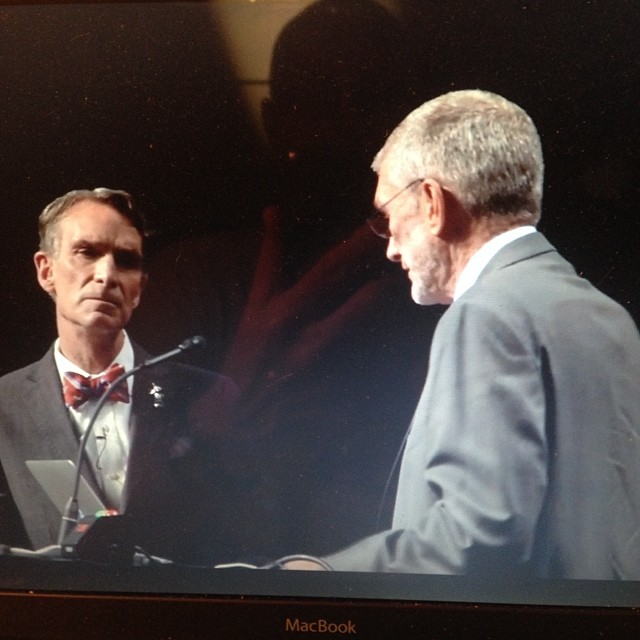
Ken Ham the Creationist versus Bill Nye the Science Guy proved a lot about how wrong Ken Ham has the Bible

By Christopher Cudworth

Bill Nye listens carefully as Ken Ham makes the claim that the Bible is a better source of fact than material science

Bill Nye listens carefully as Ken Ham makes the claim that the Bible is a better source of fact than material science

It appeared from watching the “debate” between creationist Ken Ham and scientist Bill Nye that Ham wanted desperately to prove science wrong about everything.

But a funny thing happened on the way to the conclusion of the so-called debate. Ham never mustered the ability to answer simple questions that would have proved creationism has any sort of relationship with science. His entire contention rested on the contention that the Bible must be understood “naturally” in order to understand the world. That is, the parts in the Bible Ken Ham judges to be crucial to a literal interpretation of scripture must be abided to the letter. The other parts, such as the “poetry” of Psalms, according to Ham, actually have no real bearing on the role of the Bible as science. Wow. That’s a whopper.

Yet that is the biblical foundation of Ken Ham’s creationist worldview. It begins with a denial of a significant portion of the Bible’s verity. Creationism literally starts with the assertion that not all the Bible can be trusted as fact.

And that’s just the starting point of a confused, frustrating and inaccurate worldview. Ken Ham seems to misunderstand and completely disregard the nature of what Christians call the New Testament. In fact he makes very few references to Jesus in any of his assertions about creation.

He certainly never mentions the methods by which Jesus himself taught by using organic metaphors. In simpler terms, Jesus used symbols from nature to illustrate spiritual principles. That way everyday people could comprehend what he was trying to teach about the nature of God.

But Ken Ham can’t seem to grasp or embrace that style of teaching, about nature, or about science. He prefers instead the literal view of scripture. His motive appears to be focused on leaving no room for interpretation. He is a zealot about that.

Of course that is the very same legalistic approach used by the Pharisees, leaders of the faith in Jesus’ day. He branded them a “brood of vipers” in clear reference to the Genesis depiction of Satan as a serpent.

You don’t have to take that reference literally to get the message. Jesus would not have liked Ken Ham. Jesus would have knocked the Creation Museum to the ground because it is a crass attempt to control the faith and belief of people through legalistic force and deception.

So the truth speaks for itself. Ken Ham is at odds with Jesus Christ, God’s only Son. Ken Ham considers Jesus’ method of teaching with metaphors inferior to his own brand of truth based on narrow interpretations of a book written 2000 years ago, conveyed originally as oral tradition and translated multiple times.

The simpler, more clear understanding that Jesus gave to all those who would listen is not good enough for Ken Ham. Jesus would gladly have accepted the findings of science.

Jesus said God is nature, and nature is God. All things worthy of consideration can be discerned through that simple statement. Anything else is fiction, or worse, a lie about the Word of God. And God is never happy about that.

On why we should all read about faith and what it means to the world

Lutheran School of Theology Chicago

Lutheran School of Theology Chicago

By Christopher Cudworth

Sitting in the admissions office of the Lutheran School of Theology in Chicago felt right.

A little more than two years ago a young man that had served as our church Youth Pastor had invited me to visit the school. “I think you’d like it,” he told me.

Our conversations as he prepared to leave his position at the church and begin studies to become a Lutheran pastor had centered on ministry to high school students, yet over coffee one morning the topics widened. I explained the process of writing my book, “The Genesis Fix: A Repair Manual for Faith in the Modern Age,” and how it changed the way I viewed writing about, and reading about, faith in the world.

The experience of trying to get an agent for the book had taught me a few things. The theme was the same with every contact. “You’re not a minister. You’re not a college professor. What credibility do you have to write such a book?”

Credibility is important. It gives people a foundation upon which to trust what you write. The process of earning credibility can also challenge the manner in which you arrive at your conclusions.

Regarding Masters

The message stuck with me. Despite the fact that I had spent 7 years researching and refining the book, it was true. I was not technically qualified to write it. Not in the eyes of those who make such decisions anyway.

It’s not enough that your friends call you “courageous” for taking on biblical literalism as a worldview. You must vet your viewpoints in the theological world before tearing away the dogmatic garments of the modern day Pharisees who stand in opposition to so much practical truth.

Simple truths and basic contradictions

Yet it’s a simple fact really. Biblical literalists stand in opposition to the teaching methods of Jesus Christ, who consistently used organic metaphors to convey spiritual truths through parables designed to bring the common mind to faith in God. Ignoring that principle is basically a slap in the face to Jesus. It’s like telling him, “You don’t know what you’re doing. Don’t you know that God’s Word must be taking literally or it has no meaning at all?”

While classic, the old ways of thinking may not be sufficient for a new world. Nor have they ever been.

While classic, the old ways of thinking may not be sufficient for a new world. Nor have they ever been.

Actually the community of believers who take the Bible literally never actually get close to discussing the teaching methods of Jesus. They’re stuck way back in Genesis and a literal 7 days, an Adam and Eve that were transmogrified from the dust of the Earth and a Serpent or Snake who tricks Eve and then Adam into disobeying God’s warning not to eat from the Tree of Knowledge. Of course we all know the story. Adam and Eve fall for the Serpent’s logic, thereby causing the Fall of Man.

Bad Beginnings? 

Original Sin is the pet concept that emerges from that creation story. But that quick-take worldview ignores a key aspect of the tale. What we miss by taking the story literally is the Serpent’s methodology in tricking Adam and Eve. In a crafty use of the first brand of scripture known to Man, the Serpent engages Eve in legalistic use of God’s own words to undermine her trust in God. Here is how the ploy works:

Christianity is not entirely clear on what the "serpent" really is, or looks like. So how can we take such a creation story literally?

Christianity is not entirely clear on what the “serpent” really is, or looks like. So how can we take such a creation story literally?

The Serpent’s Deception
3but from the fruit of the tree which is in the middle of the garden, God has said, ‘You shall not eat from it or touch it, or you will die.'” 4The serpent said to the woman, “You surely will not die! 5“For God knows that in the day you eat from it your eyes will be opened, and you will be like God, knowing good and evil.”…

How very similar is this exchange to the passage in Matthew 15 in which Jesus engages the Pharisees over the issue of turning the Word of God into a legalistic trap:

1Then some Pharisees and teachers of the law came to Jesus from Jerusalem and asked, 2“Why do your disciples break the tradition of the elders? They don’t wash their hands before they eat!” 3Jesus replied, “And why do you break the command of God for the sake of your tradition?

The comparison between literalism and legalism is given a direct connection to the Serpent in the Book of Genesis in Matthew 23:33, “You snakes! You brood of vipers! How will you escape being condemned to hell?”

It is a sad fact that today’s adherents to biblical literalism are playing the same game that Pharisees played with Jesus so long ago. Yet the pain and misdirection caused by today’s brand of scriptural literalism is just as potent as that depicted in Genesis with deception by the serpent, and just as power-mongering as the Pharisees of the New Testament.

And that is the point from my motivation to attend a school of theology emanates. I believe the most important thing in the world right now is to counter biblical literalism and all its awful consequences. Literal interpretation of the Bible is being used to persecute gays, to resist legitimate science, to argue against the theory of evolution and to undermine political and ethical justice on a broad spectrum of issues.

Reason and Reasons
It’s not about a mid-career change for me, or anything prosaic as that. It’s about finding ways to make the world a better place. Martin Luther changed the world by pointing out the very simple fact that we are saved first and foremost by grace. The new reformation should finish the job of removing all barriers from our acceptance of grace.

Yet we also need to define what it means to exist within and attend to the Kingdom of God. How we understand the nature of that “kingdom” is crucial to our stewardship of creation. The dangerously ironic consequence of a worldview founded on biblical literalism is the attitude that nature and all of creation is essentially a disposable tool of God, one that has no purpose other than our own somewhat greedy sustenance and no other significance than as a temporal stage between Creation and Armageddon.

Challenges

We can do better than old ships and sails of theology. And we should.

We can do better than old ships and sails of theology. And we should.

We need to challenge this fatalistic worldview at its very roots. That begins with the misinterpretation of Genesis as a literal document. Yet it also extends to our regard of scripture as a wholly inerrant document. It simply isn’t, that way. Any faith dependent on that premise is brittle, frail and sad, thus requiring a defensive posture to sustain.

The book of Romans 1:20 contains a telling point of scripture, one that reveals the idea of organic fundamentalism, the key understanding that nature itself, and our metaphorical understanding of it, holds keys to our comprehension of God and all that we read in scripture:

Romans20 For since the creation of the world God’s invisible qualities—his eternal power and divine nature—have been clearly seen, being understood from what has been made,  so that people are without excuse.

Nowhere in this passage, or any other in the Bible for that matter, does it say that we must take a literal approach to conceptions of God. In fact as demonstrated by Jesus himself, we are to do the opposite.

Recall that literalism and legalism produced the approach that one could earn the way into heaven through God works doled out by the church and vetted by leaders who earned earthly power through the system set up by the brand of Pharisees leading the Catholic church at the time.

Then along came Martin Luther, who saw through the giant ruse of literalism and legalism, and who launched a Reformation that transformed the faith, made it new again. We can view this passage in a fresh light in contradiction to the brand of literalism now vexing the world.

Nature and eternity are foundations of the Bible

There is more to the theological landscape than meets the eye. Creativity, not just creation, is part of scripture. Click for larger view.

Ephesians 8 For it is by grace you have been saved, through faith —and this is not from yourselves, it is the gift of God— 9 not by works,  so that no one can boast.

For there are many who “boast” that their literalistic view of the bible constitutes the “works” of real Christianity. Yet we also know that God’s invisible qualities are visible in Nature, and through the Word, and that there is no excuse for ignoring these greater, most important facets of faith realized.

And that is why the pursuit of truth is so important to me, and why sitting in the office of the Lutheran School of Theology in Chicago felt so very good, and so very real. Because each Reformation has to start somewhere. We all play a part in the heart of faith.

If Bill Nye the Science Guy debates Ken Ham over evolution and Genesis, things could get sticky as a spider web

By Christopher Cudworth

argiope6252a“Will you walk into my parlour?” said the Spider to the Fly,
‘Tis the prettiest little parlour that ever you did spy;
The way into my parlour is up a winding stair,
And I’ve a many curious things to shew when you are there.”

“Oh no, no,” said the little Fly, “to ask me is in vain,
For who goes up your winding stair
-can ne’er come down again.”

It’s a classic tale of deceit for advantage.  The spider uses an inviting scenario to invite the fly to the table, when in fact the intent is to make the fly a meal.

So goes the proposed debate between Bill Nye the Science Guy and Ken Ham, the leader of a group that calls itself “Answers In Genesis.”

We must start with the name of the organization to see how confusing this debate will likely be, or could become.

No Scientific Answers in Genesis

Evolution explains the structure and function of all living things. Genesis does not. It only deals with purpose.

Evolution explains the structure and function of all living things. Genesis does not. It only deals with purpose.

See, when it comes to science, there are no answers in the book of Genesis. None. The only references to the character and structure of living things are made in broad generalities, that various “kinds” of creatures walk, crawl and swim on the earth. It does not categorize them or describe them beyond a preschool level of understanding nature and all its workings.

So the supposition that Genesis somehow holds all the answers to the manner in which the world works and all its complexity is a bold farce.

People Walking With Dinosaurs

How bold? The Creation Museum that has been generated from the teachings of Answers in Genesis insists that people walked the earth at the same time as long-extinct forms of dinosaurs. Achingly sad attempts have been made to prove this fact, including the contention that fossilized dinosaur prints in a bed of Texas rock were actually made by humans. The explanation for the supposedly human footprints alongside the dinosaur tracks is found in the mere fact that mud collapses on its edges in many conditions. But the fantasy and appeal of humans and dinosaurs walking together was so strong that folks like the Answers In Genesis people tried to make a big deal out of it.

That is because there is a major clique of people who cannot see the world through anything other than an anachronistic lens in which the Bible is to be taken literally. This cabal is so desperate to find evidence to support their backwards-thinking theories of creationism and intelligent design, the merest conundrum of science sends them scurrying to catalog the fact that “science is wrong.”

The beauty of science is that makes right from many wrongs

Science is always wrong. That’s the beauty of it. Science is cannibalistic in its willingness to disprove theories and replace them with better ones. But that’s what makes science work in the world. If it cannot be repeatedly demonstrated through experimentation, or documented to be verifiable through supporting evidence, it does not stand up as science.

That’s a harsh reality. Science deals in harsh realities. It makes right from many wrongs, whereas religion takes the attitude that three wrongs can never make a right.

Different priorities

The harsh reality that Answers in Genesis emphasizes (and considers paramount and superior to the priorities of science) is the harsh reality of divine salvation.

Ken Ham may care deeply about your soul, and he may indeed worry that anything that appears to contradict the Word of God may prevent you from making that vital connection with God. But Ken Ham makes the rude assumption that only a literal take on the Bible has verity.

The priorities of Jesus

Jesus revealed spiritual truths by using organic symbols from nature as metaphors.

Jesus revealed spiritual truths by using organic symbols from nature as metaphors.

In fact in reading the Bible we find that Jesus himself taught by using metaphorical symbols from nature to convey spiritual principles that his audience might otherwise fail to grasp if they were not presented in a form that allowed them to conceive and visualize the truth he sought them to grasp. In my book The Genesis Fix, I call this method of teaching “organic fundamentalism,” and its practice is found not only in the parables of Jesus, but throughout the Bible from Genesis to Revelation. Here’s how it works:

True simplicity of faith comes in having the liberty and latitude to discover what scripture means to say rather than accepting a merely literal interpretation of a religious text. We might call this metaphorical tangibility; that is, approaching life and wisdom with an eye toward its unifying symbolism. This is the common denominator in biblical knowledge. Organic fundamentalism isn’t just a “here or there” phenomenon in the bible based on texts selected to make a case in favor of naturalism as a foundation for truth. Scriptural knowledge is consistently (even persistently) delivered to us through use of metonymy from nature to describe the abiding principles of God. Organic fundamentalism founded on observational naturalism is plainly the root source of biblical knowledge and the primary tool for understanding concepts of God. 

At odds with Christ

Ken Ham can't see the trees for the forest.

Ken Ham can’t see the trees for the forest.

So this raises the question of whether Ken Ham’s worldview has any verity at all if in fact his seemingly simple explanations of nature are in fact not in accordance with the teaching methods of Jesus Christ. I believe Jesus would have labeled Ken Ham another brand of Pharisee, someone so caught up in legalism and the hunger for power over the Word that he has lost sight of the forest for the trees. He is, in other words, a modern day zealot in search of a position in this life, not the Holy Man he claims to be.

A nasty web of religious words

When Billy Nye debates Ken Ham he will first have to sort through the many webs and fabrications of “fact” that Answers In Genesis has woven to ensnare scientists in a religious, not a scientific debate. The complicating factor is that when the version of religion is even wrong, you are in a very sticky situation. Bill Nye may well find himself having to correct Ken Ham on his religious facts in order to debate his ostensibly scientific contentions that creationism is real and true.

It isn’t, of course, and Jesus never would have demanded that it be so. Most certainly he would have appreciated the spider and the fly allegory in the poem that starts out this essay. Jesus often found himself in situations where supposedly scholarly religious leaders tried to entrap him with their words. Jesus usually deferred them by answering back with questions that were equally unanswerable and that illustrated the falsity of the original question.

This column of limestone in an Iowa forest perfectly illustrates the enormous timeline it took for oceans to lay down layers of silt that turned into stone, and the many years of hydrology and erosion it took to become a column before us.

This column of limestone in an Iowa forest perfectly illustrates the enormous timeline it took for oceans to lay down layers of silt that turned into stone, and the many years of hydrology and erosion it took to become a column before us.

Bill Nye the Science Guy could learn a few things from Jesus before he debates Ken Ham the Creation Guy. As he argues in favor of evolutionary theory, and how evolution explains the world, he may find himself mostly tugging away at the sticky questions Ken Ham throws at him about how science is frequently wrong. That would be missing the point entirely, because the point of this argument is that science actually works in a practical sense. It is the foundation of medicine and a thousand other practical applications without which the world could not operate.

So here’s the irony: Bill Nye would be wise to learn from Jesus about how to argue with a religious zealot if he doesn’t want to get stuck in a web of wordy deceit.

genesiscover1.jpg