The Advent of Meta Christianity

IMG_8609META referring to itself or to the conventions of its genre; self-referential.

Somewhere in the long arc of its transformation from a religious belief system to a political movement, Christianity lost a big chunk of its soul to a social phenomenon more concerned with owning the public dialogue over proving its theological merits in actual practice.

This was the advent of Meta Christianity, in which confessional language and dog-whistle politics contrive to take over society. 

Big Dogs

It’s not hard to point out the cast of characters that borrowed the authority of a well-respected religion as a means to self-empowerment. They are all famous names with whom we are all familiar. The process was slow at first, with social and religious conservatives frustrated by democratic rulings on issues such as abortion. But then the movement toward a more political form of Christianity formed around the likes of Jerry Falwell, a televangelist who formed the so-called Moral Majority in collusion with equally conservative politicians that found it quite convenient to borrow the authority of Christianity for their personal objectives of getting elected. Again. And again.

Voting blocs

Courting the so-called Christian voting blog translated into power for conservatives willing to say all the right things to convince conservative voters their morals were in the right place. The power conferred by the Christian voting bloc further converted the forrmely faith-based ideals of Christianity into a brand focused on social and political authority. The word Christian came to mean something entirely different than it once did, taking on a form that willingly confused God with Country. To achieve this aim the new form of old-time Christianity needed to ignore the very plain language in the United States Constitution Establishment Clause which says  “Congress shall make no law respecting an establishment of religion….”

And that was the advent of Meta Christianity. No longer was conservative Christianity going to bother abiding by its tradition of self-examinative remorse, repentance and reformation.Meta Christianity said the hell with that. The former introspective faith in the model of Christ would now be replaced by a self-referential new order focused on never admitting you’re wrong and asking people to join along because it’s the right thing to do. The Meta Christian takes a new vow: “We’re more interested in gaining power and getting our way than explaining ourselves to people who don’t get what we’re doing.”

Conventions

By these methods Meta Christians began by definition to refer to itself and its conventions as a genre outside the realm of normal social criticism. Using the age-old methods of requiring “proof texts” from the Bible to engage in any criticism of its objectives, Meta Christianity has endeavored to remove itself from any form of social criticism at all. It does the same with its politics, especially by claiming loudly and often that America was founded as a Christian nation. 

Manifestos

These tactics extend to the view of America both as a nation of destiny and as a tool for the End Times. Fundamental Christians love to claim the mantle of God’s Chosen people. The thin veil of the former worldview known as Manifest Destiny is thus torn away and worn all over again like a new garment. The Meta version of its racial overtones embrace age-old prejudicial values against people of color and origin, lambasting emigrants and Muslims and anyone that Meta Christians choose to see as an enemy. This is all based on the Meta-Christian’s perceived state of privilege by providence. 

End Times

Meanwhile some Meta Christians seem eager to hurry along the end of time any way they can. When George W. Bush first attacked Iraq in 2003, there was some hope in some deeply religious (but apparently not patriotic) quarters that a magical key was being turned in the Mideast that would bring on Armageddon and drag Christ back to earth for Judgment Day.

Even analysis from within the Christian faith has no effect on Meta Christians. Progressive Biblical scholars such as Marcus Borg, John Crossan and Rev.John Shelby Spong easily point out the contradictions inherent in Meta Fundamental Christianity by documenting the many ways in which the Bible is not infallibly composed. Bart D. Ehrman in his book Misquoting Jesus (Harper/San Francisco) documents how scribes who copied scripture sometimes changed it either intentionally or unintentionally. In so doing he points out the foibles of taking any section of scripture literally, and demonstrates the danger of those foibles at play in the modern context. Typically these include persecution of those who are made targets by literal interpretations of scripture. These include women, gays, Jews, blacks or anyone that gets casually or pointedly mentioned in the Bible as a transgressor of some sort. There is no distinctive virtue in these methods except that it provides a convenient way to define “the other” and thus give Meta Christianity the enemies it needs to rally troops to membership and shared power. 

Science of denial

But Meta Christianity turns a purposely deaf ear on such erudite analysis of its beliefs. It also lovingly ignores the findings of science, flirting happily instead with the science of denial constituted by contrived theories such as creationism and intelligent design. As a result, some 30% of Meta Christians in America claim not to trust science, especially the theory of evolution. That’s one out of two people under the influence of Meta Christianity, which uses its reputation as protectors of the truth to fuel doubts and fears of intellectual pursuits in its constituents.

Rightward ho!

Thus the advent of self-referential and self-evidencing religion of power over biblical substance continues to evolve. When challenged over this assumed position of authority in society, Meta Christianity has simply moved farther to the Right as a means to insulate itself from any brand of secular analysis. Of course Meta Christian politicians love that kind of voter. It saves them lots of work trying to convince people they are indeed “voting their values.”

Dead Ends

There’s just one problem with all this Meta Christianity. It’s a literal and physical dead end when it comes to addressing the problems of the present and future. The Meta Christian relationship with End Times theology is problem enough when considering what to do about foreign relations and plans for dealing with global climate change. Meta Christians are prone to the disturbing claim that the end is coming soon and there’s nothing we can do about it anyway. No wonder Meta Christians fall in line with the radical political right on the idea that government is the problem, not a solution to human problems or needs. If the most radical brands of Meta Christians had their way, America would simply dump its entire governmental system and trust God to solve all problems in the home of the brave and the land of the free.

F the Establishment Clause

That’s definitely not what the Founding Fathers set out to do in forming a more perfect union or writing the United States Constitution. The Establishment Clause exists for a reason. It protects the freedoms of all citizens, not just those who claim to curry favor with God. Meta Christianity sees that as an obstacle, not the law of the land. We will be wise to keep an eye on protecting the Constitution from those who would redefine its purpose in a self-referential way.

Misquoting Jesus: http://www.amazon.com/Misquoting-Jesus-Story-Behind-Changed/dp/0060859512, Bart D. Ehrman, Harper San Francisco,

The miracle of convergent evolution and faith

convergence4There’s an interesting thing that happens in evolution called “convergence.” That is, through selective forces such as habitat or climate or competitive adaptation, different kinds of animals and plants can appear to look alike. One of the most familiar examples is the convergent evolution of functional wings in birds, bats and insects.

Playful evolution

It’s an interesting fact that evolution sometimes also works in “reverse” when it comes to evolved physical characteristics such as wings. That’s why we find flightless species of penguins and cormorants. These birds no longer needed to fly to survive and their wings have evolved to be used for different purposes, or practically no purpose at all.

Flightless cormorants are birds whose wings have "devolved" through lack of need to fly.

Flightless cormorants are birds whose wings have “devolved” through lack of need to fly.

Why would any bird cease to fly? There seems to be so much value in the ability to fly away from potential predators or to fly in pursuit of potential prey. The answer (in part) is that when you live in an environment where swimming for prey and escape is the more efficient manner of existence, then flying becomes an unnecessary use of energy.

By contrast, penguins use their wings to propel through water in pursuit of fish while flightless cormorants simply rely on their back feet to propel them through the water in pursuit of the fish they eat. And it works. So are penguins going “backwards” in terms of evolution? Not really. They’ve simply evolved in a different direction from other forms of flying or flightless birds.

Dumb choices? 

Penguins sometimes use their bellies to slide across the ice.

Penguins sometimes use their bellies to slide across the ice.

If you choose to think in anthropomorphic terms (projecting human characteristics on animals) you could criticize penguins for making poor evolutionary choices.“Look at you stupid penguins! Now you’re not like the rest of the birds! You made a dumb choice. Now you can no longer fly!”

There’s a problem with that line of thinking. The many species of penguins on this earth did not “choose” to become flightless. They became flightless in practical response to the environments where they live. Flying to capture food or escape predators was no longer useful.

Evolution at work

txblindsalamandersm807cu

A Texas blind salamander

There is no end to the odd number of ways evolution** works on living creatures. We also have blind salamanders that live in caves. They no longer need their eyesight to find food in an environment where there is no light. We also have mammals known as bats that have poor eyesight, yet navigate through the night sky using echolocation to avoid trees and zero in on flying insect prey.

Nature is thus a highly creative source of evolutionary invention. This includes convergence, where different types of animals or plants evolve the same characteristics such as limbs or wings or eyes. There is also divergence, where through genetic variation or interbreeding changes in physical structure become part of the selective forces at work in the survival of a species.

About sex

Of course evolution also works with physical and behavioral characteristics in seemingly confusing ways. In the animal and plant world it is quite common for all sorts of living species to have both male and female sexual characteristics. In such cases we use the general scientific term of  hermaphrodite to describe these multisexual life forms.

In nature hermaphroditic animals and plants are known to assume both sexual roles in the mating process. Some types of living things begin as a male and change into a female. Others work female into male within a single lifespan depending on their lifecycle. Still others are bidirectional in nature, switching sexual roles from one gender to another and back again.

There’s a difference, but it’s natural and normal

Among human beings the term used to describe people with both sexual identities or physical characteristics is intersex or transgender to describe people with both male and female body parts. 

Again, these are not people who have chosen to be both male and female, nor are they. Yet transgender people are often forced by culture and society to make choices people should never have to make. Society seems to demand that they choose one sex or the other or be forced to live in a dichotomous world where they are not accepted by either sex.

The same holds true for homosexual people as well. While the sexual characteristics of a homosexual person are not necessarily demonstrated in a physical sense, the sexual orientation of a homosexual person who is sexually attracted to those of the same sex is just as biologically expressive as being transgender.

Fears and actions

Of course these differences in human sexual characteristics and orientation have long been ostracized by societies that fear differences of any sort. In fact many societies fear even the common sexual expressions in women and men. Basic functions such as menstruation were once considered “unclean” by ancient cultures. This prejudice and fear against menstruating women was codified in the Bible with calls to isolate women from society for a period of days until they were judged to be “clean” again. The same rules applied for men who ejected semen onto their clothes.

Even in today’s society, sexual repression and control over a women’s body is carried out in ancient tribal traditions that mutilate the clitoris of young women to deny them sexual pleasure in intercourse. This brand of controlling behavior is the sign of a culture that has not evolved in its comprehension and understanding of individual equality and gender roles in society.

Canonized fears

Even supposedly advanced cultures embrace ancient taboos because they mask a brand of machismo based on ignorance and fear about the female gender. These male fears are canonized in the Genesis creation story where Eve tricks Adam into trying fruit from the “tree of knowledge.” Notice the interesting theme at work in that creation tradition? Right away it is knowledge that is the enemy. Remain ignorant and you’ll be safe from all temptation, says Genesis.

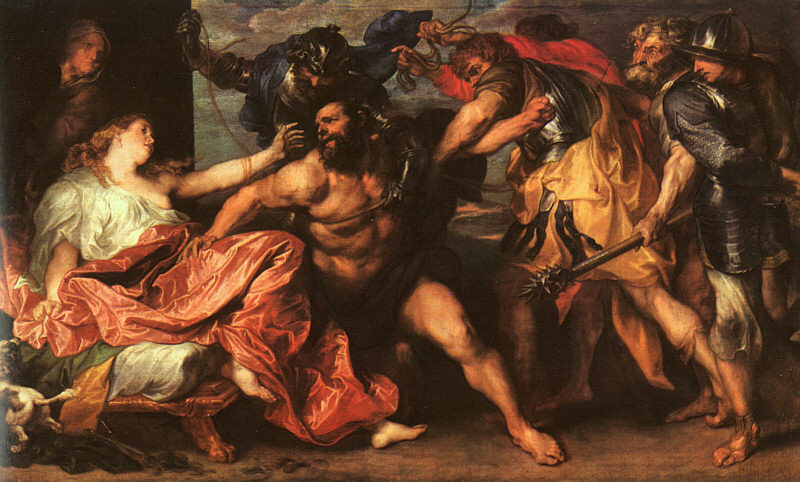
Samson and Delilah

Samson and Delilah

It carries through many other biblical stories as well. When Delilah secretly cuts the hair of Samson he loses his legendary strength. The power of such stories holds true to this day, as evidenced by this question and answer posted on Yahoo! Answers.

Q: Do you lose strength when you cut your hair?

A: Wow, are we bored today? No, you cannot lose your strength if/when you cut your hair. Samson was a biblical fable used to demonstrate that when you forget your faith, and rely on the wrong thing, you can and will lose everything you have. (Not that I’m really Christian or anything, just completing the train of thought, *grin*)

Of course the real meaning of the story focused on being dedicated to God in faith. Yet how interesting it is that this notion persists that a man could lose strength by having his hair cut.

There are many such perceptions that masculine traits are evidence of strength and personal valor. When people don’t follow these “norms” they immediately come into question by society. These prejudices against men who act feminine or engage other men in a homosexual relationship are also canonized in the Bible.

It is interesting to note that while the Bible calls homosexuality a sin in some cases, it is just as often used as a warning of symbol for fears about falling into other types of sins. Here is one such example:

Romans 1:26-32, “For this cause God gave them up unto vile affections: for even their women did change the natural use into that which is against nature: And likewise also the men, leaving the natural use of the woman, burned in their lust one toward another; men with men working that which is unseemly, and receiving in themselves that recompence of their error which was meet.

And even as they did not like to retain God in their knowledge, God gave them over to a reprobate mind, to do those things which are not convenient; Being filled with all unrighteousness, fornication, wickedness, covetousness, maliciousness; full of envy, murder, debate, deceit, malignity; whisperers, Backbiters, haters of God, despiteful, proud, boasters, inventors of evil things, disobedient to parents, Without understanding, covenantbreakers, without natural affection, implacable, unmerciful: Who knowing the judgment of God, that they which commit such things are worthy of death, not only do the same, but have pleasure in them that do them.”

wipe_out_homophobia_by_wipeout_homophobia-d4835i7This passage foremost condemns anything other than the “natural use of a woman,” which is rather a patriarchal manner in which to view women as a rule. And the fact of “men with men working that which is unseemly” actually reveals the entire lack of knowledge that in most of nature, such clear lines of demarcation and behavior do not always exist. Absent the knowledge of modern science, the Bible falls into a definition of “normalcy” that depends far too much on fear and not enough on understanding.

And for homosexuality to stand at the start of it all seems like a certain condemnation. But the real message of this passage is a condemnation of people acting out of control. That’s the real message of the Sodom and Gomorrah story in the Bible as well. When strangers wander into town, they take refuge with Lot. The townspeople call them out because town tradition states that strangers found after dark are fair sport for all sorts of abuse. God is disgusted not just with this tradition, but all sorts of abusive behavior in these towns. He blots them out for their transgressions, but homosexuality was not the sole cause for that wrath. Yet that story has been used to condemn homosexuals for “sodomy” based on a fear of sexual practices that do not supposedly fit the “normal” behavior of human beings.

Thought control

It’s all about thought control, plain and simple.

In 2015 this practice of imposing thought control based on ancient and ignorant prejudices is being called into question by none other than Pope Francis, head of the Catholic Church. He takes ancient bad habits to task by calling people to remember that Jesus himself came to turn the law over on its head. The Catholic News Service reports:

Jesus did “strange things,” like “walk with sinners, eat with tax collectors” — things the scholars of the law “did not like; doctrine was in danger, that doctrine of the law” that they and the “theologians had created over the centuries,” he said, according to Vatican Radio.

The scholars were safeguarding the law “out of love, to be faithful to God,” the pope said, but “they were closed up right there,” and forgot all the ways God has acted in history.

“They forgot that God is the God of the law, but is also the God of surprises,” he said.

“God is always new; he never denies himself, he never says that what he had said is wrong, but he always surprises us,” the pope said.

20130911cnsbr1564-1024x730But the Pope doesn’t stop there. He dispenses with ancient prejudices by taking his line of thought to conclusion in this way, as the CNS reports:

The scholars of the law also forgot that the people of God are a people on a journey, “and when you journey, you always find new things, things you never knew before,” he said. But the journey, like the law, is not an end in itself; they are a path, “a pedagogy,” toward “the ultimate manifestation of the Lord. Life is a journey toward the fullness of Jesus Christ, when he will come again.”

The law teaches the way to Christ, and “if the law does not lead to Jesus Christ,” he said, “and if it doesn’t get us closer to Jesus Christ, it is dead.”

Pope Francis is forced by tradition to make these statements as part of a transitional focus on change. The church cannot just flip its doctrine lest it come off as too flip for its position as an authority on faith. Yet the message is clear: We must dispense with ancient prejudices or find ourselves set apart from God and Christ.

And this is the convergent evolution between the church and the life of Christ. It has taken 2015 years for the church to come around to this understanding. In between there have been persecutions of millions of people based on ancient prejudices against Jews and Muslims despite Christ’s call to love our supposed enemies. There has been canonized and politicized prejudice exercised against homosexuals, lesbians and transgender people despite the fact that all these characteristics and orientations are manifested wholly in God’s own creations. It continues to this day. 

thYet perhaps we are finally evolving as a faith. The church can only find use of its true wings if it is allowed to embrace all the many forms of human beings. That is, we are homo sapiens.

The word “homo” means man. The word sapiens is based on the root Latin word “sapere” that means wise. Perhaps now the scientific term describing human beings––home sapiens––is at last converging on something approaching the truth. Sometimes it takes a long time for evolution to work in this world. 

* unprincipled (often used as a humorous or affectionate reproach)

**For a long time questions by those who doubt the theory of evolution focused on the idea there were no transitional forms in the fossil record to demonstrate links between ancient dinosaurs and modern creatures.

In the world of birds we have long had the skeletal imprint of the archaeopteryx, an apparently transitional form of dinosaur with feathers. Thanks to recent fossil discoveries from China we how have dozens more examples of feathered dinosaurs. These extinct life forms demonstrate structural progressions from feathered dinosaurs to modern birds. Some of these fossils exhibit such clear detail that scientists are even able to discern and analyze structures such as cones in the retinas that tell us these creatures could perceive color. These similarities demonstrate clear structural and functional relationships and serve as clear evidence of evolution at work throughout history. .

There’s a bumper crop of hatred out there

By Christopher Cudworth

Fire HydrantOn my way to a business networking meeting this morning I took a shortcut through the neighborhood where I’d recently been hired to paint a fire hydrant for a community contest. The gentleman that paid me for the gig called to let me know that the fire hydrant I’d painted was one of the utilities scheduled for replacement. That meant the old fire hydrant was torn out and a new one installed. 

As I parked my car to take an iPhone picture of the new hydrant, the headlights of another car appeared in my rear view mirror. I snapped the photo as quickly as I could since I was parked in the middle of the street. Before I could put the phone away the vehicle behind me came ripping past at about 30 mph headed for Route 38 two blocks ahead. 

His vehicle got stopped by passing traffic. As I rolled up behind him at the intersection, the image on the bumper of his car caught my eye. It featured one of those bratty looking little kids taking a piss. The object of his aim was hard to read at first in the early light, but I held up my camera and tried to take a photo anyway. In light press-on letters the words FAGGOTS, LIBERALS, OBAMA, CHASE BANK were printed on the bumper.  

Piss on all those, I guess? 

Piss on faggots. Okay, we get that this guy doesn’t like gay people and prefers to refer to homosexuals by a derogatory name long since abandoned by most of civil society. 

Piss on Liberals. Okay, that could mean a lot of things. Many of the Founding Fathers were quite devout liberals, and our Constitution is by definition quite a liberal document focused on the guarantee and protection of civil rights. But piss on those too. 

Piss on Obama. Well well well. Perhaps this is getting to the core of things here. If this guy didn’t like gays and liberals, then a president that supports equal rights including those guaranteed for people of his own race, then piss on him too. 

Piss OnPretty consistent pissing so far, you might say. 

But then comes Piss On Chase Bank. Now that’s downright confusing unless your local Chase banker is a gay liberal who voted for Obama. That’s pretty hard to tell in your average teller. So the hatred for Chase must come from something deeper. Perhaps this guy is an Occupy Wall Streeter? That doesn’t make sense. Most of those folks are fairly liberal. Some people even call them socialists for seeking to have the banking industry actually abide by the existing regulations by which financial management is supposed to occur. 

The Chase is on

Interestingly enough, I had plenty of time to consider all these options as I entered traffic behind the Piss On Faggots, Liberals, Obama and Chase Bank guy. He happened to be turning the same direction as me at the next stop light. His vehicle next took a strange diagonal across the intersection. 

Another 6 blocks later his turn signal pointed where I was headed as well. This time he cut close to the curb on his turn and swung weirdly into the other lane before righting his car. I wondered if he was busy texting. Three blocks later he was turning left again, the same direction I was also headed. This time he nearly cut off the headlights of the car parked in the lane waiting to turn left. 

Perhaps he was a little spooked by now that I might be following him. He hit the gas hard through a neighborhood where I knew the speed limit was carefully monitored. The street cuts through a residential neighborhood rife with kids. Piss On Little Kids, I guess.

His frantic speed made me think that perhaps he’d seen me taking an iPhoto of his rather hateful bumper decoration and wanted to avoid any potential confrontation. But that was probably just my imagination working overtime. When he took off at high speed on the next right turn I literally gave him a wave goodbye. 

Can’t get no…no no no…

IMG_8609It struck me: What satisfaction could he possibly derive from driving his old Toyota around with that mean message on his bumper? When does one bend over and stick that little mean kid bumper sticker on there and then hand press the words FAGGOT, LIBERALS, OBAMA AND CHASE BANK onto one’s bumper? 

His satisfaction must come from expressing his hatred. Yet you can only hate so much before the satisfaction drawn from that hatred begins to drain out of you. Or perhaps he also spends nights on the Internet trolling liberal websites and posting racist or partisan comments about Obama. With a bumper crop of hatred out there perhaps it is true that the line between Blue and Red is permanent, inhumane divide. 

Human interest

Three out of four of the things Mr. Piss On claims to hate are actually human beings of one kind or another. His hatred of Chase Bank only qualifies as hatred for other human beings if you abide by the Mitt Romneyesque pandering ploy that “Corporations are people too, my friend…”

Frankly one wonders why the Piss On fellow limited his list of hated things to such a short list. Could he have not added Muslims to the list given the seemingly categorical partisan hatred of all things different than Christian, White, Straight and Republican in America. 

Piss On, Brother

As indicated by the intellectual gravity of the fellow with the Piss On logo, there’s a bumper crop of hatred out there. While people like me can and should admit our disgust with George W. Bush, and I’ve written at length and frequently about frustrations with the seeming lack of conscience in the modern (catch the irony) batch of conservative, I did not go to some truck store where they sell stickers of naughty little boys and mount them next to the words GOP or any other group of people with whom I might disagree. 

Liberals usually take the long way home and the long way around to express their opinions. Yes, there’s hatred being expressed from the liberal side as well, and I keep an eye out for liberal bumper stickers that cross the line. But you just don’t see many. Instead you might see that sticker that says COEXIST with all the religious symbols intermixed. 

What would Jesus piss on? 

But is it conservative or liberal to sport a bumper sticker that says KNOW JESUS. KNOW PEACE? That depends on how you interpret knowing Jesus, of course. Liberals would say you need to embrace the social justice aspects of his ministry and stewardship of the earth. Conservative Christians have claimed that knowing Jesus is the same as respecting God and Country. So there’s a critical divide based on interpretation of the very same words of the Bible. 

The scary part in all this is that some people might brand the list posted on the bumper of the Piss On vehicle a statement in keeping with Christian values. People who hate on homosexuals or even ‘love the sinner an hate the sin’ are effectively saying the same thing as “Piss On Faggots.” Either way the subject of the criticism is ostracized based on anachronistic interpretation of a very few bible passages. 

Going down the list, justifying conservative hatred for Obama opens some very sore wounds in America. He’s black, which opens up the entirely racist can of worms. He’s a Democrat and ostensibly a liberal, although people who disagree with his kid glove treatment of Wall Street bankers might argue with the lack of accountability demanded from financial interests that bent the law and bankrupted the country. 

Which brings us again to the very interesting subject of Chase Bank, one of the few massively large financial institutions deemed “too big to fail” lest our nation and our world economy go into turmoil. 

So our friend that wants to piss on Chase Bank either likes the bushes behind his local branch office or else he agrees with liberal economists that companies like Chase should have to straighten up and fly right or pay the penalty. 

But the question we have to ask from the perspective of the Judeo-Christian tradition is this: What would Jesus think of the Piss On bumper sticker and the hate it communicates?

Well, Jesus was not recorded as having said anything about homosexuality in the Bible. So the Piss On Faggots attitude is manufactured from something outside the words of the Son of God. 

And Jesus loved liberals because he loved himself, tender of the key liberal idea that all humans are deserving of equal rights. So that that, Mr. Piss On Liberals. Jesus thinks you suck. 

As for Obama, Jesus might call into question some of the things that Obama does. But taking steps to provide better health and human services is not one of them. Nor is protecting the environment against anthropogenic change (look it up if you don’t know what it means). And for all the hatred pointed at Obama by Tea Party Conservatives that “He’s a Muslim,” well, guess what? Jesus is a key figure in the Muslim tradition too. 

Was Jesus a greedy bugger? 

Meanwhile one of the biggest problems Jesus addressed in his ministry was the abuse of trust and love of money produced by those with greedy lack of conscience. And what do we find out there dominating conservative ideology these days? Crybabies whining about how the 1% are so persecuted.

Screeching politicians who owe their careers to political investors (you read that right…) are simply not going to behave in good conscience on behalf of the public when behind closed doors they have already shook hands and struck deals with the companies that own them. 

If Chase Bank is just a symbol for all that ugly greed, dismissal and manipulation of the social good for profit, then perhaps the Piss On guy might have a small point. 

But don’t tell him that, because he’s probably pretty sensitive about the size of his pointer, if you catch my drift. These hateful guys are always compensating for something, it seems. 

Nice hydrant, dude

Which brings us full circle to the whole reason I was parked along that road where the Piss On guy blew on past me and caught my attention with his angry, small-minded bumper sticker. 

The new fire hydrant I’m supposed to paint sticks much farther out of the ground than the original implement. That means it will make an even more inviting target for dogs to come along and piss on. I’ll be painting the new hydrant with that fact in mind. I plan to paint some targets with dog prints along the base. And I hope no dogs are offended. But that’s their business. 

Why I refuse to hide my years, my liberalism or my political views despite the new censorship age

by Christopher Cudworth

A close and longtime friend pulled me aside the other day with a warning of sorts. “I love you man,” he told me. “But you’ve got to stop giving people reasons not to hire you.” 

His advice is so well-intentioned. In the age of social media, your personal brand is how you sell yourself to others. Mine is all over the Internet. From LinkedIn to Twitter to Facebook, Google+ to all the blogs I write. My views are out there. So is my age. Plus I effectively rank all top 10 spots on Google for the name Christopher Cudworth. 

But what people really worry about most when it comes to their personal reputation is their religious and/or political views being perceived as oppositional to all those who might want to do business with them. 

I’m not afraid of that. And here’s why. 

Nothing to fear

Who lays claim to the flag in America?My years have taught me there’s nothing to fear. Not if you truly believe in God and trust that your faith will show you the way. There is no consequence on this earth that you cannot spiritually survive. Your words and actions and beliefs may indeed cost you social or work advantages.


But still, people warn you not to reveal too much about your age, your viewpoints or your religion.

The Internet is full of advice on how to hide your age, as if doing so were some kind of actual job qualification.

And surely there are plenty of people who will tell you to avoid saying anything political on business social media such as LinkedIn. 

I am 57. I am a liberal. And a Christian. Or both.

Chicken to speak out?

Pretty much this brand of advice seems to be focused on connecting with people who make business choices based on religious or political views.

But it works both ways. Certainly the recent stories about Chick-Fil-A choosing to fund non-profit organizations aligned with its company views have impacted their reputation. Rightly or wrongly, consumers often choose to base their decisions on who to support based on liberal or conservative views. Then it came out that Chick-Fil-A even hires or chooses franchisees based on their core values. That seems like a pretty sound business principle. But again, they took flack for those practices because the social media flurry took off before the full breadth of the company’s policies was vetted. 

There was some debate that went on about this issue on LinkedIn and I commented about that. Advisable or not, I expressed concern that some companies might use policies like that to be exclusionary in their hiring. But it’s a gray area. According to Snopes.com, this is what actually appears on the Chick-Fil-A website as to company culture: “The Chick-fil-A culture and service tradition in our restaurants is to treat every person with honor, dignity and respect — regardless of their belief, race, creed, sexual orientation or gender. We will continue this tradition in the over 1,600 Restaurants run by independent Owner/Operators. Going forward, our intent is to leave the policy debate over same-sex marriage to the government and political arena.” 

Fair enough. That’s a fairly conservative enough statement about hiring practices. I mean that in the best way. It’s not Conservative in the sense that it is outlining some political view as necessary to employment. It is conservative in the sense that it advocates fair and reasonable hiring practices. There are other forms of conservative viewpoints at work in business as well. 

Creative creationist

For example, I once knew a geologist who was a devout creationist. The thought of his worldview at work in that field was astounding to me. Creationists typically view the earth as having a very limited time span. I asked the man specifically for his opinion about that. “All I care about in the job is the layers. I just need to know where things are. How old they are does not matter to me.”

I thought about those words for a long time. He’d been through all that geological education and processed it in his own fashion. He was not a man afraid to speak his mind either. At some point he likely spoke up about his beliefs. Surely some of his science education professors shouted him down if he brought up his religious views and the opinion that the earth’s geology was all the product of the Great Flood. Or whatever. Yet he’d kept true to his anachronistic worldview despite all contentions to the contrary. And he was successful in his profession. 

That’s a conservative, tried and true I suppose. He’d held his convictions and stuck to religious tradition despite all that liberal science stuff swirling around him.

Equivalence

In a similar way, I suppose, I have clung to my liberal views despite all the Conservative opinion dominating the business world. Am I, as a Liberal, the equivalent of a Creationist in the business world? Am I denying the science of economics and business. Are Harvard or Booth School MBAs gathering in coffee shops to snigger about my naive notions about business? 

Well, I can only speak from personal experience in my business dealings, where my conservative instincts have always controlled my actions.

Conservative actions

For example, when I was elected President of the Chamber of Commerce in Batavia, IL., my primary goal was to make the organization run more efficiently than it had been for years. I moved to cut the Board from 20 down to 11 members. Then I required that all events and activities of the Chamber have a budget. Surprisingly, that was a new policy to everyone. When it was all said and done, we’d also created all new marketing materials for the Chamber and provided a guarantee of a prescribed set of services to all members that helped increase the membership.

 All those could be characterized as policies indicative of a Conservative mindset. Cutting staff or representation to a manageable size, reducing waste and increasing accountability and finishing with a financial cushion, all are in line with a conservative approach to business. 

Fairness

My personal liberalism primarily enters business when it comes to issues of fairness. Because I believe, like the conservative entity known as Chick-Fil-A, that it is not just important but a requirement  “to treat every person with honor, dignity and respect — regardless of their belief, race, creed, sexual orientation or gender.”

At one point during my career in marketing, the organization where I worked had built a reputation for sexual harassment. A few lawsuits had been filed and won against the company. One day while riding back from lunch with co-workers a young woman began relating to us that her boss had made multiple inquiries into what she wore under her work clothes, what type of relations she had with her boyfriend and other types of sexual innuendos. I took the step of networking through a friend in law who helped her find a lawyer to represent her interests with the company. She sued and won, then left the company. 

Was that a conservative or liberal action on my part? It was both. In truth I was protecting the company’s interests while protecting the interests of the young woman subject to the harassment. I did not take matters into my own hands but providing assistance to legally assist the young woman find a recourse for her situation. 

Culture clashes

PaversBut the real issue for me was not just that young woman’s situation. The company maintained a culture of harassment in many other ways. The President made frequent statements that were designed to intimidate and offend for purposes of control. “Bring in the Design Fairies,” he once blurted while meeting with a group of creative directors. Comments like that were not complimentary to the staff, as if they were magically endowed with the ability to solve creative issues. Instead he regularly issued statements devaluing the talents of design staff, intimating that their sexuality had much to do with their station in life as lowly designers.

That rankled my liberal instincts on so many fronts it was tough to keep composure sometimes. 

Religious blows

Even bosses trying to be the pillar of conservative values can blow it sometimes as well. One director at a media company issued a written statement titled The (Company) Way, The Truth and the Light. A number of employees raised concerns that he should be using a biblical construct in the context of company policy. There was enough rumbling among the ranks that as marketing manager I brought the concerns to light in a leadership meeting that week. The reception of this feedback was less than welcome, and when someone stapled a picture of Jesus to the company memo and sent it to the corporate headquarters, the director was determined that some heads should fall. He called me into his office accusing me of sending the memo. “No one can criticize my faith,” he blustered to me. “I go to church every week!”

Indeed he did. But it did not stop him from forcing me out of the company for bringing up the issue in the first place. My liberal instincts toward free dialog and problem-solving had gotten me into trouble once again. 

Public opinion

When I accepted a job as editorial writer for a major newspaper it was with joy and expectation that we debated issues on a weekly basis. My fellow staff writers were long-experienced journalists with a highly objective bent earned from years of street and business reporting. We criticized each other’s work, which ultimately had to pass muster with the Publisher and Editors, a strong mix of leadership with both liberal and conservative views. 

We also edited for space the writing of both conservative and liberal columnists including the likes of George Will and Ann Coulter. Tasks like that help you learn to appreciate the constructs of the arguments they make, and find ways to make sure their columns do not suffer for the editing. 

Balance

So it has been with a critical eye that I have proceeded in my career while examining the conservative and liberal facets of society. We need both. But we need a balance. 

Yin and yang symbol.

That much I learned as a member of the highly conservative Missouri Synod Lutheran Church. For 25 years our family attended services and I served on the Board, taught Sunday School and led activities for that church including 5 years in the Praise Band translating music into theology. At one point I led a search committee for a new praise leader and set some parameters for the committee at which some members bristled. “We’ll meet one hour, once a week,” I told them. “And we’ll get our business done.” 

In 8 weeks we had vetted the criteria, interviewed candidates and made a selection from amongst 8 different praise musicians. And then we waited. And waited. It took the church another four months to approve the choice. The conservative opinion was that we’d actually proceeded too quickly in doing our business. “We need time to think,” I was told. And then the backroom meetings began. It was as if the entire search enterprise had to be done all over again. Finally the hiring of our candidate was accomplished. But the experience left a sour taste in the mouths of all on the committee including the Pastor Emeritus, a 60-year veteran of Missouri Synod pastoral duties who proclaimed, during one of the meetings, “This is the best committee on which I’ve ever served.” All were in agreement.

That success was undercut by a suspicious, highly conservative worldview that believed itself better able to do the job than the committee elected to perform its duties.

Pounding fists

I’d run into that kind of logic before at the same church. We’d gone to the congregation twice already with budgets that were approved for construction of an addition using money donated by a wealthy member who died and left her fortune to the church. The church board was worried the congregation needed to hear the whole story again. I pounded my fist on the table and barked, “It’s already approved. We need to move forward.” The Pastor pulled me aside the next Sunday and thanked me for having the courage to speak up. We built the new addition and moved forward. It wasn’t a risk to do all that. We’d already done all the work necessary to guide and improve the plans.

So that raises an interesting question: Was I too liberal for wanting to move forward rather than remain stuck in our cycle of constant equivocation? I’m not afraid to take risks. I’m not afraid to propose creative ideas. I’m not afraid to pound my fist on the table and demand progress, productivity and accountability. 

Consideration

photo (1)I do however respect and appreciate the need for review and consideration before action. That’s why I like the foreign and domestic policy of our current President, Barack Obama. He thinks about what he does before doing it. Our country has not embarked on any new ideological war games as a result. Supporting that kind of conservative, considerate approach makes me a liberal according to some. Some call it namby pamby wimpass liberal stuff. I call it intelligent reasoning and a moderate approach to international challenges. The forces we’re fighting in the Middle East have been there for 800 years or more. We’re not going to solve them overnight. That’s not conservative or liberal. Flailing around for quick solutions is just dumb. We’ve already tried that and look how Iraq turned out. 

So it disturbs me that some people might sit out there in judgment of my political views as too liberal when in fact they are much more conservative in nature than liberal. I think the same way about the environment and conservation. Protecting the earth is a conservative, not a liberal thing to do. 

Liberal faith

I also think that way about matters of faith, where social justice and working to provide equal rights to all comes first. That worldview aligns precisely with the biblical truth of Jesus Christ. From what I’ve read––and I’ve read the Bible cover to cover several time over, studied it groups and read hundreds of books on the topic o faith–– my liberalism aligns with the core truths of all religions except where conservative ideology steps in to make rules about how to live and who to tolerate. That’s an ugly form of conservatism that has led to Nazi Germany, the Spanish Inquisition, the Crusades and the KKK. Not all conservatives are extreme of course. But it does makes me wonder why anyone is willing to call themselves conservative without first taking a close and studied look at what that means now and what it has meant in the past. Even the conservative wing of the Catholic Church has been repeatedly wrong about things, including the position of the earth in the solar system, for one notable mistake. 

Conservative consequences

When you examine what so-called modern conservatism has wrought the last ten years it makes you wonder why anyone would be proud to call themselves conservative at all. Or perhaps they’re not really getting their point across to the people in power. The Bush administration ran amok with wars and de-regulating the economy, reducing taxes and pushing constrictive policies on American education. Conservatives seemed to say nothing about all that. 

Yet when the economy tanked thanks to all that reckless behavior it was liberals who stepped in to mop up the mess and put things back in order. We’re not out of the woods by any measure. The economy could still tank. But that’s not a product of liberal policy. That’s a product of refusal to change or require accountability of organizations acting out of control in the financial world. That world is still run primarily by financial conservatives who bristle at governmental intrusion. 

Holdouts and bailouts

What was the first response of banks and lending institutions following the economic crash? They refused to lend money even to successful businesses. That was not some liberal scheme. In fact some wondered if it was a conservative punishment doled out in response to the election of a supposedly liberal president. 

That President bailed out the auto industry and put strict controls in place to restore and revitalize American auto companies. Those were highly disciplined, conservative measures to require accountability. 

Ageless principles

IMG_6475So I simply don’t buy the idea that it is my responsibility to apologize for my liberal background and beliefs. I also don’t buy that I’m too old at 57 years of age to be a contributing member of society or a business leader. Most of our Presidents and business leaders don’t become CEOs or leading politicians until their 50s and 60s. 

Yet we’re told all the time that we have to hide our age on our resumes lest a company be discouraged from hiring us. I say bullshit. It’s not my problem that my experience and my creativity are at an all-time peak. Some companies don’t want to hire people like me because they think people my age too expensive compared to hiring some younger candidate. I’m all for that too, if it fits the bill. But from an employee’s perspective you can’t buy experience or learn how to effectively apply creativity to creating business solutions. That comes with time. 

And do we actually think we can hide our age in this day and age? Do we think hiring managers and HR directors are so stupid they can’t do a simple Google search and find out when you graduated from college? Give. Me. A. Break. 

So-called “Age-Proofing” your resume is a game no one should play. The companies and hiring managers that use age as a determining factor in hiring are literally breaking the law. Do you want to work for a company that willingly breaks the law as a matter of its business practices? That’s the question and the challenge we should be putting to all businesses. Why do you think its okay to carry on with those practices when they are against the law? 

3C Creative Content

So I’m running my own little business now and it’s going okay especially because I’m able to purchase reasonably priced health insurance thanks to Obamacare. I’m even improving my policy some now that the company is moving forward. I wanted to do this years ago but couldn’t because my wife had ovarian cancer and we could not buy insurance on our own because her pre-existing condition precluded us from doing so. Obamacare changed all that. For now. 

Because we hear all kinds of conservative politicians threatening to “roll back Obamacare” if the Senate goes Red. But do they know what they’re really talking about? I don’t think so. The liberal convictions of that law are providing safety and security in health care to millions of people. Society has not collapsed since the law was installed. In fact millions of Americans including small business owners like me––and I employ my 24-year-old daughter as well––can now get health insurance and run their business without worrying that they can’t get insured. 

To me that sounds a lot like the American Dream and the American Way. Which is liberal. Defined as: 

  1. broad-minded: tolerant of different views and standards of behavior in others
  2. progressive politically or socially: favoring gradual reform, especially political reforms that extend democracy, distribute wealth more evenly, and protect the personal freedom of the individual
  3. generous: freely giving money, time, or some other asset

Yet we hear advice all the time, “Don’t be too political” or “Don’t discuss religion” online or in public because people won’t hire you if you express your opinions. I say that’s an insidious form of new censorship. It’s not why I’m alive. Or you. Or anyone. This is America. Expressing opinions is healthy even if they’re wrong. That’s the only way you learn. 

Do you want an employee who just sits there in company meetings and refuses to contribute because they’re afraid something they say might appear stupid or be wrong? That doesn’t help anyone. And do you want an employee who kisses your ass simply to get ahead or do you want an associate who can challenge you to better things, better ideas and better profitability? All those are liberal, not conservative instincts. And they make better employees. 

Liberal lectures

So you can lecture me all you want about how liberals like me don’t fit into the business world. You can tell me I’m told old (though I can likely kick your ass on the bike and in a race…can you do a 12:00 two mile?) or getting slow or “too set in our ways. 

What a load of fucking crap. Never in the history of the human race has there been a generation of people more willing to experiment and redefine themselves, learn new technology and adapt to circumstances. That extends from the youngest kids in the workforce to the oldest. Everyone’s learning. The only ones unwilling to learn and change are those too conservative to try. That’s why I’m a liberal too. 

True Convictions

I believe that Jesus loved people like me for the willingness to take on injustice in the workplace, to respect the time of others and to make decisions with a conscience clear of political ramifications and conniving conservatism. Jesus hated all that rot and told the Pharisees to go choke on it. 

They hung him on a cross to try to shut him up. But somehow things didn’t work out that way. His liberal, radical message of spiritual creativity lives on to this day. It is ours to keep it alive in the face of those who think rules and power and control and money are more important than knowing love, and loving life. That includes loving what you do in the workplace. 

I’ve written a book about the process of loving life, and living it well in the face of considerable obstacles. It’s called The Right Kind of Pride. It focuses on what it’s like to get through cancer as patient and caregiver. But it’s about much more than that. It’s about the balance of conservative and liberal instincts that make it possible to thrive. 

I’m always going to be proud to be a liberal. Life has not made me more cynical or apt to hew conservatively as if being cranky and controlling is the sign of a more realistic outlook.

If being more open-minded yet practically focused exclude me from doing the job for you, then it’s your loss. I know for a fact that I can do a great job on anything I set out to do. I’m confident of that, and I’ve proven it, and no amount of supposed discouragement can keep me from moving ahead. 

The Genesis Fix.

On why we should all read about faith and what it means to the world

Lutheran School of Theology Chicago

Lutheran School of Theology Chicago

By Christopher Cudworth

Sitting in the admissions office of the Lutheran School of Theology in Chicago felt right.

A little more than two years ago a young man that had served as our church Youth Pastor had invited me to visit the school. “I think you’d like it,” he told me.

Our conversations as he prepared to leave his position at the church and begin studies to become a Lutheran pastor had centered on ministry to high school students, yet over coffee one morning the topics widened. I explained the process of writing my book, “The Genesis Fix: A Repair Manual for Faith in the Modern Age,” and how it changed the way I viewed writing about, and reading about, faith in the world.

The experience of trying to get an agent for the book had taught me a few things. The theme was the same with every contact. “You’re not a minister. You’re not a college professor. What credibility do you have to write such a book?”

Credibility is important. It gives people a foundation upon which to trust what you write. The process of earning credibility can also challenge the manner in which you arrive at your conclusions.

Regarding Masters

The message stuck with me. Despite the fact that I had spent 7 years researching and refining the book, it was true. I was not technically qualified to write it. Not in the eyes of those who make such decisions anyway.

It’s not enough that your friends call you “courageous” for taking on biblical literalism as a worldview. You must vet your viewpoints in the theological world before tearing away the dogmatic garments of the modern day Pharisees who stand in opposition to so much practical truth.

Simple truths and basic contradictions

Yet it’s a simple fact really. Biblical literalists stand in opposition to the teaching methods of Jesus Christ, who consistently used organic metaphors to convey spiritual truths through parables designed to bring the common mind to faith in God. Ignoring that principle is basically a slap in the face to Jesus. It’s like telling him, “You don’t know what you’re doing. Don’t you know that God’s Word must be taking literally or it has no meaning at all?”

While classic, the old ways of thinking may not be sufficient for a new world. Nor have they ever been.

While classic, the old ways of thinking may not be sufficient for a new world. Nor have they ever been.

Actually the community of believers who take the Bible literally never actually get close to discussing the teaching methods of Jesus. They’re stuck way back in Genesis and a literal 7 days, an Adam and Eve that were transmogrified from the dust of the Earth and a Serpent or Snake who tricks Eve and then Adam into disobeying God’s warning not to eat from the Tree of Knowledge. Of course we all know the story. Adam and Eve fall for the Serpent’s logic, thereby causing the Fall of Man.

Bad Beginnings? 

Original Sin is the pet concept that emerges from that creation story. But that quick-take worldview ignores a key aspect of the tale. What we miss by taking the story literally is the Serpent’s methodology in tricking Adam and Eve. In a crafty use of the first brand of scripture known to Man, the Serpent engages Eve in legalistic use of God’s own words to undermine her trust in God. Here is how the ploy works:

Christianity is not entirely clear on what the "serpent" really is, or looks like. So how can we take such a creation story literally?

Christianity is not entirely clear on what the “serpent” really is, or looks like. So how can we take such a creation story literally?

The Serpent’s Deception
…3but from the fruit of the tree which is in the middle of the garden, God has said, ‘You shall not eat from it or touch it, or you will die.'” 4The serpent said to the woman, “You surely will not die! 5“For God knows that in the day you eat from it your eyes will be opened, and you will be like God, knowing good and evil.”…

How very similar is this exchange to the passage in Matthew 15 in which Jesus engages the Pharisees over the issue of turning the Word of God into a legalistic trap:

1Then some Pharisees and teachers of the law came to Jesus from Jerusalem and asked, 2“Why do your disciples break the tradition of the elders? They don’t wash their hands before they eat!” 3Jesus replied, “And why do you break the command of God for the sake of your tradition?

The comparison between literalism and legalism is given a direct connection to the Serpent in the Book of Genesis in Matthew 23:33, “You snakes! You brood of vipers! How will you escape being condemned to hell?”

It is a sad fact that today’s adherents to biblical literalism are playing the same game that Pharisees played with Jesus so long ago. Yet the pain and misdirection caused by today’s brand of scriptural literalism is just as potent as that depicted in Genesis with deception by the serpent, and just as power-mongering as the Pharisees of the New Testament.

And that is the point from my motivation to attend a school of theology emanates. I believe the most important thing in the world right now is to counter biblical literalism and all its awful consequences. Literal interpretation of the Bible is being used to persecute gays, to resist legitimate science, to argue against the theory of evolution and to undermine political and ethical justice on a broad spectrum of issues.

Reason and Reasons
It’s not about a mid-career change for me, or anything prosaic as that. It’s about finding ways to make the world a better place. Martin Luther changed the world by pointing out the very simple fact that we are saved first and foremost by grace. The new reformation should finish the job of removing all barriers from our acceptance of grace.

Yet we also need to define what it means to exist within and attend to the Kingdom of God. How we understand the nature of that “kingdom” is crucial to our stewardship of creation. The dangerously ironic consequence of a worldview founded on biblical literalism is the attitude that nature and all of creation is essentially a disposable tool of God, one that has no purpose other than our own somewhat greedy sustenance and no other significance than as a temporal stage between Creation and Armageddon.

Challenges

We can do better than old ships and sails of theology. And we should.

We can do better than old ships and sails of theology. And we should.

We need to challenge this fatalistic worldview at its very roots. That begins with the misinterpretation of Genesis as a literal document. Yet it also extends to our regard of scripture as a wholly inerrant document. It simply isn’t, that way. Any faith dependent on that premise is brittle, frail and sad, thus requiring a defensive posture to sustain.

The book of Romans 1:20 contains a telling point of scripture, one that reveals the idea of organic fundamentalism, the key understanding that nature itself, and our metaphorical understanding of it, holds keys to our comprehension of God and all that we read in scripture:

Romans20 For since the creation of the world God’s invisible qualities—his eternal power and divine nature—have been clearly seen, being understood from what has been made,  so that people are without excuse.

Nowhere in this passage, or any other in the Bible for that matter, does it say that we must take a literal approach to conceptions of God. In fact as demonstrated by Jesus himself, we are to do the opposite.

Recall that literalism and legalism produced the approach that one could earn the way into heaven through God works doled out by the church and vetted by leaders who earned earthly power through the system set up by the brand of Pharisees leading the Catholic church at the time.

Then along came Martin Luther, who saw through the giant ruse of literalism and legalism, and who launched a Reformation that transformed the faith, made it new again. We can view this passage in a fresh light in contradiction to the brand of literalism now vexing the world.

Nature and eternity are foundations of the Bible

There is more to the theological landscape than meets the eye. Creativity, not just creation, is part of scripture. Click for larger view.

Ephesians 8 For it is by grace you have been saved, through faith —and this is not from yourselves, it is the gift of God— 9 not by works,  so that no one can boast.

For there are many who “boast” that their literalistic view of the bible constitutes the “works” of real Christianity. Yet we also know that God’s invisible qualities are visible in Nature, and through the Word, and that there is no excuse for ignoring these greater, most important facets of faith realized.

And that is why the pursuit of truth is so important to me, and why sitting in the office of the Lutheran School of Theology in Chicago felt so very good, and so very real. Because each Reformation has to start somewhere. We all play a part in the heart of faith.

How preteens evolve into thinking human beings

photoAt some early age it entered my head that perhaps everyone around me was in on a secret. That I was the only one that thought as I do, and that even my parents were putting me on, big time.

I worried that I was not a “normal” person.

It happened again to some extent when I was 13 years old. That’s the age when your interests begin to collide with the world, and that’s a dual problem because your interests when you are in middle school tend to be really intense, sometimes nerdy and ridiculously easy to ridicule.

My interests happened to be all over the board, from art to nature, but one avocation got me in trouble with my friends who all seemed to think birdwatching was stupid, silly and less than manly. They made up bird names with obscene roots and laughed when I told them I’d identified a certain species of importance to me.

Resilience

To my everlasting credit, I never let the teasing stop me from pursuing any of my interests, even at the vulnerable age of 13. Now the same people who used to ridicule will call with a “bird question” when something unexpected shows up at their feeder, or they see a bald eagle along the river. The enthusiasm they now show for such things is a much-delayed apology for the abuse long ago.

As an adult I was asked to teach Sunday School for the middle schoolers because no one else wanted to take on the task. I liked it. Working with a series of teacher-partners over a 12-year period, it was fascinating to see the variability in maturity and self-awareness among preteens.

Sleepy minds

Many Sunday mornings they’d arrive sullen and bored, aching to get back to their sleepy beds where the rest of the world could not reach them. But reach them I did.

The church absentmindedly neglected to shove some curriculum my way for years and years. The parents did not complain about my teaching so everyone must have thought it was working out okay.

Little did they know that Sunday School was a perfect place to get those preteens thinking about what matters in life beyond the Bible. Sure, we always talked about scripture in a roundabout way. I’d always have an idea to discuss and would bring them around to the topic by asking what they’d done during the week and even how they felt about it. They deserved that attention. The minds of preteens seem to be largely ignored by this world, as if they have nothing of value to say about it. But the world would be wrong about that. It always has.

The example of Jesus

You may recall that it was a preteen Jesus (about age 12) who stayed behind at a temple when he was supposed to be following his parents back home after a visit to the city. This is what transpired:

46 After three days they found him in the temple courts, sitting among the teachers, listening to them and asking them questions. 47 Everyone who heard him was amazed at his understanding and his answers. 48 When his parents saw him, they were astonished. His mother said to him, “Son, why have you treated us like this? Your father and I have been anxiously searching for you.”

49 “Why were you searching for me?” he asked. “Didn’t you know I had to be in my Father’s house?”[a] 50 But they did not understand what he was saying to them.

51 Then he went down to Nazareth with them and was obedient to them. But his mother treasured all these things in her heart. 52 And Jesus grew in wisdom and stature, and in favor with God and man.

Echoes of Christ

In many ways that scene was replayed among the preteens who entered the middle school Sunday School class. They had ideas. They wanted answers. They asked questions and to the best of my ability I answered their questions or encouraged them to find answers, and at all costs.

That church did not preach tolerance for science, yet several of my former students went on to become chemical engineers and biologists and other occupations whose educational processes effectively denied what that simpleton religious worldview maintained.

Rational faith

You may ask why I remained a member so long (25 years) and I can answer that my rational faith survived outside of that venue, but was sustained by the fellowship that came through membership. I am now a member of a church that respects rational thought and yet embraces full discipleship as a matter of practice. In other words, a church that actually teaches what the Bible says to do. Instead of denial like the Pharisees and legalistic practices, my current church loves this world with all its heart, as an expression of creation, but not as an exclusive Creation that cannot be understood or appreciated by the human mind.

That’s what I taught all those years, and what it taught me in return was that the middle school, preteen mind appreciates honesty and respect. If you don’t give pat answers, it doesn’t feel like you’re patting them on the head, telling them to go away and quit thinking. For themselves.

Leadership 

One year I had as students three young women that each vied for the title of Valedictorian at their respective high schools. Keeping them engaged was not that difficult, but keeping the rest of the class in pace with their challenging minds was interesting at times.

Yet it happened. The other kids knew and appreciated true leadership and intellect when they saw it. The girls in return were not disrespectful of their peers. Even those who were brought to the church by bus from underprivileged families participated in the discussions. I often thought about how much those women brought to the table, and the fact that women were not allowed to assume positions of full leadership at that church. It bothered me. So I ignored that example and let them be leaders.

It was proof to me that the Kingdom of God, if that’s what you call it, can embrace the rich in mind and the poor in spirit alike. The principle benefit was, in the end, an open regard for the preteen mind that perhaps they would never have experienced if shielded from the concepts we discussed in biblical context. Those were evolution as well as salvation. I told them there was no reason why the Bible and science could not be reconciled. I told them Jesus was the original naturalist. He used organic symbols in his parables to convey spiritual principles. Later I wrote a book and continue a blog about that subject and more.

Other subjects

We talked about fame and deception, hope and depression. We talked about their lives and encouraged them to keep the confidence of others. Basic human respect was at play at all times.

And we talked about Jesus. Not the Jesus of the Sunday School curriculum that sails around the landscape working miracles. We talked about the Jesus who cried and prayed in the Garden of Gethsemane, abandoned by his friends. We considered what that meant to be alone, to feel alone.

Then we talked about what it meant to be normal in this world. To have fears and feelings that you poorly understood. To be worried about what others thought about you and about how adults don’t have all the answers. Those were just some of the things discussed with those preteens. They just wanted to know what it meant to be normal, and what it meant if you chose to depart from those norms on your own.

Jesus was a helluva an example on what it meant to go your own way. It has costs, but sometimes its worth it. Not being normal, that is.

A short letter to Billy Graham on his endorsement of Mitt Romney for President of the United States

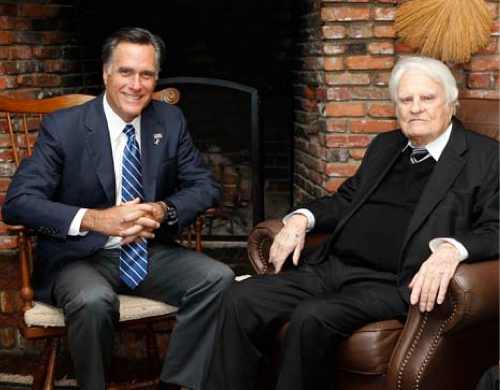
The inscrutable Mitt Romney meets the intractable Billy Graham

Let’s deconstruct what Billy Graham has to say about endorsing Mitt Romney:

“It was a privilege to pray with Governor Romney—for his family and our country. I will turn 94 the day after the upcoming election, and I believe America is at a crossroads. I hope millions of Americans will join me in praying for our nation and to vote for candidates who will support the biblical definition of marriage, protect the sanctity of life and defend our religious freedoms.”

Well, Mr. Graham. You left out a lot, didn’t you? No mention of protecting the poor, a favorite topic of Jesus. NO mention of holding the wealthy accountable for exploitation of the country and its resources. No mention of protecting the earth as God’s creation. No mention of holding our former President and VP accountable for unbudgeted, illegal wars and torture.

Especially no mention of the inscrutable lack of accountability by Mitt Romney, who has changed his stated positions on every single position he claims to advocate, and obscured facts about his personal business and finances that more accurately reflect his cutthroat disregard for his fellow human beings. These acts make him either an untrustworthy leader or an outright liar. Or both. The recovery Mr. Romney needs to focus on is his credibility.

Billy Graham has endorsed an ideological chimera in Mitt Romney, and as such has sided with powerful special interests and a brand of prejudiced thinking that impinges on real American rights including freedom FROM religion as guaranteed by the US Constitution. Graham completely ignores that fact of law. His assumptions speak volumes about his anachronistic brand of religion and its lack of scriptural substance in an age of rational faith and Constitutional interpretation based on human equality, not religious prejudices.

Graham proves through his endorsement that a vote for the Romney/Ryan ticket is a vote to misappropriate American rights and freedoms in favor of a stilted worldview that sadly is also a misunderstanding of the very faith Mr. Graham and his ilk have long claimed to represent. The best illustration of this desperate grab for power and respect is the scrubbing of his own website to remove the claim that Mormonism is a ‘cult.’ Like Joe Paterno, we might be seeing another hero embracing power over principle.

It is possible to lose perspective in life when your legacy is bigger than your ability to sort out your priorities. Perhaps the influence of his now infamous son Franklin Graham has jaded the Rev. Billy Graham’s once famously wise counsel. Of course, fame ultimately has a way of corrupting judgment. Position has a way of undermining the will to discern what is truly right and wrong. And time has a way of destroying the patience for change.

All in all, Mr. Graham, you have gotten it wrong, made a spectacle of yourself and the presidential race, and intimated that our current President is not a moral and considerate man. That may be the most damning of all references in your endorsement of Romney.

Supposedly, Billy Graham, you have provided wise counsel to many Presidents. Perhaps you’ve even spoken with Barack Obama at some point in time. But what you have done now is reveal the sad political prejudice of this age, which is disturbingly ill-informed single issue voting as the premise for political loyalty. One would think a man of your stature would see beyond the narrow-minded views you express. But having heard what you now have to say, we can write you off as the product of a different age. One that never really aligned with the true path of faith, forgiveness and fruition outlined in the Bible. Perhaps you should read it again.

It really doesn’t say some of the things you apparently think it does. Or have you only read it in the presence of those who agree with you, and therefore have much to gain by doing so?

Jesus didn’t like those types of religious leaders. It says so in the Bible.

Do you live in the City of Sanitary?

By Christopher Cudworth

City of Batavia Sanitary

While walking the dog on a Sunday morning before the newspapers were even delivered and a low sun was casting long shadows on the street, I stopped to let the dog have a sniff of something in the neighbor’s yard and found myself standing directly over a manhole cover. I looked down at the circular metal object and read the words, which said: CITY OF SANITARY BATAVIA.

Of course what the manhole cover was supposed to read was CITY OF BATAVIA, SANITARY

Those two short phrases seem to convey exactly the same thing. But in practice and reality, they might not.

Either way you read the words on the manhole cover, it is intended to convey its function as an access point to the sanitary system under the streets of Batavia, a municipality of approximately 30,000 people in northern Illinois.

But let’s imagine that it is no longer 2012, but is instead the year 2812. Language and culture have changed significantly over the last 8 centuries. English is no longer the primary language on Earth, yet translators are being assigned to study the hardiest artifacts of the past. The manhole cover and its confusing words survived the nuclear holocaust that wiped out most of North America’s population and left an entire continent nearly uninhabitable for more than 800 years due to nuclear radiation poisoning and pursuant destruction of habitation and resources. Such a grim scene, and hard to imagine in a way. But really, the present and the possible future all comes down to the quality of our ability to communicate.

The natural tendency of that English language translator in the future is to read the words on the manhole cover in logical order, as it says: CITY OF SANITARY BATAVIA. The translators therefore struggle to understand the meaning of this lost language, and particularly of the meaning of the words on the manhole cover. Was it intended to convey some message about the place called SANITARY or was it designed to communicate some aspect of a function called BATAVIA?

You see, language is a funny thing. It can be used to improve understanding in rationally liberal way, in full context. Or, it can be used to intentionally constrain meaning in a conservative way, and limit the context. Both have their legitimate applications at times. We know that historians have struggled with this challenge for centuries. That is why we have so many translations of the Bible because ultimately not everyone can agree on what the holy texts are meant to say.

Beyond translation there are issues of interpretation. Should we take the Bible literally or figuratively? Did Jesus actually say the things for which he is credited, or were his quotes and activities reconstructed to line up with a constrained view of the Christian faith as written 80-200 years after his death?

We now know the books of the New Testament are not arranged by chronology, so a judgment has already been made to place the Gospels before the writings of Paul, arguably the first Christian author. In some respects, that forces us into a viewpoint about primacy that some people might now consider conflicted by the arrangement of the books in the New Testament. Yet this prioritization can in some ways be viewed as vital to the history and meaning of Christian faith. Liberals might contend that the Bible should be reordered to reflect its true chronology, while conservatives would likely place their trust in the judgment of the ages.

If something so historically relevant as an entire religious tradition can be dependent on liberal and conservative judgements such as these, then we are certainly at the mercy of many other sources of disagreement over what constitutes accuracy and truth.

The liberal vs. conservative debate

Liberals and conservatives argue over the use of language and its meaning on every front. So let us begin by examine what liberal and conservative language really means.

The liberal use of language is defined as follows:

liberal: favoring or permitting freedom of action, especially with respect to matters of personal belief or expression.

Liberalism is therefore the pursuit of all possible meanings with respect to the course of comprehension. The ultimate determination of meaning may therefore require considerable study, even consulting with outside sources before full understanding of a word or phrase in context can be ascertained. This is largely the foundation for all academics, science and other forms of inquiry.

By contrast, a conservative pursuit of meaning in a word or phrase is by definition constrained to existing or traditional understandings as a starting point, with the resultant findings to be measured against prior knowledge. To be conservative is therefore defined as follows:

con·serv·a·tive disposed to preserve existing conditions, institutions, etc.,or to restore traditional ones, and to limit change.

The full reach of conservative thought includes the right to limit not only the liberal or contextual understanding of a phrase or idea, but is also known to aggressively limit information deemed likely to change the meaning of and idea, word, phrase or a passage as it has been tested over time. This is judged acceptable in conservative thought because it places its highest values on traditional sources as primary virtues, and established principles as standards or qualifiers against which change must be measured.

This is known as a conservative viewpoint, and in America it bears influence on everything from standards in education to Constitutional interpretation of law by the Supreme Court. Ironically some of the so-called “conservative” interpretations of Constitutional law passed down by a conservatively dominated court have resulted in highly liberal interpretations of issues such as corporate personhood. Such is the confusion of liberalism versus conservatism. This raises the issue of whether our existing understanding of conservative and liberal thought is really accurate at all, a subject we will pursue further in a moment, in context of so-called media bias.

Still, conservatism can be largely defined as a preoccupation with the defense of the original or traditional understanding of an idea while liberalism is in a constant search for multiple or possible meanings.

Principle challenges

The challenge in this game of defining meaning according to conservatives and liberals is how the scope and scale of meaning is allowed to be either constrained or expanded. That is where ideology or intent enters the picture when it comes to defining the meaning of a thing or an idea.

For example, if the image of the manhole cover were cropped (or constrained) to show only the words CITY OF SANITARY we would be left with an entirely different understanding of the object, as show here:

THE CITY OF SANITARY

Now the word BATAVIA is invisible. We have lost the complete context of the manhole cover as an object, and are left with, or presented only, that information that supports the idea that the City of Sanitary is an actual place!

Of course it is not. But the conservative or constrained presentation of information is a real phenomenon. It happens every day in the news. Conservatives blame the general media for a ‘liberal bias’ in presenting only news that favors liberal political policies while liberal blame media outlets such as Fox News for serving up news that is highly constrained to a conservative point of view.

We must further consider the definitions of liberal and conservative news to consider who is telling the truth in this situation, and why.

Liberal Media Bias

If only news stories that favor liberal politics are being shown or discussed on so-called ‘liberal media outlets’ that is very different than pursuing a truly liberal understanding of the news. All news, politics and government is democratic and fair only if it is transparent and provides full context for its constituents. The accusation of a “liberal bias” is most difficult to justify, however, if the problem is simply that the general media is indeed providing full information to support a story.

The selective fact that a conservative viewpoint considers the truth an objectionable deterrence to their cause is not, therefore, a truly liberal bias in the media. It is simply reporting the truth and letting the public decide what to think about what they hear. But the claim that the ‘liberal media’ may be choosing news stories that favor liberal politicians or policies can be determined through analysis, and in some cases this has produced contentions with merit.

It is a very subtle argument, however, because like a so-called liberal media bias, the dividing line between truly “conservative news” and conservative opinion are highly difficult to determine. If a plot to bomb an abortion clinic is reported on the general news but an act of eco-terrorism against a chemical company goes unreported by the general media, then that may indicate a choice based on politically liberal objectives. News editors make decisions every day to determine what news to present and report, and the formats of daily news shows allow such narrow space and time to fully present a story that decisions to cut or keep news stories is made every day.

Beaten at their own conservative game? 

But even if liberal media outlets are guilty of biased reporting, that is still a conservative or constraining choice of how to report the news. That is likely what conservatives find so objectionable. For years they have been beaten at their own game.

Which is why news outlets such as Fox News now attempt to level the playing field by appearing to conduct themselves as liberal media outlets, committed to reporting the full truth while in fact they are radically committed to a conservative approach to news reporting, and not by coincidence, favoring a conservative political viewpoint as well.

So there you have it. What appears to be a battle between liberals and conservatives is in fact a protracted fight over an overall conservative approach to reporting and presenting the news. The battle then, is not between liberals and conservatives as is so often presented, but between conservative methods of reporting the news.

Colbert exploits the ruse

That is what makes the comedy of a man like Stephen Colbert so hilarious. Colbert imitates the presentation methods of conservative media outlets while actually espousing and presenting liberal perspectives. The fact that these opinions about the news are force-fed through a faux Fox News filter is what makes the satire so funny. There is nothing Fair or Balanced about Stephen Colbert just as there is nothing Fair and Balanced about Fox News. It’s all just highly charged political information disguised as news.

Fox News, you see, excels at the City of Sanitary method of so-called news reporting. The company as a whole typically receives its marching orders on the choice of appropriate news topics and how to report on them from the very top where Roger Ailes, the chief network executive who built the American outlet for Fox News from the ground up, highly favors political conservatism as the solution to America’s problems.

His “news” staff is cleverly disguised as reporters and anchors when in fact they are positioned with a conservative ideology (and prescribed ‘talking points’) in place to constrain and deliver the information Fox News creates. It controls its messaging on a regular basis by taking a “closeup” look at news stories rather than backing up and providing the whole (and therefore liberal) context of the story. In other words, the difference between what Fox News does is the same as the difference between taking a look at the whole manhole cover that shows City of Batavia Sanitary as opposed to just showing the City of Sanitary image and using that constrained viewpoint as a jumping off point for political commentary.

Sanitized at Fox News

Fox News viewers seldom if ever get to see the entire context of a news story. Instead they are “sanitized” into thinking only about what Fox News presents as truth. It is hard to argue that Fox News is lying, exactly, because that they show on TV often exists as a “fact” just as the manhole cover actually does read City of Sanitary. But this “sanitizing” of the news is a grand deception of sorts, because it disallows context and essentially brainwashes viewers into a clipped understanding of the world and its activities.

Then the Fox News commentators like Sean Hannity further present these constrained, conservative media talking points to generate outrage over issues that have never been fairly presented. This radicalization of the news through constrained reporting and conflagratory discussion is the poison that has undermined true journalism in America.

The goals of sanitized news

Fox News has used its carefully “sanitized” views of patriotism, its jingoistic and flag-waving support for ugly and dangerous wars, its support of torture and covert aggression against nations around the world, and its advocacy for domestic policies and administrations that clearly have failed the nation and risked it very sovereignty in the process.

Insanitization of the news

We must therefore consider whether we should characterize the information presented by conservative news outlets like Fox News as the “insanitization” of news and information. It is literally as if the insane have taken over the media on all fronts. It is no longer possible or profitable for media outlets to engage and invest in liberal news reporting. The news cycle and competition for viewer attention is so tight and self-fulfilling that companies who attempt to present news in its full context are losing out to aggressive competitors like Fox who sound byte everything through the insanitization of the information presented. The American public can no longer even identify or understanding news as it is defined in journalistic terms. The insanitization of news and information has cut attention spans and comprehension among consumers to a bare minimum. Viewers now prefer the City of Sanitary to the City of Batavia Sanitary. “Don’t bother me with the facts,” the public seems to say, “Just tell me what I need to know.”

Screw the fact-checkers = Ignore the truth

In 2012 the Mitt Romney campaign boldly proclaimed that it won’t be constrained by “fact checkers.” This is a precise expression of the insanitization of information.  Think about what politicians like Romney claim they are entitled to do: They are running a campaign where the truth literally does not matter. Yet 40% of Americans will support a candidate who makes no claim to represent the truth? That is insanity. But that is exactly the strategy of the conservative brand of thought. Through sanitization of information and turning the truth against itself, people can be convinced to believe that what you are saying is “more real” than the truth.

Think of the manhole cover. Think of think of the City of Sanitary. Is that where you really want to live?

Sanitization: It’s a religious tradition

This is nothing new, of course, under the sun. Religious groups have for years blindered believers with literal interpretations of scripture and controlled their belief systems with law and practices that even Reformation and revolution have not erased. The result is a society where 50% of Americans still believe in a literal Adam and Eve and refuse to comprehend even the slightest truth in the theory of evolution. This is the insanitization of religion just as politics and news have been distorted and contorted. Conservative religion rather precisely limits its believers understanding to the City of Sanitary level. In fact it likely goes a step further, focusing only on the word SANITARY with claims that true believers must sanitize themselves from recognizing equal rights for gays and women, or associating with environmentalists or tolerating other faiths.

Meanwhile the Muslim faith is engaged in the very same sanitization and insantization of its ideology, producing radical terrorists engaged in a fight to impose Muslim law in otherwise democratic societys and engaging in an ideological fight with Christianity that produced the Crusades.

A walled city under a siege of misinformation and fear

The City of Sanitary is a walled city that behaves as if it is in a state of siege. It promotes and feeds the fears of its dwellers. Indeed, fear and constrained thinking is the main and primary focus of its ideology, for fear is the factor that keeps its audience under control.

The City of Sanitary is therefore the most dangerous enemy of America, which fully depends on the liberalism inherent in its Constitution along with freedom of a press and a truly liberal media committed to full reporting– and not sanitization–of the news as a means to protect and defend America’s most precious freedoms, both liberal and conservative.

Anything else deserves to be shoved down the manhole of history.

RELEVANT DEFINITIONS

san·i·tar·y [san-i-ter-ee]  adjective

1.of or pertaining to health or the conditions affecting health,especially with reference to cleanliness, precautions againstdisease, etc.

2.favorable to health; free from dirt, bacteria, etc.: a sanitarywashroom.

3.providing healthy cleanliness: a sanitary wrapper on allsandwiches.

san·i·tize [san-i-tahyz]  verb (used with object), san·i·tized, san·i·tiz·ing.

1. to free from dirt, germs, etc., as by cleaning or sterilizing.

2.to make less offensive by eliminating anythingunwholesome, objectionable, incriminating, etc.: to sanitize adocument before releasing it to the press.

insan·i·tize [san-i-tahyz]  verb (used with object), in·san·i·tized, in·san·i·tiz·ing.

1. to purposely constrain information in a radical way as a means to confuse and obfuscate while claiming to speak the truth

2.to propagandize factual information by limiting its context, thereby avoiding the appearance of lying by being able to point to a portion of the information as demonstrable fact

2.to lie like a sack of shit and deny that you are lying despite all proof to the contrary, as in presenting your corporate brand as Fair and Balanced when it is anything but.

Is the reason you vote Republican because your religion has failed society?

This election year millions of ostensibly Pro-Life Christians will vote Republican because they feel that Republican politicians represent the best opportunity to strike down legalized abortions.

Of course Republicans line up like sheep to claim the Pro-Life mantle. Some indeed do try to pass legislation to overturn existing laws resulting from court rulings such as Roe vs. Wade, which delivered protection for legalized abortions in the United States.

Religion in the public sector

For perspective on the use of religion as a foundation for political alliance and public policy, you may recall that many people of conservative faith originally threw their hopes behind a largely politicized attempt to bar teaching of evolution in public schools in the Scopes Monkey Trial of 1925. A teacher named John Scopes defied the Butler act, a Tennessee law prohibiting public teachers from denying the literalist interpretation of the biblical account of man’s origin. Scopes was actually convicted of defying the law, but was let go on a technicality.

What that story illustrates is not a flaw in the judicial system or public policy, but the eventual and necessary failure of a segment of society to impose a religious view on the society as a whole. States across the country now advocate teaching of evolutionary theory because it is founded on real, discoverable science, not just a religious view dependent on a narrow interpretation of scripture. Evolutionary theory is also (not coincidentally) supported and complimented by myriad other scientific facts and theories. Evolutionary theory has led to important discoveries in sciences ranging from medicine to genetics to astrophysics. It is an important theory not just because of what it says, but because it works. Just as importantly, the theory itself continues to evolve, because that is the heart of science, not a fixed, one-time snapshot, as if life were a Polaroid picture.

Creationism, by contrast, is essentially the practice of denying science to support an anachronistic worldview. It is nothing but a Polaroid picture of the process of creation. And like many early Polaroids, its picture of the world is mostly black and white and not very clear. In sum, creationism is a negative theory whose only contribution to the world is the surety it provides to its adherents.

Sum-negative thinking

The same sort of sum-negative-thinking theory is at work in efforts to ban abortion in America. Years before abortion was legalized, millions of women engaged in the practice on their own or through black market providers delivering abortion services. Abortion was not invented after it was legalized. Instead it was legalized to make the practice safer for women in need of abortions for legitimate reasons, including protection of a woman’s health in at-risk pregnancies, termination of pregnancies caused by rape and yes, selective choice to terminate unwanted pregnancies.

That last phrase is what causes abortion opponents the most pain. The religious view that life begins at conception––itself an evolving contention––is used to contend that all forms of abortion are a type of murder.

Here is where the Pro-Life movement begins to resemble the creationist argument in its religious framework. The Bible makes no specific reference to abortion anywhere in its text. The 10 Commandments do say “Thou shalt not kill” but again, the interpretation of that commandment is short on actual, specific substance with regards to abortion, except when supported by scripture such as Psalm 139:13, which reads “for you created my inmost being; you knit me together in my mother’s womb.” (NIV)

That very elegant passage makes a great case for protection of life in the womb from conception. You can see how that image would move and motivate people to advocate for protection of life and the banning of abortion.

But here we are faced with a difficult question. If the religious case for protection of life is so compelling, why hasn’t religion been able to convince our nation and the world that abortion is not a good choice for women?

Religion’s failures do not make good public policy

The answer is that religion has failed miserably in its chartered role of reaching the world through its ministries. This fact relates to its failure to make relevant sense of its message in several key respects.

The first of these is that the most conservative forms of religion fail to reconcile scripture to any form of modern knowledge, especially the sciences that informs and improve our daily lives. In that context, the continuing effort by literalist sects to impose teaching of creationism undermines the credibility of religion as a whole in the public sector. How can we trust what religion says on any practical issue if a big chunk of the faith is living in a dream world where something always has to come from nothing, and never changes?

Secondly, large segments of the Christian faith also take a contrary view toward practical solutions such as birth control that would prevent the need for abortion. This sort of denial is cruel, aggressively naive and irresponsible, yet the largest bloc Christian faith in the world would deny its believers birth control under any circumstances. How interesting that more than 90% of Catholic women ignore this “law” imposed by the church.

Then think about what the Catholic church actually advocates for a method of birth control. The so-called Rhythm Method suggests that couples conspire to engage in “natural” birth control by timing their copulation to avoid impregnation. What a cynical “solution,” for it actually advises lying about the reasons for sex!

There are many examples in the bible in which Christ states that the intent of an oath or an act is as much a sin as the actual act. The idea of trying to avoid pregnancy and essentially “trick God” through use of the rhythm method sounds much like that moment when Adam and Eve were caught sneaking around the garden after they ate of the fruit of the Tree of Knowledge and figured out they were naked. God didn’t like that little ruse, so the Creator surely must not like the Catholic Church encouraging its members to engage in procreative trickery.

The Catholic Church does not have a very good record in many such areas of theology, having actively persecuted scientists like Galileo for discovering that the earth was not the center of the universe, and others for teaching that the earth was round. These were practical realities that eventually revolutionized the Christian worldview, but not with much help from the Pope, who also threatened the life of Martin Luther for contending that it was not good works but grace alone that earned the believer salvation. Religion has a pretty sorry track record when it comes to figuring out the truth when it conflicts with some literal interpretation of scripture.

Old habits and infallibility

Yet we live in a time where many Christian believers persist in old religious habits and claims of infallibility (especially Leviticus and other texts of law) that have long been ignored, proven wrong or debunked through scriptural scholarship and newly inspired interpretation of holy texts. That process continues as faith evolves, as it always has since Jesus Christ himself came along to deliver the knockout blow to the love of law over the opportunity for fulfillment, salvation and life through redemption from sin.

Pay attention to what was just said. The love of law is not where Christians should reside, in whole. Jesus taught that the law of God is best understood through tools of parable, metaphor and experience, which when used together give us greater perspective on the will of God. He also chastised the religious leaders of his day for turning scripture into law, and turning the lives of believers into unholy efforts to justify themselves before the church or before God.

That also means that Christians should not try to turn their personal faith into the strict law of the land. Because as soon as you begin defining the core of your faith through the imposition of law, especially in the public sector, you have failed God in the commission of faith. Obviously your efforts have not been good enough on behalf of God to reach the people whom you seek to reach through law and politics.

If that sound harsh or accusatory, the truth really does hurt sometimes. But truly, nothing is so cleanly evident than the failure of religion when it claims to be the salvation of the world but fails in some grandiose and crucial way.

In politicians, not God, we trust?

Instead of taking direct responsibility for the failure of faith to convince people of those moral objectives some believers who high, they crawl instead to politicians in positions of public power, convincing them that the most important goal of the republic is to impose Christian law on a secular society. This is the exact same thing Christians find so abhorrent in the Muslim world when religious law is imposed in place of democracy.

The cynical sideline to all this has been the efforts of groups from the Christian Coalition to the Moral Majority working to install politicians who favor religious law over public law, thereby creating a virtual theocracy. This is done in spite of the fact that our own Constitution guarantees freedom from religion as well as freedom of religion.

But when religion fails as it has on the abortion issue to convince people of its brand of morality, it is too hard for believers to admit or accept.

So you get pompously righteous politicians pumping their fists, proclaiming they are “on the side of God” while  saying “We want to ban abortion!”

And why? Because it will get them elected and bring in campaign contributions. And yes, if they build enough consensus in America for their various pet “religious causes”, they may indeed seek to impose their religious worldview on the nation by banning abortion, teaching of evolution and taking away equal rights for gays and women and people of color. Well, America by definition and Constitution is supposed to provide equal rights for all, not just the religious citizens of the republic. Yet the Republican platform has determined that’s not good enough. They’ve made up their own agenda for America, supposedly in the name of God.

Failure twice over

We’ll state it plainly to make the matter clear. It is never right to use politics to compensate for the failures of religion. For religion to refuse to acknowledge its own failures and then blame America for persecuting the Christian faith is the ultimate hypocrisy. But that is the Republican platform these days, and it should be seen for what it is: A failure wrapped in political lies in an attempt to grab power.

So you should ask yourself: Is the reason you vote Republican because your religion has failed society? If so, then you should go to your church, not the voting booth as the means to effect change in society. Because if you really trust God, why do you need to rely on politicians to accomplish your aims?

Have we had enough of Superhero Comicbook Jesus?

Personally, I’m sick of Superhero Comic Jesus.

Perhaps you’re sick of him too. The Jesus who is depicted as a comic superhero destined to come rolling back to earth when heaven supposedly sucks up the good people and leaves the bad people behind. Because it seems that same sort of Jesus also serves as shepard for the bigoted, moneygrubbing, biblical literalists who think their brand of faith is question-proof. It’s a very vengeful cycle, you see; setting up victims and knocking them down. Arguing theology with that crowd is like arguing who is the stronger superhero, Spiderman or Superman, Batman or the Avengers? It isn’t really theology we’re talking about, you see, but a new sort of myth-making that tries to put Jesus on par with our post-Modern theories of what the human race needs to survive.

Here are the plain facts––minus the comic book dress-up clothes.

When you read the Bible with any sort of rational consideration, the Superhero Comicbook Jesus does not appear to exist. Yet that Jesus appears to reign over so much of America. He is the type of superhero that ardent Comicbook believers want taught in our public schools. The Superhero Comicbook Jesus can’t be defeated by evolution or even global warming, because those things are temporal and earthly, and everyone with any sense knows that even we human beings are more superhero than that! We’re Specially Created, the Favorites of God! We have no earthly connection to apes or insects or genetic histories, and don’t try to tell us that we do! Noah is our only real ancestor, if you take the Bible at its word. Well, we can add in Adam too, but only if you want to align yourself with a superhero prone to the fatal flaw of eating Forbidden Fruit. That was Kryptonite for Adam and Eve, you know.

Then along comes Superhero Comicbook Jesus. To rescue us average human superheroes from all our fatal flaws! Hooray! He’s the Jesus we all know and trust!

Boy, I’m sick and tired of that Jesus. And perhaps you getting a little of sick of Superhero Comicbook Jesus too.

Jesus the Comicbook Superhero just seems so, unrelatable. It’s a little hard to imagine ourselves performing miracles anything like the Superhero Comicbook Jesus, feeding the 5000 and all. So many of us don’t really try to be miraculous in any way. We leave the miracles to others, even though God himself asks us to give of ourselves in ways that really are miraculous. That is, giving ourselves away that we might be a blessing to others. Forgiving our enemies. Sacrificing wealth for spiritual virtue. And yes, even supporting social policy that might help others, controversial though it might be. Birth control. Social welfare. Racial and social tolerance. All these things are supported when you read the Bible in its fullness through tangible interpretation in which parables and metaphors are understood to help us understand the whole truth of scripture, not just its Sunday School basics. That is how Jesus taught, and that is how he admonished his own disciples to understand his teachings. Otherwise he called them stupid and without understanding. Nothing superhero about that. Just the basic facts.

Instead many people gravitate to a faith tradition that relies on a Superhero version of Jesus to convince people that the Bible is infallible, inerrant and literal in every sense. That is an armor of perception for fans of the Superhero Comicbook Jesus. The triune claims of infallibility, inerrancy and literalistic interpretation stand against any question of truth or authority. But they are a brittle armor.

The real Jesus was the first to question authority and point out the fallibility of radically conservative interpretation of scripture, especially the dangers and misappropriations of literalist and legalistic application of scripture truth to daily life. He called the Pharisees a “brood of vipers” for hiding behind the rock of radically conservative views.

But to the point: the Bible clearly predicts the rise of the Superhero Comicbook Jesus. It even tells why.

In the following bible text ascribed to St. Paul in 2 Timothy: 4 we find the master letter-writer doing a marvelous job of summing up the dangers of turning Jesus into a Comicbook Superhero around which great urban myths can be built. Paul warns that faith can easily be waylaid to doctrine. These would include pursuit of personal wealth in the name of Christ, speculation about the End Times and leveraging of faith for political power.

That is exactly what’s happening in leading evangelical communities today. But Paul warned us:

“In the presence of God and of Christ Jesus, who will judge the living and the dead, and in view of his appearing and his kingdom, I give you this charge: Preach the Word; be prepared in season and out of season; correct, rebuke and encourage–with great patience and careful instruction. For the time will come when men will not put up with sound doctrine. Instead, to suit their own desires, they will gather around them a great number of teachers to say what their itching ears want to hear. They will turn their ears away from the truth and turn aside to myths. But you, keep your head in all situations, endure hardship, do the work of an evangelist, discharge all the duties of your ministry.”

Here we find Paul challenging believers to rebuke those who turn faith into law, and thus a brutal, literalistic caricature of itself. Paul encourages people of true Christian faith to patiently and persistently fight back against this brand of legalism that dominated even early believers.

Paul, while no perfect human being, suffered at the hands of those within the very own faith tradition he helped to start, and also suffered the pain of the secular world around him that distrusted his ministry because it stood against the politics of the day.

Paul was of course a contradictory character, and this inner conflict sometimes resulted in philosophical rifts in the service of God. In Titus 2:9-10 we find Paul advising slaves to “be subject to their masters in everything, to try to please them, not to talk back to them, and not to steal from them, but to show that they can be fully trusted, so that in every way they will make the teaching about God our Savior attractive.”

Then in Titus 2: 11, Paul states: “For the grace of God that brings salvation has appeared to all men.”

Is the future promise of salvation enough to justify human slavery here on earth? Paul seems in error on this one, but his judgment was produced in context of societal norms of his day. We might expect better from the Word of God, but of course some might rationalize these conflicts by insisting that slavery is an apt symbol for holy servitude. But tell that to people in bondage or slavery today. Are we to ignore their plight? Not in the name of God, we’re not. There are other examples in the bible where human understanding of social equality (women’s rights) or biology (sexual diversity and orientation) fall short in standards of behavior and scientific knowledge that evolved in 2000 years. We also know that the earth is neither flat or the center of the universe, yet somehow the human race has managed to overcome these viewpoints that were once promoted through anachronistic interpretations of scripture. But we do not depend on them today, and we are the better for it.

Paul’s abiding tolerance toward slavery is unfortunately a brand of Superhero theology, in which the misfortunes of others are somehow judged to be the product of inferior makeup, intellect or approval by God. But that attitude essentially imbues the more fortunate with a brand of “superpowers.” Hence our societal worshipping of the very rich. They can seem like Superheroes to those who aren’t rolling the dough.

Superhero mythology also disconnects faith from the temporal reality that people of every race, gender and sexual orientation are to be seen as equal in the eyes of God. Just as no one deserves to be a slave, no one deserves to feel scorn or discrimination for the color of their skin, their sexual orientation or the fact that they were born transgender. Despite what some people insist, the Bible does not support this type of discrimination. Otherwise we are playing the role of gods ourselves, using the Bible as justification for our singular or collective prejudices. This Superhero Comicbook version of faith is both discriminatory and insidious, for it ascribes at some point a hierarchy to those who claim to be destined to own and run the very faith to which all people are called.

Timothy 4 warns us that prejudice and runaway desires for power and authority are bound to come along. It is thus our duty as Christians to challenge and rebuke the Superhero psychology of literalistic faith, through which evangelists claim the very authority of God, to dispense or withhold at will, inject in politics or education, and to judge those it deems worthy of discrimination, without question or trial, nor rational appeal to human virtue.

The more humble, earthly relevant Jesus is not so much Superhero Comicbook character as genuine friend in time of need. He seeks the humble and protects the needy and powerless through the moral character and actions of those who abide by his Word. Our Friend in God Jesus cherishes the earth itself, for he taught through parables based on its rhythms and profundity, and is therefore never in contradiction with natural law or even the science upon which human beings build a celebrated and sustainable world. We also find the miraculous through science, inspiring us to both respect and explore the world in which we live, without fear or trepidation of discovering anything that God cannot explain, if we but allow scripture room for its metaphorical grace.

We don’t need a Jesus who flies around the sky shooting lightning bolts and threatening the damned. We need a Jesus who is by our side advising us on how to do good to others, who recognizes that we are intimately connected to the kingdoms of plants and animals, and who urges us to respect them as genuine products of an eternally evolving creation. We need a Jesus who urges us to restore and renew our world even as we extract and expand its resources for our use. Most of all we need a Jesus who is not vengeful or conflicted––as so many Superheroes seem to be––but who guides us to attitudes of humility, forgiveness and encouragement of these same qualities in others so that we can build a more civil society. Peace on earth. Goodwill to all people.

That is a Jesus who has escaped the comic book fantasies of those who propagate their own literalistic myths to satisfy millions of ears itching for news of power and authority, who would also gladly vote or give money to those who promise shares of that same power and authority if elected as earthly Superheroes with all the rewards and attention it accords.

But that’s not how God calls us to love and reflection of His image.

In the end, even Paul seems to have redeemed himself on the issue of slavery. In the tiny book (letter) of Philemon he pleas to a slave owner on behalf of Onesimus, “Perhaps the reason he was separated from you for a little while was that you might have him back for good––no longer a slave, but better than a slave, as a dear brother.”

Those are the words not of a Superhero Comicbook character, but of one loving human being to another. We could use a lot more of the latter than the former to make the world a better place.