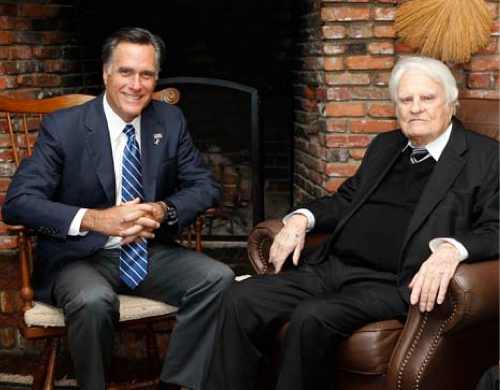
A short letter to Billy Graham on his endorsement of Mitt Romney for President of the United States

The inscrutable Mitt Romney meets the intractable Billy Graham

Let’s deconstruct what Billy Graham has to say about endorsing Mitt Romney:

“It was a privilege to pray with Governor Romney—for his family and our country. I will turn 94 the day after the upcoming election, and I believe America is at a crossroads. I hope millions of Americans will join me in praying for our nation and to vote for candidates who will support the biblical definition of marriage, protect the sanctity of life and defend our religious freedoms.”

Well, Mr. Graham. You left out a lot, didn’t you? No mention of protecting the poor, a favorite topic of Jesus. NO mention of holding the wealthy accountable for exploitation of the country and its resources. No mention of protecting the earth as God’s creation. No mention of holding our former President and VP accountable for unbudgeted, illegal wars and torture.

Especially no mention of the inscrutable lack of accountability by Mitt Romney, who has changed his stated positions on every single position he claims to advocate, and obscured facts about his personal business and finances that more accurately reflect his cutthroat disregard for his fellow human beings. These acts make him either an untrustworthy leader or an outright liar. Or both. The recovery Mr. Romney needs to focus on is his credibility.

Billy Graham has endorsed an ideological chimera in Mitt Romney, and as such has sided with powerful special interests and a brand of prejudiced thinking that impinges on real American rights including freedom FROM religion as guaranteed by the US Constitution. Graham completely ignores that fact of law. His assumptions speak volumes about his anachronistic brand of religion and its lack of scriptural substance in an age of rational faith and Constitutional interpretation based on human equality, not religious prejudices.

Graham proves through his endorsement that a vote for the Romney/Ryan ticket is a vote to misappropriate American rights and freedoms in favor of a stilted worldview that sadly is also a misunderstanding of the very faith Mr. Graham and his ilk have long claimed to represent. The best illustration of this desperate grab for power and respect is the scrubbing of his own website to remove the claim that Mormonism is a ‘cult.’ Like Joe Paterno, we might be seeing another hero embracing power over principle.

It is possible to lose perspective in life when your legacy is bigger than your ability to sort out your priorities. Perhaps the influence of his now infamous son Franklin Graham has jaded the Rev. Billy Graham’s once famously wise counsel. Of course, fame ultimately has a way of corrupting judgment. Position has a way of undermining the will to discern what is truly right and wrong. And time has a way of destroying the patience for change.

All in all, Mr. Graham, you have gotten it wrong, made a spectacle of yourself and the presidential race, and intimated that our current President is not a moral and considerate man. That may be the most damning of all references in your endorsement of Romney.

Supposedly, Billy Graham, you have provided wise counsel to many Presidents. Perhaps you’ve even spoken with Barack Obama at some point in time. But what you have done now is reveal the sad political prejudice of this age, which is disturbingly ill-informed single issue voting as the premise for political loyalty. One would think a man of your stature would see beyond the narrow-minded views you express. But having heard what you now have to say, we can write you off as the product of a different age. One that never really aligned with the true path of faith, forgiveness and fruition outlined in the Bible. Perhaps you should read it again.

It really doesn’t say some of the things you apparently think it does. Or have you only read it in the presence of those who agree with you, and therefore have much to gain by doing so?

Jesus didn’t like those types of religious leaders. It says so in the Bible.

Do you live in the City of Sanitary?

By Christopher Cudworth

City of Batavia Sanitary

While walking the dog on a Sunday morning before the newspapers were even delivered and a low sun was casting long shadows on the street, I stopped to let the dog have a sniff of something in the neighbor’s yard and found myself standing directly over a manhole cover. I looked down at the circular metal object and read the words, which said: CITY OF SANITARY BATAVIA.

Of course what the manhole cover was supposed to read was CITY OF BATAVIA, SANITARY

Those two short phrases seem to convey exactly the same thing. But in practice and reality, they might not.

Either way you read the words on the manhole cover, it is intended to convey its function as an access point to the sanitary system under the streets of Batavia, a municipality of approximately 30,000 people in northern Illinois.

But let’s imagine that it is no longer 2012, but is instead the year 2812. Language and culture have changed significantly over the last 8 centuries. English is no longer the primary language on Earth, yet translators are being assigned to study the hardiest artifacts of the past. The manhole cover and its confusing words survived the nuclear holocaust that wiped out most of North America’s population and left an entire continent nearly uninhabitable for more than 800 years due to nuclear radiation poisoning and pursuant destruction of habitation and resources. Such a grim scene, and hard to imagine in a way. But really, the present and the possible future all comes down to the quality of our ability to communicate.

The natural tendency of that English language translator in the future is to read the words on the manhole cover in logical order, as it says: CITY OF SANITARY BATAVIA. The translators therefore struggle to understand the meaning of this lost language, and particularly of the meaning of the words on the manhole cover. Was it intended to convey some message about the place called SANITARY or was it designed to communicate some aspect of a function called BATAVIA?

You see, language is a funny thing. It can be used to improve understanding in rationally liberal way, in full context. Or, it can be used to intentionally constrain meaning in a conservative way, and limit the context. Both have their legitimate applications at times. We know that historians have struggled with this challenge for centuries. That is why we have so many translations of the Bible because ultimately not everyone can agree on what the holy texts are meant to say.

Beyond translation there are issues of interpretation. Should we take the Bible literally or figuratively? Did Jesus actually say the things for which he is credited, or were his quotes and activities reconstructed to line up with a constrained view of the Christian faith as written 80-200 years after his death?

We now know the books of the New Testament are not arranged by chronology, so a judgment has already been made to place the Gospels before the writings of Paul, arguably the first Christian author. In some respects, that forces us into a viewpoint about primacy that some people might now consider conflicted by the arrangement of the books in the New Testament. Yet this prioritization can in some ways be viewed as vital to the history and meaning of Christian faith. Liberals might contend that the Bible should be reordered to reflect its true chronology, while conservatives would likely place their trust in the judgment of the ages.

If something so historically relevant as an entire religious tradition can be dependent on liberal and conservative judgements such as these, then we are certainly at the mercy of many other sources of disagreement over what constitutes accuracy and truth.

The liberal vs. conservative debate

Liberals and conservatives argue over the use of language and its meaning on every front. So let us begin by examine what liberal and conservative language really means.

The liberal use of language is defined as follows:

liberal: favoring or permitting freedom of action, especially with respect to matters of personal belief or expression.

Liberalism is therefore the pursuit of all possible meanings with respect to the course of comprehension. The ultimate determination of meaning may therefore require considerable study, even consulting with outside sources before full understanding of a word or phrase in context can be ascertained. This is largely the foundation for all academics, science and other forms of inquiry.

By contrast, a conservative pursuit of meaning in a word or phrase is by definition constrained to existing or traditional understandings as a starting point, with the resultant findings to be measured against prior knowledge. To be conservative is therefore defined as follows:

con·serv·a·tive disposed to preserve existing conditions, institutions, etc.,or to restore traditional ones, and to limit change.

The full reach of conservative thought includes the right to limit not only the liberal or contextual understanding of a phrase or idea, but is also known to aggressively limit information deemed likely to change the meaning of and idea, word, phrase or a passage as it has been tested over time. This is judged acceptable in conservative thought because it places its highest values on traditional sources as primary virtues, and established principles as standards or qualifiers against which change must be measured.

This is known as a conservative viewpoint, and in America it bears influence on everything from standards in education to Constitutional interpretation of law by the Supreme Court. Ironically some of the so-called “conservative” interpretations of Constitutional law passed down by a conservatively dominated court have resulted in highly liberal interpretations of issues such as corporate personhood. Such is the confusion of liberalism versus conservatism. This raises the issue of whether our existing understanding of conservative and liberal thought is really accurate at all, a subject we will pursue further in a moment, in context of so-called media bias.

Still, conservatism can be largely defined as a preoccupation with the defense of the original or traditional understanding of an idea while liberalism is in a constant search for multiple or possible meanings.

Principle challenges

The challenge in this game of defining meaning according to conservatives and liberals is how the scope and scale of meaning is allowed to be either constrained or expanded. That is where ideology or intent enters the picture when it comes to defining the meaning of a thing or an idea.

For example, if the image of the manhole cover were cropped (or constrained) to show only the words CITY OF SANITARY we would be left with an entirely different understanding of the object, as show here:

THE CITY OF SANITARY

Now the word BATAVIA is invisible. We have lost the complete context of the manhole cover as an object, and are left with, or presented only, that information that supports the idea that the City of Sanitary is an actual place!

Of course it is not. But the conservative or constrained presentation of information is a real phenomenon. It happens every day in the news. Conservatives blame the general media for a ‘liberal bias’ in presenting only news that favors liberal political policies while liberal blame media outlets such as Fox News for serving up news that is highly constrained to a conservative point of view.

We must further consider the definitions of liberal and conservative news to consider who is telling the truth in this situation, and why.

Liberal Media Bias

If only news stories that favor liberal politics are being shown or discussed on so-called ‘liberal media outlets’ that is very different than pursuing a truly liberal understanding of the news. All news, politics and government is democratic and fair only if it is transparent and provides full context for its constituents. The accusation of a “liberal bias” is most difficult to justify, however, if the problem is simply that the general media is indeed providing full information to support a story.

The selective fact that a conservative viewpoint considers the truth an objectionable deterrence to their cause is not, therefore, a truly liberal bias in the media. It is simply reporting the truth and letting the public decide what to think about what they hear. But the claim that the ‘liberal media’ may be choosing news stories that favor liberal politicians or policies can be determined through analysis, and in some cases this has produced contentions with merit.

It is a very subtle argument, however, because like a so-called liberal media bias, the dividing line between truly “conservative news” and conservative opinion are highly difficult to determine. If a plot to bomb an abortion clinic is reported on the general news but an act of eco-terrorism against a chemical company goes unreported by the general media, then that may indicate a choice based on politically liberal objectives. News editors make decisions every day to determine what news to present and report, and the formats of daily news shows allow such narrow space and time to fully present a story that decisions to cut or keep news stories is made every day.

Beaten at their own conservative game? 

But even if liberal media outlets are guilty of biased reporting, that is still a conservative or constraining choice of how to report the news. That is likely what conservatives find so objectionable. For years they have been beaten at their own game.

Which is why news outlets such as Fox News now attempt to level the playing field by appearing to conduct themselves as liberal media outlets, committed to reporting the full truth while in fact they are radically committed to a conservative approach to news reporting, and not by coincidence, favoring a conservative political viewpoint as well.

So there you have it. What appears to be a battle between liberals and conservatives is in fact a protracted fight over an overall conservative approach to reporting and presenting the news. The battle then, is not between liberals and conservatives as is so often presented, but between conservative methods of reporting the news.

Colbert exploits the ruse

That is what makes the comedy of a man like Stephen Colbert so hilarious. Colbert imitates the presentation methods of conservative media outlets while actually espousing and presenting liberal perspectives. The fact that these opinions about the news are force-fed through a faux Fox News filter is what makes the satire so funny. There is nothing Fair or Balanced about Stephen Colbert just as there is nothing Fair and Balanced about Fox News. It’s all just highly charged political information disguised as news.

Fox News, you see, excels at the City of Sanitary method of so-called news reporting. The company as a whole typically receives its marching orders on the choice of appropriate news topics and how to report on them from the very top where Roger Ailes, the chief network executive who built the American outlet for Fox News from the ground up, highly favors political conservatism as the solution to America’s problems.

His “news” staff is cleverly disguised as reporters and anchors when in fact they are positioned with a conservative ideology (and prescribed ‘talking points’) in place to constrain and deliver the information Fox News creates. It controls its messaging on a regular basis by taking a “closeup” look at news stories rather than backing up and providing the whole (and therefore liberal) context of the story. In other words, the difference between what Fox News does is the same as the difference between taking a look at the whole manhole cover that shows City of Batavia Sanitary as opposed to just showing the City of Sanitary image and using that constrained viewpoint as a jumping off point for political commentary.

Sanitized at Fox News

Fox News viewers seldom if ever get to see the entire context of a news story. Instead they are “sanitized” into thinking only about what Fox News presents as truth. It is hard to argue that Fox News is lying, exactly, because that they show on TV often exists as a “fact” just as the manhole cover actually does read City of Sanitary. But this “sanitizing” of the news is a grand deception of sorts, because it disallows context and essentially brainwashes viewers into a clipped understanding of the world and its activities.

Then the Fox News commentators like Sean Hannity further present these constrained, conservative media talking points to generate outrage over issues that have never been fairly presented. This radicalization of the news through constrained reporting and conflagratory discussion is the poison that has undermined true journalism in America.

The goals of sanitized news

Fox News has used its carefully “sanitized” views of patriotism, its jingoistic and flag-waving support for ugly and dangerous wars, its support of torture and covert aggression against nations around the world, and its advocacy for domestic policies and administrations that clearly have failed the nation and risked it very sovereignty in the process.

Insanitization of the news

We must therefore consider whether we should characterize the information presented by conservative news outlets like Fox News as the “insanitization” of news and information. It is literally as if the insane have taken over the media on all fronts. It is no longer possible or profitable for media outlets to engage and invest in liberal news reporting. The news cycle and competition for viewer attention is so tight and self-fulfilling that companies who attempt to present news in its full context are losing out to aggressive competitors like Fox who sound byte everything through the insanitization of the information presented. The American public can no longer even identify or understanding news as it is defined in journalistic terms. The insanitization of news and information has cut attention spans and comprehension among consumers to a bare minimum. Viewers now prefer the City of Sanitary to the City of Batavia Sanitary. “Don’t bother me with the facts,” the public seems to say, “Just tell me what I need to know.”

Screw the fact-checkers = Ignore the truth

In 2012 the Mitt Romney campaign boldly proclaimed that it won’t be constrained by “fact checkers.” This is a precise expression of the insanitization of information.  Think about what politicians like Romney claim they are entitled to do: They are running a campaign where the truth literally does not matter. Yet 40% of Americans will support a candidate who makes no claim to represent the truth? That is insanity. But that is exactly the strategy of the conservative brand of thought. Through sanitization of information and turning the truth against itself, people can be convinced to believe that what you are saying is “more real” than the truth.

Think of the manhole cover. Think of think of the City of Sanitary. Is that where you really want to live?

Sanitization: It’s a religious tradition

This is nothing new, of course, under the sun. Religious groups have for years blindered believers with literal interpretations of scripture and controlled their belief systems with law and practices that even Reformation and revolution have not erased. The result is a society where 50% of Americans still believe in a literal Adam and Eve and refuse to comprehend even the slightest truth in the theory of evolution. This is the insanitization of religion just as politics and news have been distorted and contorted. Conservative religion rather precisely limits its believers understanding to the City of Sanitary level. In fact it likely goes a step further, focusing only on the word SANITARY with claims that true believers must sanitize themselves from recognizing equal rights for gays and women, or associating with environmentalists or tolerating other faiths.

Meanwhile the Muslim faith is engaged in the very same sanitization and insantization of its ideology, producing radical terrorists engaged in a fight to impose Muslim law in otherwise democratic societys and engaging in an ideological fight with Christianity that produced the Crusades.

A walled city under a siege of misinformation and fear

The City of Sanitary is a walled city that behaves as if it is in a state of siege. It promotes and feeds the fears of its dwellers. Indeed, fear and constrained thinking is the main and primary focus of its ideology, for fear is the factor that keeps its audience under control.

The City of Sanitary is therefore the most dangerous enemy of America, which fully depends on the liberalism inherent in its Constitution along with freedom of a press and a truly liberal media committed to full reporting– and not sanitization–of the news as a means to protect and defend America’s most precious freedoms, both liberal and conservative.

Anything else deserves to be shoved down the manhole of history.

RELEVANT DEFINITIONS

san·i·tar·y [san-i-ter-ee]  adjective

1.of or pertaining to health or the conditions affecting health,especially with reference to cleanliness, precautions againstdisease, etc.

2.favorable to health; free from dirt, bacteria, etc.: a sanitarywashroom.

3.providing healthy cleanliness: a sanitary wrapper on allsandwiches.

san·i·tize [san-i-tahyz]  verb (used with object), san·i·tized, san·i·tiz·ing.

1. to free from dirt, germs, etc., as by cleaning or sterilizing.

2.to make less offensive by eliminating anythingunwholesome, objectionable, incriminating, etc.: to sanitize adocument before releasing it to the press.

insan·i·tize [san-i-tahyz]  verb (used with object), in·san·i·tized, in·san·i·tiz·ing.

1. to purposely constrain information in a radical way as a means to confuse and obfuscate while claiming to speak the truth

2.to propagandize factual information by limiting its context, thereby avoiding the appearance of lying by being able to point to a portion of the information as demonstrable fact

2.to lie like a sack of shit and deny that you are lying despite all proof to the contrary, as in presenting your corporate brand as Fair and Balanced when it is anything but.

What the bible really says about the nature of human knowledge

Nature can help us look beyond our earthly perspectivesNaturalism and Organic fundamentalism

Some high profile politicians like to profile faith issues as stark “either/or” propositions. One of the most divisive arguments is over what it means for humans to have “dominion” over the earth. A literal translation of this term leads to a theology that says the earth and every living thing were put there for human use. Lashed together with conservative fiscal doctrine that resists environmental legislation and government regulation on business, this literal translation can be used to make the argument that environmentalism and science undercut key foundations of moral values.

But is it really that simple? And does the Bible really contend–and does Jesus really teach us–that the earth is a vessel to be poured out at our discretion, and that science stands in opposition to God?

We can examine this issue by looking at some  basic principles of human knowledge, both naturalistic and scriptural.

In modern culture, naturalism and human reason drive the pursuits of science, mathematics, physics, chemistry, medicine and more. The worldview we conceive through naturalism has been developed through increase of human knowledge tied primarily to the sciences. This approach has simultaneously defined how we gather, employ and relate information.

Yet we need to recognize that naturalism is primarily an organized system of observation. As such, naturalism has always been part of human culture. It informs the workings of our lives just as knowledge about nature, planting, sowing and harvesting informed the lives of people during bible times. Granted, advances in technology and our corresponding ability to manipulate nature have been used to create tremendous change in the world. But the basic practice of observing the natural order of creation to form beliefs about our selves and the universe has changed little in the last 10,000 years. We remain a culture of human beings in which storytelling infused with natural images is a primary method of communicating universal truths.

Let us be specific: the knowledge conveyed in the Bible utilizes the same observational methods as naturalism to gather and pass on knowledge. The key difference between biblical and scientific knowledge is the manner in which naturalistic observations are used, and to what ends. For example, one of the ways in which naturalistic observations form the basis of literary truth in the bible is through metonymy, a literary device that describes “the use of a name for one thing for that of another, of which it is an attribute with which it is associated.” 

Metonymy is based on “organic metaphors,” natural symbols used to draw parallels between our worldly life and what we call the “kingdom of God.” For example, the “tree of life9” portrayed in the Garden of Eden (Genesis 2:8) serves as a symbol for the nature of knowledge, cultures and descendants. At a literal level, we can observe a tree and know that it is an example of the constancy of nature. But we can also view a tree as the symbol for intellectual concepts such as genealogy and wisdom. Other examples of biblical metonymy include the mountain of God in Isaiah 2, symbolizing the higher moral ground of faith. The river of life in Revelation 22:1 similarly symbolizes the flow of life’s generations through time. In each case the literary device of metonymy illustrates a spiritual concept using the natural dimension, size or structure of something we can readily see or observe here on earth. The Bible plainly uses these material examples to teach us about spiritual concepts.

Of course one could argue that the modern tradition of using naturalism to define knowledge denies the supernatural by definition. But the corresponding argument is that the Bible cannot be understood without some foundation of naturalism to help us appreciate the symbols and meaning conveyed through the literary device of metonymy and other metaphorical, literary devices. The methodologies of naturalism help us identify appropriate organic symbols for knowledge, truth, moral and spiritual concepts. We might call this the nature of revelation.

Put another way, the Bible is so reliant on metaphorical devices that we would have little affirmation of the concept of God if it were not for the naturalistic biblical metaphors describing how God appears, acts, feels or creates in this world. Metaphor is an indispensable tool for understanding the literature we call scripture. By contrast, treating metaphorical symbols literally divests them of nearly all meaning. So it is crucial to avoid unmerited literalism when reading the Bible, especially if it leads us away from the original and organic sources of knowledge that drive scripture. We should instead respect the important role played by naturalism, metonymy and symbolic language as tools chosen by God and Christ to make the Bible’s ultimate message relatable to the human race. Thus the organic fundamentalism of the Bible is defined as wisdom anchored in observations about the natural world delivered through literary devices such as metonymy.

Jesus the naturalist

Organic fundamentalism plays an important role in the ministry of Jesus Christ, who used a simple form of naturalism in so many of his parables. Jesus uses parables to describe spiritual and moral principles that would otherwise be difficult for people to understand without some way to make them tangible and relevant to his audience. In Matthew 13:31 we find Jesus playing the role of naturalist with this parable: “The kingdom of heaven is like a mustard seed. Though it is the smallest of all your seeds, when it grows, it is the largest of garden plants and becomes a tree, so that the birds of the air come and perch in its branches.”

The significance of this parable is that it communicates an important concept of faith by drawing on the seemingly supernatural ability of a tiny seed to become a giant tree. People in Jesus’ day understood this parable because the illustration of faith was presented to them in terms with which they were familiar. The concept of faith in God is not so threatening when it starts in the image of a tiny mustard seed. So we see that Jesus was able to communicate revelatory concepts through organic principles. This is organic fundamentalism in action.

This concept of growing a faith through knowledge of nature is given another application in Matthew 13:33, only this time human beings are assigned an active role in the organic process: “The kingdom of heaven is like yeast that a woman took and mixed into a large amount of flour until it worked all through the dough.” Here the act of adding yeast to dough symbolizes the ability of human beings to effect change in the world through faith and good works. This is organic fundamentalism with an added human dimension, demonstrating it is acceptable for human beings to be materially involved to the world. Naturalism is again no enemy of God in this context.

Matthew 13:34 outlines just how important organic fundamentalism really was to the ministry of Jesus Christ:  “Jesus spoke all these things to the crowd in parables; he did not say anything to them without using a parable. So was fulfilled what was spoken through the prophet: “I will open my mouth in parables, I will utter things hidden since the creation of the world (reference to Psalms 78).” This prophetic reference to “creation of the world” outlines the unifying role of parable, metonymy and organic fundamentalism present from beginning to end in the Bible. Now let us consider the importance of parables in the teaching ministry of Jesus Christ and what it says about how we should read the bible from Genesis to Revelation.

Parables: The link between matter and spirit

A parable is defined by Webster’s Dictionary this way; “a usually short fictitious story that illustrates a moral attitude or principle.” To ascertain the meaning of a parable, the listener (or reader) must make connections between the subject of the story and what it illustrates in terms of good and evil, but also the difference between matter and spirit. This process requires thought and rationality on the part of the listener. Matthew 13:34 is an ideal illustration of the spiritual truths of the bible communicated through rationality (parables) spirituality (things hidden) and organic traditions (creation of the world) that form the foundation of biblical tradition. It makes perfect sense that for Jesus Christ “things hidden since the creation of the world” should be discerned from organic or naturalistic sources.

The bible recognizes that Jesus was a man in the material sense, but with a spiritual essence that challenged all notions of human limitation. In this respect both his existence and his parables are an essential link between life on earth and whatever we think of as heaven. By constructing this vertical link between earthly examples and spiritual purposes, parables anchored in organic fundamentalism make it possible for us to imagine concepts of faith that would otherwise be foreign or inconceivable. Language is a key link between the apparent objectivity of natural theology and the emotional experience we call revelation.

Some people get so wrapped up in the revelatory experience of faith they may choose to ignore its organic foundations altogether. But Jesus perfectly demonstrates the value of a faith in balance with organic fundamentalism and revelatory experience. What can we learn from this example?

We should ask ourselves how well we are following the example of Jesus in the modern age. If through literal interpretation of the Bible we ignore, dismiss or fail to appreciate the organic tradition upon which biblical knowledge is dependent, we deceive ourselves into thinking an anthropic or revelatory interpretation of the Bible is the only way to establish and sustain a relationship with God and creation. Instead we should be skeptical of any teaching that imposes a prideful dichotomy between our material and spiritual lives. That approach is not in keeping with the ministry and message of Jesus Christ, whose use of naturalism to convey truth demonstrated an attitude of sanctity toward creation. Worldly knowledge is a compliment to faith. Organic fundamentalism affirms the idea that gaining wisdom through the metaphorical significance of nature as a creative act of God is the wellspring for biblical truth. All that is required for us to bring the bible into the modern context is a corresponding openness to metaphor and the pursuant will to draw parallels between the organic fundamentalism of scripture and the naturalism driving modern culture. The Bible is more alive, accessible and materially pertinent if we celebrate its organic fundamentalism rather than forcing our interpretation of scripture into a literal doctrine that effectively separates us from the heart of naturalism at its core.

True simplicity of faith comes in having the liberty and latitude to discover what scripture means to say rather than accepting a merely literal interpretation of a religious text. We might call this metaphorical tangibility; that is, approaching life and wisdom with an eye toward its unifying symbolism. This is the common denominator in biblical knowledge. And take note: Organic fundamentalism isn’t just a “here or there” phenomenon in the bible based on selected texts to make a case in favor of naturalism as a foundation for truth.

The useful knowledge we gain from sciences such as geology, biology and physics is therefore not the enemy when it comes to understanding and appreciating God. The natural conclusion of this analysis is that we can sustainably engage a reading of the Bible while maintaining a fluid worldview. That is, a worldview that accepts science, naturalism and the notion that the world is part of an infinite and changing universe. And a fluid worldview is a more consistent way to make God and the Bible relevant in the modern age than a worldview of biblical literalism and its typically rigid, purposefully limited and fearful perspective.

The lesson is that politicians like to make use of the rigid, limited and fearful perspective to draw stark lines among the voting electorate. But do not confuse their worlds with good theology, or perceive them as some kind of gifted message from God. The very human motivation of worldly power often negates the very real connections between our earthly lives and our truly spiritual goals of understanding and respecting God’s creation.


Our vestigial past embodied in theology

The following is an excerpt from the upcoming revision of my book, The Genesis Fix: A Repair Manual for Faith in the Modern Age.

Our Vestigial Past

The basics of biology tell us that whales are mammals that live in the ocean. Though shaped like fish with fins instead of legs, we know from physical evidence inside the bodies of whales that their evolutionary ancestors once walked on land. Hidden inside the body of every modern whale species are vestiges of legs and pelvic bones. These remnant leg and pelvic bones clearly do not help a whale walk on land anymore––so we call them vestigial body parts.

Ironically human beings can provide a wonderful illustration of why whales now use fins instead of legs to swim in the water. When humans swim, we are forced to use arms, hands and feet ill-suited to the process. We rely instead on propulsive motions of arms and legs to move through the water. But if we place rubber flippers on our feet we can swim much faster, dive and turn more quickly. Essentially by using our intellect and adding the instrument of flippers to our feet, we can shortcut the evolutionary process and become better adapted to life in the water. Of course, the feet we use to walk on land are still embedded inside those rubber flippers, but for the moments they are encased inside flippers their original design as instruments for walking are vestigial. Just watch anyone try to walk in swim fins. It truly is like reverse evolution.

Humans can take an evolutionary shortcut however and dispense with flippers to instantly walk on land again. Whales are not so lucky. Their leg and pelvic bones have receded into the body where they no longer interfere with the swimming motion.

There are people who object to the idea that body parts of living things can be vestigial. They call the theory of evolution a false belief, maintaining it is too big a stretch to say that ancestors of whales once walked on land, or that the origins of living things can be explained through the apparently random process we call evolution.

Philosophical resistance to evolution theory is largely founded on religious beliefs, especially the belief system known as creationism that says God created living things in original forms unchanged since the dawn of time. In recent years creationism morphed into a pseudo-science known as Intelligent Design. But really it is better labeled an anti-science because its arguments do little to explain the origins of living things but do provide complicated objections to why evolution could never occur. Proponents of intelligent design have invented scientific-sounding terms such as “irreducible complexity” to explain why some organs and processes in living things are too complex to have evolved on their own. But if we follow the thinking behind intelligent design theory to its conclusion, we find it dead-ends at the point where true human science begins––trying to discover how things works, and why. So intelligent design theory does not work as a science, but it does serve a useful purpose in illustrating how anachronistic worldviews tend to create more confusion than clarity.

Let us consider how intelligent design theory chooses to explain the presence of essentially useless leg and pelvic bones in the body of a whale. The answer given by Intelligent Design is scientifically inconclusive––but also, it turns out–– theologically unsound. Intelligent Design says God put them there by design. It is not for us to know why. But is that really how God designed the world, or more specifically, the human mind?

This rather cynical response wears a disguise of human humility towards God when in fact it is a tremendous arrogance. And here is how we know that to be a fact. If we trace intelligent design theory back through its roots of creationism to the source of religious literalism at its foundation, we encounter a worldview that depends on an aggressive fiction––belief that the scripture is to be followed literally in every respect, including the history of our origins. But literalism as a tradition of faith was rejected by Jesus Christ who chastised the Pharisees as hypocrites (and worse, a brood of vipers!) for turning scripture into religious practices diverting spiritual devotion from God into law. Through literalism, that process is still happens today. We never seem to learn our lesson.

There is of course a reason why people persist in taking scripture literally. It appears to deliver answers in neat little packages. To say that God put useless leg and pelvic bones in a whale seems like a shortcut to truth. Such a belief does not require much thought or analysis to comprehend. There is its principal appeal. But let us turn the paradigm of literalism around for a moment. Aim it straight back at the bible to examine scripture with scripture, as theologians advise us to do. Then we shall see if the strict methodology of literal truth is applied with consistency in our practice of religious faith.

It is readily determined that we do not follow the strict letter of the law or scripture as it is presented in the bible. In fact we ignore as archaic and anachronistic all kinds of religious laws and practices laid out in the bible. Entire books could be written just about the differences between life as an ancient Israelite and life today. So let us choose just one example––the acceptance and practice of slavery––that is the most glaring difference between life in bible times and our culture today.

References and acceptance of slavery occurs with almost casual frequency in the bible. Yet we reject its existence for outright moral reasons today. Yet Leviticus 25: 44 says: “Your male and female slaves are to come from the nations around you; from them you may buy slaves.” On the issue of slavery Leviticus is far from alone in the bible. Both Old and New Testament texts bear evidence that slavery was not only tolerated but in some cases  advocated as preferable to upsetting the social order.

This is madness, of course. Yet literal belief in the value of slavery persisted well into the last century. Only 60 years ago, noted theologian Dietrich Bonhoeffer could not shake his own fixation with biblical dramatics related to slavery when he wrote “The Cost of Discipleship,” an instruction manual on how to live the Christian live. But instead of conceding that society had long since rejected slavery as an acceptable tool for moral instruction, Bonhoeffer went to great lengths justifying the warped perspectives of St. Paul, whom Bonhoeffer quoted liberally on the Christian role of a slave, “No, his real meaning is that to renounce rebellion and revolution is the most appropriate way of expressing our conviction that the Christian hope is not set on this world, but on Christ and his kingdom. And so––let the slave be a slave! It is not reform the world needs, for it is already ripe for destruction. And so––let the slave be a slave!”

Bonhoeffer was later forced to admit that this worldview was dangerously in error when slavery and other forms of social bondage came to evil fruition in his own country through Hitler and Nazi Germany. Bonhoeffer ultimately chose to resist Hitler, thereby rejecting his own advice that one should “let the slave be a slave!” Eventually Bonhoeffer even participated in a plot to assassinate Hitler. That action essentially relegated his advice to “let the slave remain a slave” to the theological dump heap. It became vestigial, in a sense, to a faith focused instead on achieving social justice. That was the faith Bonhoeffer conceived as he was persecuted and imprisoned by the Nazis. His vestigial analysis of scripture was forced to evolve. He no longer adhered to this advice from St. Paul in Romans 13:  “Therefore let every soul be in subjection to the higher powers. The Christian must not be drawn to the bearers of high office: his calling is to stay below.”

There is no question that Dietrich Bonhoeffer was a man of convictions. His faith cost him his life. He was hanged by Nazi Germany for resisting another literalistic brand of faith leveraging the supposed racial and cultural superiority of white Christians seeking world domination. Bonhoeffer rightly recognized that the brand of faith espoused by Hitler and the Third Reich was corrupted by lust for power. Some argue that true Christian faith could never produce such an evil, but there is no doubt Nazi Germany used the language and authority of Christianity to recruit people to its cause. Its anti-Semitism led to the execution of millions of Jews. It was a perverse form of biblical literalism that informed this anti-Semitism.

Abolishing slavery is only one of the more dramatic differences in how we manage our affairs today in comparison to people in bible times. Let us state the truth plainly: The bible is full of laws and practices we no longer use. They are now vestigial. Present but harmless. Real but relegated to a function that no longer drives our faith. Most of all, such texts should never be taken literally or used to dictate our actions and lives today. This realization should open our eyes to places in society where religion and especially literalistic forms of Christianity continue their persecutions today.