The entire message of Genesis comes down to one thing: “You should know better than that.”

By Christopher Cudworth

Nature and eternity are foundations of the BibleThe narrative of the Book of Genesis begins with the creation story at the heart of the Judeo-Christian tradition. As such it is also a watershed in terms of competing worldviews. Some take as literal truth these fundamental ideas: God created the world in seven 24-hour days, created man from dust and woman from the rib of man, kicked them out of the Garden of Eden for cheating on a few rules set up by God to protect them, and then the trouble started.

Ostensibly sin entered the world through the actions of Adam and Eve. Eventually the nasty little habit of people doing bad things led God to wipe out most of the living things on the planet. That’s according to the legend of Noah and his ark, which is also considered a literal truth by those who consider that important to the verity of the Bible.

Having read the entire Book of Genesis over many times, and having read everything I can about the book from both literal and metaphorical perspectives, there’s a plain fact staring everyone in the face that is too often ignored. The entire message of the Book of Genesis comes down to one thing, something God wants us all to know. “You should know better than that.”

If you take the Bible literally, that is still the message of Genesis. “You should know better than that.” God warned Adam and Eve not to eat of the fruit of the tree in the middle of the Garden. But they did. They obviously should have known better.

As chronicled in the rest of the Bible, God repeatedly tries to warn his chosen people and all those who would listen that they need to have faith and trust in the principles God has mapped out for the human race. Time and again people breach these promises from God and all hell breaks loose.

When wandering in the wilderness after being freed by Moses from bondage by the Egyptians, the Israelites complain and moan and create idols in defiance of God’s orders to be faithful. God is not pleased.

Later on in biblical history God’s people complain that they have no king. God tells them, “Pay attention to my guidance and you’ll never need kings.” But they insist, and the kings turn out to be flawed and tragic and selfish. Just like the rest of us. God tried to tell them. “You should know better than that.”

Of course the entire arc of the Book of Genesis ultimately points toward the arrival on earth of God’s own Son. That would perhaps be Yeshua, if we were hewing to the pronunciation of the day. To those of us reading various translations of the Bible, that man is Jesus.

Whose main message is that you should love one another even to a fault. You should even love your enemies. That is the only true path to forgiveness, grace and salvation.  Versus the ugly path our journeys take when we let our base instincts rule the day. In so many words the primary message of Jesus was an echo of Genesis. “You should know better than that.”

The people who really should have known better never accepted the fact that Jesus was the Messiah. They conspired to have him killed and succeeded in their mission to retain power and authority over the religion of the day. Of all people, they should have known better than that. Problem was, they were so obsessed with the rule of law and owning that authority for themselves, they could not see that they were the very real problem Jesus came to address.

Which brings us to the current day, and how so many people wield the message of Genesis like a weapon. They brandish a literal interpretation of the Bible as if it were God’s own words. But let us not forget––the real message of Genesis is this: “You should know better than that.”

God has been telling us the same thing for millenniums, yet people refuse to listen. They’re so busy being faithful to the idea of what the Bible is about they fail to see the basic message of it all. “You should know better than that.”

Jesus called the Pharisees hypocrites and a brood of vipers for being so possessive of the truth. He blamed them for obscuring the true message of scripture, which is and always will be, “You should know better than that.”

So those of us who believe in evolution and do the honest work of reconciling the legitimate worldview of science to our faith cannot be blamed for for being the ones who undermine the true message of scripture. That has long been the work of those who patently should know better.

Jesus admonished his own disciples for failing to grasp the meaning of his parables. “Are you so dull?” he asked them. See, there’s a whole lot of truth that is healthily accessible through metaphor. That’s why Jesus taught in parables, to help people get a grip on spiritual principles by using natural examples such as mustard seeds and yeast to explain the growth of faith and the reach of grace. People “got it” because the truth was distilled to a simple principle.

Divorced from these cogent examples, the Bible really is just words on a page. We lose the symbol of the Lamb for Jesus Christ. We lose the foreshadowing of Abram willing to kill his own son Isaac. We lose the glorious fight that David engaged in for God. But we also lose the significance of the hugely flawed human being that David was, and why his sins hold true for us as well. Indeed, God did not even allow David to build a temple in His honor. God told David, in so many words: “You have too much blood on your hands.”

The patent irony of God’s decisive powers should not be lost on us. Even when you are a dedicated servant of God, not everything is going to go your way. Truly, you should know better than that. But just because our lives have difficulty does not mean that we are not special in the eyes of God. All things in the universe are special in the eyes of God.

For those of us with a hunger for attribution, the 14+ billion year history of the universe only confirms the special nature of our existence. The fact that for millions of years human beings did not exist on this earth, and the fact that 99% of all living things that ever existed are now extinct makes it even more special that human beings know how to survive. Yet we waste that gift of creation in so many ways. We have poisoned and polluted and abused our world many times over, and often in the name of God. Genesis 1:26: “Then God said, “Let us make mankind in our image, in our likeness, so that they may rule over the fish in the sea and the birds in the sky, over the livestock and all the wild animals, and over all the creatures that move along the ground.”

Nothing in that phrase justifies abuse of the earth. In fact the word ‘dominion’ can be translated in other ways, especially to mean ‘good stewards.’ Yet that is not the legacy demanded by so many who take the Bible literally. They proceed with such force of will and selfish perspective it cannot possibly be the will of God. Yet they claim it so.

Remember that God favored David in many ways. Yet when it came time for David to honor God by building a temple in His name, it was not for that servant to receive that honor. That fell to his son Solomon, a wise man in many ways, yet also a flawed individual.

It was a harsh directive God returned to David. “So you thought you could earn the right to build a temple to me through violence alone? You should know better than that.”

That is the lesson people refuse to learn. Yes, you may have done your job well in your devotion to God. But you can also do it too well, which was the lesson for both David and the Pharisees. By being so religious and forceful that you miss the true message of God, it become possible that ego and desires run your soul when a share of prudence, consideration and metaphorical breadth of mind would serve you so much better than that other thing you do.

The Genesis Fix: A Repair Manual for Faith in the Modern Age

The Genesis Fix: A Repair Manual for Faith in the Modern Age is being revised for release on Amazon.com

Salvation from a liberal perspective

By Christopher Cudworth

PaversThe Second Presbyterian church in downtown Lancaster, Pennsylvania was our family’s religious home from my elementary school years through middle school. Then we pulled up roots and moved to the tiny town of Elburn deep in the cornfields of Illinois. My parents landed at a Presbyterian church in Geneva, nine miles east.

I got confirmed with a group of fellow 8th graders at a congregational church run by the pastor who was our neighbor. Then our family moved once again and my church attendance dropped away with obligations in high school.

A brush with conservatism

But then a group of friends joined Campus Life, the evangelical youth ministry staffed mostly by students from nearby Wheaton College, one of the leading bastions of conservative education in the Upper Midwest.

Most of us did not recognize the conservative ideology behind Campus Life when it first arrived in our town. We attended with students from other high schools, which was pretty radical for the time. So it all felt new and exciting in its way.

As the program grew and its participants were encouraged to dig deeper into the theology behind the feelgood high school ministry, I began to ask questions about what we were being encouraged to learn. Some of these questions exasperated the head of the group, who pulled me aside with a warning and an admonition. “If you keep asking questions you’ll never be a Christian.”

I ignored his aggressive warning and finished out the year with the group. But something about the confrontation made me even more determined to ask questions about the Christian faith and its teachings.

New laws

In college I received a C grade in a New Testament course. I failed to grasp that in that particular situation the path to success was to recite what we were being taught, not to question its verity.

As a senior I fell in love with a girl with whom I watched the television program Jesus of Nazareth. It’s narrative was basically traditional, but the emotion was compelling. My curiosity about faith was kicked back into gear. My questions about some notable aspects of faith were answered. For the first time in life I recognized the liberal truth of Christ. He resisted the wrong kinds of authority. He fought back against people seeking to control religion through literal or legalistic means.

Watching that program taught me that Jesus also asked and welcomed a lot of questions. In fact he won many of his most famous arguments by asking questions in response to legalistic challenges. I’d found a hero of sorts.

Narnian virtues

The summer following my senior year in college I took turns reading all the books in the C.S. Lewis series The Chronicles of Narnia. Christian themes were evident in the metaphorically fantastic story of a band of children who travel to a different dimension where animals can talk and evil sorcery is resisted by the lion known as Aslan. Much like the parables of Jesus the Chronicles of Narnia use symbolism to convey spiritual principles. That opened my eyes even further to the fact that symbolism is one of the most powerful forces in all of scripture.

Marriage and beyond

I did not marry that girl from college but our mutual spiritual exploration did have a deep effect on my life. When I got married in 1985 my wife and I began worship at a Lutheran Church Missouri Synod congregation because that is the tradition in which she had been raised.

The pastor at the time was a wise former campus minister who once gave a sermon titled “Liberals, Bleeding Hearts and Do-Gooders” in which he boldly challenged the growing perception that the Bible was strictly a conservative document. His main point focused on the fact that Jesus himself was a do-gooder, a bleeding heart and yes, a liberal. Scandalous!

When that pastor retired the church brought in a fire and brimstone preacher from the St. Louis area. He wore a wickedly bad toupee and spent most Sundays railing about an angry God. But my wife and I hung in there even when the church itself became an angry place to be. This was a new and not delightful experience for both of us. We loved our fellow church members and continued our bible studies, church participation and teaching. Yet Sundays often left us sad and confused by the near hatred we kept hearing from the pulpit. We talked often of leaving. But we hung in there.

Facts and fictions

Through a succession of increasingly conservative pastors for another 12 years my wife and I served that church in many ways. She took a job in the preschool. I sang in numerous choirs and ultimately had the opportunity to sing and play guitar in Praise Band too.

Our children were confirmed at that church. But during the process they both admitted exasperation at the manner in which certain “biblical facts” were being taught. The pastor railed against evolution, for example. Both of them had learned plenty in school that taught them science was a reliable, well-founded worldview. Yet both kids dutifully recited what they were told to learn for confirmation and the pastor praised them as model students of the Lutheran faith.

As the church grew increasingly conservative, sermons attacked evolution as a godless belief and characterized homosexuality as a nearly unforgivable sin. After 25 years our family migrated up the river to an ELCA Lutheran Church with open communion and even women pastors. God Forbid.

Questions and devotions

All through this process of growing up and raising a family, the questions I had about faith did not keep me from a certain devotion to God. All the journals I kept about my running through high school, college and beyond express thankfulness to God for the opportunity to compete and sometimes win. I prayed for insight through both challenges and triumphs.

My 25 years of service to a Missouri Synod Lutheran church taught me there was no special insight gained from conservatism. As a board member several times over I saw how decisions were made, or not made, by people with ostensibly ironclad convictions. How desperately wrong they could be, and in so many ways.

That confirmed many of the suspicions I had about conservatism in the world at large. Starting with Ronald Reagan in the early 1980s, It struck that conservatism was far more concerned with ideology than justice. When Reagan installed James Watt as Secretary of the Interior, he openly proclaimed himself an adversary of the environmental movement on grounds of religious views. Reagan himself claimed to be a protector of moral values in America, yet the so-called Great Communicator branded ketchup a vegetable and played dishonest games through the Iran-Contra affair. The fact that people called Oliver North a hero for his illegal activities and seemed to worship his “above the law” convictions confirmed my worst suspicions about conservatism and its methodologies.

Chance encounter

Ten full years after I had participated in the high Campus Life program where that evangelical counselor confronted me for questioning conservative ideology, I encountered the same man at a McDonald’s in my hometown. At first he avoided looking at me, but when our eyes finally met I could see tears running down his face.

Immediately I went over and invited him to sit down with me. We talked and he confessed that he was upset about what he’d said to be a decade before. I told him: “There’s no reason to be upset. What you said to me did not discourage me from a personal faith. I still ask questions. But I still believe.”

Perhaps he was surprised. We parted on friendly terms and I thanked him for his service to Campus Life. It still strikes me that so many people find it hard to believe there is salvation from a liberal perspective. As noted, Jesus often answered questions by asking questions of his own. This was particularly true when he encountered people with conservative opinions trying to impose their convictions on him. Here’s one classic example from the Book of Matthew:

That Which Defiles

15 Then some Pharisees and teachers of the law came to Jesus from Jerusalem and asked, “Why do your disciples break the tradition of the elders? They don’t wash their hands before they eat!”

Jesus replied, “And why do you break the command of God for the sake of your tradition? For God said, ‘Honor your father and mother’[a] and ‘Anyone who curses their father or mother is to be put to death.’[b] But you say that if anyone declares that what might have been used to help their father or mother is ‘devoted to God,’ they are not to ‘honor their father or mother’ with it. Thus you nullify the word of God for the sake of your tradition. You hypocrites! Isaiah was right when he prophesied about you:

“‘These people honor me with their lips,
    but their hearts are far from me.
They worship me in vain;
    their teachings are merely human rules.’[c]

And that, in a nutshell, is why I’m now a liberal and will always be a liberal believer. That liberal pastor in the conservative Missouri Synod Lutheran Church was also right when he preached the Jesus was a “Liberal, Do-Gooder and Bleeding Heart.” Salvation from a liberal perspectives comes through the very act of questioning false authority, and standing up for the social justice deeply integrated in the liberal Christian faith. That’s how it’s always been, according to Jesus at least.

How biblical literalism affects politics, culture and the environment

Revisiting biblical dietary laws and other anachronisms of scripture

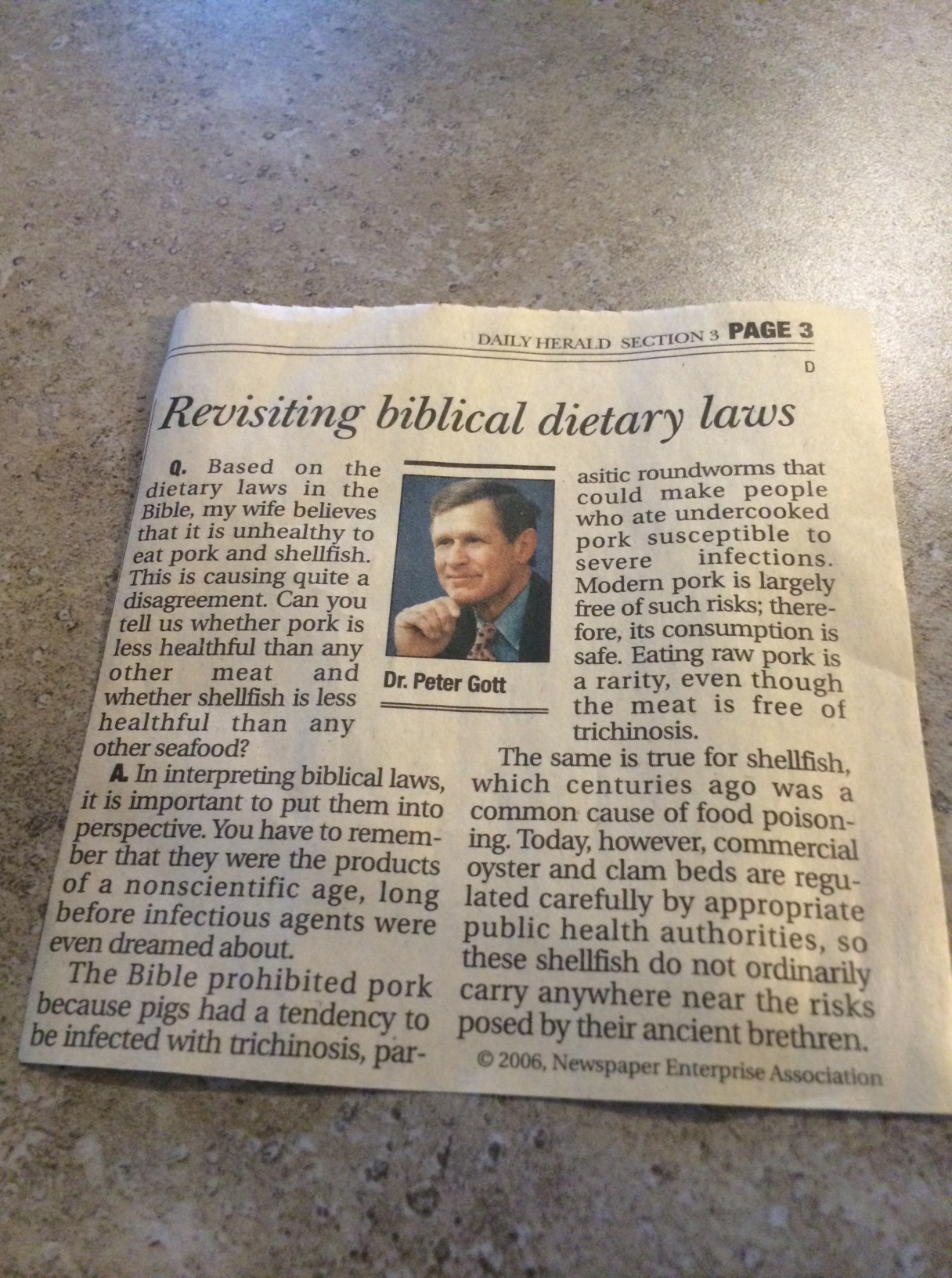
Dr. GottFor years I’ve kept a simple news clipping published in the Daily Herald, a traditional newspaper in Arlington Heights, Illinois, where I worked for 7 years.

The clipping featured a short column by Dr. Peter Gott, a physician whose column on health was syndicated all across the country.

A reader had written Dr. Gott with the following question: “Based on the dietary laws in the Bible, my wife believes that it is unhealthy to eat pork and shellfish. This is causing quite a disagreement. Can you tell us whether pork is less healthful than any other meat and whether shellfish is less healthful than any other seafood.”

Dr. Gott replied most simply, telling his reader:

“In interpreting biblical laws, it is important to put them into perspective. You have to remember that they were the products of a nonscientific age, long before infectious agents were even dreamed about. 

The Bible prohibited pork because pigs had a tendency to be infected with trichinosis, parasitic roundworms that could make people who ate undercooked pork susceptive to severe infections. Modern pork is largely free of such risks, therefore, its consumption is safe. Eating raw pork is a rarity, even though the meat is free of trichinosis. 

The same is true for shellfish, which centuries ago was a common cause of food poisoning. Today, however, commercial oyster and clam beds are regulated carefully by appropriate public health authorities, so these shellfish do not ordinarily carry anywhere near the risks posed by their ancient brethren.”

What an interesting choice of words to close his advice. “Ancient brethren.” It says a lot about the attitudes that lead people to take ancient aspects of the bible literally. Then they seek out people with similar attitudes and call them “brethren.”

Ancient laws

The Bible not only documents ancient dietary laws, but also lists warnings against contact with women who menstruate and homosexuals too.

We now understand the full biology of the female body. Back when the Bible was written, that was certainly not the case. Women were also discriminated against in civil and equal rights, treated as property and even murdered for infidelity. The patriarchal society from which the Bible emanated feared women’s bodies in ways that we no longer need in modern times. However there are still many men who do fear women. Some of those men hold positions of great power and still try to control what women can do in society, even to the point of legislating their personal and reproductive rights. But women aren’t buying it. 

Being gay is not a demonic issue

The same goes for homosexuality, which along with mental illness was viewed as a sign of an accursed condition like demon possession or a permanent state of sin. We now understand the brain chemistry of mental illness. Educated people no longer speak of mental illness in terms of demon-possession.

Education matters

Educated people also understand that homosexuality is not a “choice” but a rather common biological orientation estimated by many to constitute as much as 20% of the American population. Some experts place the figure lower, at 10% or so, while some like to believe that the homosexual population is relative miniscule, as low as 1-2%.

That would not reflect the seemingly panicked reaction many conservatives espouse on the prospects of gay marriage being legalized in many states across America. Fears over the so-called gay “agenda” also indicate that securing equal civil rights for gay people is considered anti-American and certainly anti-biblical.

Discriminating minds

But that old clipping by Dr. Peter Gott seems to counter the fears and anachronistic beliefs by which some people still choose to use as grounds for discrimination against all sorts of formerly mysterious aspects of human culture that are now better understood through science and medicine.

Getting past the fears and acknowledging the fact that the bible is no longer absolutely right about many topics is hard for people who equally fear the intellectual requirement to think about their faith and culture rather than live by terms that are black and white.

But as we learned from cultural wars over slavery, racism and women’s rights, society does not collapse when fearful attitudes are forsaken and replaced by practices and policies that are more enlightened, tolerant and civil.

In fact those are principles that Jesus would have liked just fine. He lived by them most certainly, and expects us to do the same.

What we can really learn from attempts to attack the President

By Christopher Cudworth

LincolnObama

Obama to Lincoln: “It’s a lot harder being President these days. People can’t be civil.”

So much of history depends on chance. Recently a man named Omar Gonzalez jumped the White House fence and entered the building. He was armed, but not with guns. The Las Vegas Review–– a media company based in the gambling mecca––carried the story online:

“President Barack Obama and his daughters had just left the White House by helicopter on Friday evening when the Secret Service says 42-year-old Omar J. Gonzalez scaled the fence, darting across the lawn and through the unlocked North Portico doors before officers finally tackled him.”

It’s only speculation to wonder what might have happened had Obama been home to encounter an intruder carrying a knife. Surely the fit and adroit President would not just have stood there and waited for an attack. They must train the President to protect himself in some ways? Yet even if the Secret Service does not provide such training, good old gut instincts would take over for Obama, a man young enough to stay fit playing sports on a regular (but not excessive) basis.

Suppose the intruder had stumbled onto Obama working at his desk. The two might have scuffled and knife or not, Obama likely could have overpowered the man eventually. There might have been blood spilled and shouts, whereupon the Secret Service would finally arrive and the intruder would indeed have been subdued.

If such personal heroics  had ensued, what would the reaction of the media have been? We might recall the coverage given to the incident in which George W. Bush reportedly gagged on a chunk of dry pretzel. The President almost succumbed to a salty snack. It made the headlines for sure.

But a President fighting off an intruder by his own power? That would have made major headlines. And had there been video released by the White House that showed the President in action saving his own life, such footage would go viral. Experts would scrutinize its verity. Ultimately someone would accuse the President of wagging the dog, trying to shore up his reputation as a tough guy in the latter stages of his presidency.

IMG_8609The conspiracy theories would have dominated coverage by Fox News especially. Already during Obama’s presidency the news network has demonstrated a major propensity to lead with specious questions about Benghazi and complaints about whether Obama actually deserved any credit for the killing of Osama bin Laden.

It is a unique point in American history when news media wielding the power and scope of Fox News invest so much time and effort digging into such non-stories, and presenting speculation as fact while simultaneously giving so much time and support to people whose ideologies serve as “real news” and “fair and balanced” ideas about issues such as global climate change or teaching religion public school classrooms.

Such topsy turvy “reporting” has created a climate in which it is suitable for even a Supreme Court Justice such as Antonin Scalia to spout the opinion (and it is his own) that the United States Constitution serves the purpose of religion over the rights of all others.

That’s where all this is going, and it has poisoned the flow of reason in public discourse. So much so that had an intruder reached President Obama, and had he fought for himself in the face of Secret Service failures, no one would have believed the event. Not completely.

PaversIt may be that the game is played both ways. As a result of so much falseness in the media, there is no doubt that Presidents long ago learned to play the media game to the point where Americans cannot really trust what anyone, not even the President, has to say about anything.

We’ve never gotten the full truth even about the Kennedy assassination back in 1963. Recent releases from the Kennedy library reveal that Jackie Kennedy Onassis believed the then-Vice President Lyndon B. Johnson had motive to kill her husband and assume the Presidency.

That was Democrat vs. Democrat. Or was it really? Could a man with such bully motives and methods as LBJ truly be grouped with any particular political party? There were so many interests that wanted JFK dead it was truly no one man that did it. The mob or the CIA certainly had their reasons to participate (cooperate?) in such actions.

But that remains speculation until that day the one line of evidence is revealed that points a finger at the exact incident or moment where the motives and actions are revealed.

That’s why Fox News can get away with what it does these days. Because lacking hard evidence that such conspiracies actually do have consequence, and without proof that both liberal and conservative causes have the audacity to ignore reason and law in pursuit of power, the rest of us are left guessing about the truth.

Even our fullest sources of truth such as the Bible are subject to gross speculations and wild interpretations. Some of these are anachronistic in their literalism while others engage in flat-out denials of modern knowledge to the point of insincerity. Yet some 30% of Americans still believe in a literal interpretation of the Bible and millions fall prey to ridiculous theories about the Rapture that the Bible itself clearly debunks as sinful and stupid to abide.

News outlets such as Fox know they can exploit and manipulate such naive and cynical, angry and feckless minds to their own advantage. It has occurred to such a degree that half the Fox audience would have questioned the verity of any report of a President defending himself while the other half might have welcomed a different, less positive outcome.

FlagWaiverHave you any doubt this is true, simply visit the websites where Obama-haters regularly reside. Try the Tea Party News Network for starters, whose very headlines contain a leading bias in many cases. Then witness the barely disguised racism in the commentary on those stories, and absorb the hatred for our current President. It would obviously not take much for a person driven by the hatred apparent in such places to take up arms and make a charge for the White House on his or her own.

Ask Gabby Giffords about how anger-driven violence can enter your life, changing it forever. And consider how other politicians fail to act even when challenged again and again by violent forces to legislate change in our nation.

What we can really learn from recent attempts to attack the President is that its hard to believe how far we’ve come from that day in 1963 when the nation and the world stood in shock at news that Kennedy had been assassinated. Those were not more innocent times, we all now know. Instead what we know now is that corrupt influences have become more bold and adept at the lies they are willing to tell and the acts they are willing to perpetrate in order to gain and maintain power.

Sometimes it only takes one man and one “lucky” shot at murder to change history. Abraham Lincoln fell to such a shooter, but it was an uncivil society that gave birth to his motives and the courage to act.

Because it is never just one man and one gun who does the killing. It is all of us, and how we abide by truth or accept something far less as fact. That’s the lesson we have long failed to learn.

Ken Ham the Creationist versus Bill Nye the Science Guy proved a lot about how wrong Ken Ham has the Bible

By Christopher Cudworth

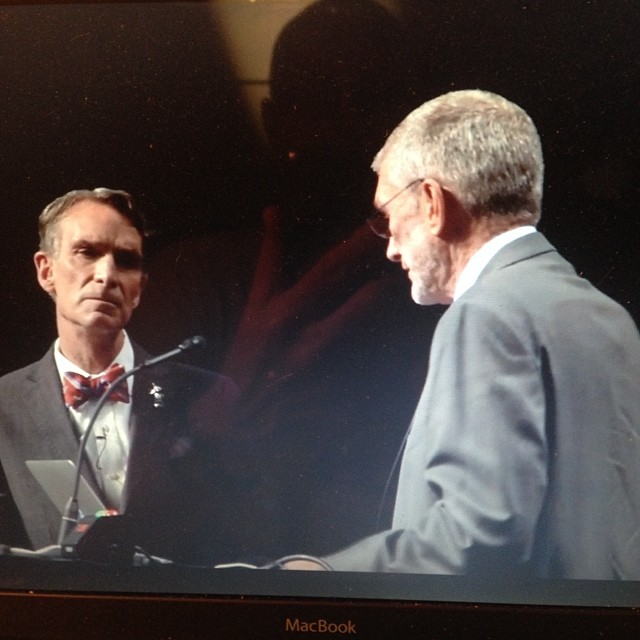
Bill Nye listens carefully as Ken Ham makes the claim that the Bible is a better source of fact than material science

Bill Nye listens carefully as Ken Ham makes the claim that the Bible is a better source of fact than material science

It appeared from watching the “debate” between creationist Ken Ham and scientist Bill Nye that Ham wanted desperately to prove science wrong about everything.

But a funny thing happened on the way to the conclusion of the so-called debate. Ham never mustered the ability to answer simple questions that would have proved creationism has any sort of relationship with science. His entire contention rested on the contention that the Bible must be understood “naturally” in order to understand the world. That is, the parts in the Bible Ken Ham judges to be crucial to a literal interpretation of scripture must be abided to the letter. The other parts, such as the “poetry” of Psalms, according to Ham, actually have no real bearing on the role of the Bible as science. Wow. That’s a whopper.

Yet that is the biblical foundation of Ken Ham’s creationist worldview. It begins with a denial of a significant portion of the Bible’s verity. Creationism literally starts with the assertion that not all the Bible can be trusted as fact.

And that’s just the starting point of a confused, frustrating and inaccurate worldview. Ken Ham seems to misunderstand and completely disregard the nature of what Christians call the New Testament. In fact he makes very few references to Jesus in any of his assertions about creation.

He certainly never mentions the methods by which Jesus himself taught by using organic metaphors. In simpler terms, Jesus used symbols from nature to illustrate spiritual principles. That way everyday people could comprehend what he was trying to teach about the nature of God.

But Ken Ham can’t seem to grasp or embrace that style of teaching, about nature, or about science. He prefers instead the literal view of scripture. His motive appears to be focused on leaving no room for interpretation. He is a zealot about that.

Of course that is the very same legalistic approach used by the Pharisees, leaders of the faith in Jesus’ day. He branded them a “brood of vipers” in clear reference to the Genesis depiction of Satan as a serpent.

You don’t have to take that reference literally to get the message. Jesus would not have liked Ken Ham. Jesus would have knocked the Creation Museum to the ground because it is a crass attempt to control the faith and belief of people through legalistic force and deception.

So the truth speaks for itself. Ken Ham is at odds with Jesus Christ, God’s only Son. Ken Ham considers Jesus’ method of teaching with metaphors inferior to his own brand of truth based on narrow interpretations of a book written 2000 years ago, conveyed originally as oral tradition and translated multiple times.

The simpler, more clear understanding that Jesus gave to all those who would listen is not good enough for Ken Ham. Jesus would gladly have accepted the findings of science.

Jesus said God is nature, and nature is God. All things worthy of consideration can be discerned through that simple statement. Anything else is fiction, or worse, a lie about the Word of God. And God is never happy about that.

On why we should all read about faith and what it means to the world

Lutheran School of Theology Chicago

Lutheran School of Theology Chicago

By Christopher Cudworth

Sitting in the admissions office of the Lutheran School of Theology in Chicago felt right.

A little more than two years ago a young man that had served as our church Youth Pastor had invited me to visit the school. “I think you’d like it,” he told me.

Our conversations as he prepared to leave his position at the church and begin studies to become a Lutheran pastor had centered on ministry to high school students, yet over coffee one morning the topics widened. I explained the process of writing my book, “The Genesis Fix: A Repair Manual for Faith in the Modern Age,” and how it changed the way I viewed writing about, and reading about, faith in the world.

The experience of trying to get an agent for the book had taught me a few things. The theme was the same with every contact. “You’re not a minister. You’re not a college professor. What credibility do you have to write such a book?”

Credibility is important. It gives people a foundation upon which to trust what you write. The process of earning credibility can also challenge the manner in which you arrive at your conclusions.

Regarding Masters

The message stuck with me. Despite the fact that I had spent 7 years researching and refining the book, it was true. I was not technically qualified to write it. Not in the eyes of those who make such decisions anyway.

It’s not enough that your friends call you “courageous” for taking on biblical literalism as a worldview. You must vet your viewpoints in the theological world before tearing away the dogmatic garments of the modern day Pharisees who stand in opposition to so much practical truth.

Simple truths and basic contradictions

Yet it’s a simple fact really. Biblical literalists stand in opposition to the teaching methods of Jesus Christ, who consistently used organic metaphors to convey spiritual truths through parables designed to bring the common mind to faith in God. Ignoring that principle is basically a slap in the face to Jesus. It’s like telling him, “You don’t know what you’re doing. Don’t you know that God’s Word must be taking literally or it has no meaning at all?”

While classic, the old ways of thinking may not be sufficient for a new world. Nor have they ever been.

While classic, the old ways of thinking may not be sufficient for a new world. Nor have they ever been.

Actually the community of believers who take the Bible literally never actually get close to discussing the teaching methods of Jesus. They’re stuck way back in Genesis and a literal 7 days, an Adam and Eve that were transmogrified from the dust of the Earth and a Serpent or Snake who tricks Eve and then Adam into disobeying God’s warning not to eat from the Tree of Knowledge. Of course we all know the story. Adam and Eve fall for the Serpent’s logic, thereby causing the Fall of Man.

Bad Beginnings? 

Original Sin is the pet concept that emerges from that creation story. But that quick-take worldview ignores a key aspect of the tale. What we miss by taking the story literally is the Serpent’s methodology in tricking Adam and Eve. In a crafty use of the first brand of scripture known to Man, the Serpent engages Eve in legalistic use of God’s own words to undermine her trust in God. Here is how the ploy works:

Christianity is not entirely clear on what the "serpent" really is, or looks like. So how can we take such a creation story literally?

Christianity is not entirely clear on what the “serpent” really is, or looks like. So how can we take such a creation story literally?

The Serpent’s Deception
3but from the fruit of the tree which is in the middle of the garden, God has said, ‘You shall not eat from it or touch it, or you will die.'” 4The serpent said to the woman, “You surely will not die! 5“For God knows that in the day you eat from it your eyes will be opened, and you will be like God, knowing good and evil.”…

How very similar is this exchange to the passage in Matthew 15 in which Jesus engages the Pharisees over the issue of turning the Word of God into a legalistic trap:

1Then some Pharisees and teachers of the law came to Jesus from Jerusalem and asked, 2“Why do your disciples break the tradition of the elders? They don’t wash their hands before they eat!” 3Jesus replied, “And why do you break the command of God for the sake of your tradition?

The comparison between literalism and legalism is given a direct connection to the Serpent in the Book of Genesis in Matthew 23:33, “You snakes! You brood of vipers! How will you escape being condemned to hell?”

It is a sad fact that today’s adherents to biblical literalism are playing the same game that Pharisees played with Jesus so long ago. Yet the pain and misdirection caused by today’s brand of scriptural literalism is just as potent as that depicted in Genesis with deception by the serpent, and just as power-mongering as the Pharisees of the New Testament.

And that is the point from my motivation to attend a school of theology emanates. I believe the most important thing in the world right now is to counter biblical literalism and all its awful consequences. Literal interpretation of the Bible is being used to persecute gays, to resist legitimate science, to argue against the theory of evolution and to undermine political and ethical justice on a broad spectrum of issues.

Reason and Reasons
It’s not about a mid-career change for me, or anything prosaic as that. It’s about finding ways to make the world a better place. Martin Luther changed the world by pointing out the very simple fact that we are saved first and foremost by grace. The new reformation should finish the job of removing all barriers from our acceptance of grace.

Yet we also need to define what it means to exist within and attend to the Kingdom of God. How we understand the nature of that “kingdom” is crucial to our stewardship of creation. The dangerously ironic consequence of a worldview founded on biblical literalism is the attitude that nature and all of creation is essentially a disposable tool of God, one that has no purpose other than our own somewhat greedy sustenance and no other significance than as a temporal stage between Creation and Armageddon.

Challenges

We can do better than old ships and sails of theology. And we should.

We can do better than old ships and sails of theology. And we should.

We need to challenge this fatalistic worldview at its very roots. That begins with the misinterpretation of Genesis as a literal document. Yet it also extends to our regard of scripture as a wholly inerrant document. It simply isn’t, that way. Any faith dependent on that premise is brittle, frail and sad, thus requiring a defensive posture to sustain.

The book of Romans 1:20 contains a telling point of scripture, one that reveals the idea of organic fundamentalism, the key understanding that nature itself, and our metaphorical understanding of it, holds keys to our comprehension of God and all that we read in scripture:

Romans20 For since the creation of the world God’s invisible qualities—his eternal power and divine nature—have been clearly seen, being understood from what has been made,  so that people are without excuse.

Nowhere in this passage, or any other in the Bible for that matter, does it say that we must take a literal approach to conceptions of God. In fact as demonstrated by Jesus himself, we are to do the opposite.

Recall that literalism and legalism produced the approach that one could earn the way into heaven through God works doled out by the church and vetted by leaders who earned earthly power through the system set up by the brand of Pharisees leading the Catholic church at the time.

Then along came Martin Luther, who saw through the giant ruse of literalism and legalism, and who launched a Reformation that transformed the faith, made it new again. We can view this passage in a fresh light in contradiction to the brand of literalism now vexing the world.

Nature and eternity are foundations of the Bible

There is more to the theological landscape than meets the eye. Creativity, not just creation, is part of scripture. Click for larger view.

Ephesians 8 For it is by grace you have been saved, through faith —and this is not from yourselves, it is the gift of God— 9 not by works,  so that no one can boast.

For there are many who “boast” that their literalistic view of the bible constitutes the “works” of real Christianity. Yet we also know that God’s invisible qualities are visible in Nature, and through the Word, and that there is no excuse for ignoring these greater, most important facets of faith realized.

And that is why the pursuit of truth is so important to me, and why sitting in the office of the Lutheran School of Theology in Chicago felt so very good, and so very real. Because each Reformation has to start somewhere. We all play a part in the heart of faith.

How preteens evolve into thinking human beings

photoAt some early age it entered my head that perhaps everyone around me was in on a secret. That I was the only one that thought as I do, and that even my parents were putting me on, big time.

I worried that I was not a “normal” person.

It happened again to some extent when I was 13 years old. That’s the age when your interests begin to collide with the world, and that’s a dual problem because your interests when you are in middle school tend to be really intense, sometimes nerdy and ridiculously easy to ridicule.

My interests happened to be all over the board, from art to nature, but one avocation got me in trouble with my friends who all seemed to think birdwatching was stupid, silly and less than manly. They made up bird names with obscene roots and laughed when I told them I’d identified a certain species of importance to me.

Resilience

To my everlasting credit, I never let the teasing stop me from pursuing any of my interests, even at the vulnerable age of 13. Now the same people who used to ridicule will call with a “bird question” when something unexpected shows up at their feeder, or they see a bald eagle along the river. The enthusiasm they now show for such things is a much-delayed apology for the abuse long ago.

As an adult I was asked to teach Sunday School for the middle schoolers because no one else wanted to take on the task. I liked it. Working with a series of teacher-partners over a 12-year period, it was fascinating to see the variability in maturity and self-awareness among preteens.

Sleepy minds

Many Sunday mornings they’d arrive sullen and bored, aching to get back to their sleepy beds where the rest of the world could not reach them. But reach them I did.

The church absentmindedly neglected to shove some curriculum my way for years and years. The parents did not complain about my teaching so everyone must have thought it was working out okay.

Little did they know that Sunday School was a perfect place to get those preteens thinking about what matters in life beyond the Bible. Sure, we always talked about scripture in a roundabout way. I’d always have an idea to discuss and would bring them around to the topic by asking what they’d done during the week and even how they felt about it. They deserved that attention. The minds of preteens seem to be largely ignored by this world, as if they have nothing of value to say about it. But the world would be wrong about that. It always has.

The example of Jesus

You may recall that it was a preteen Jesus (about age 12) who stayed behind at a temple when he was supposed to be following his parents back home after a visit to the city. This is what transpired:

46 After three days they found him in the temple courts, sitting among the teachers, listening to them and asking them questions. 47 Everyone who heard him was amazed at his understanding and his answers. 48 When his parents saw him, they were astonished. His mother said to him, “Son, why have you treated us like this? Your father and I have been anxiously searching for you.”

49 “Why were you searching for me?” he asked. “Didn’t you know I had to be in my Father’s house?”[a] 50 But they did not understand what he was saying to them.

51 Then he went down to Nazareth with them and was obedient to them. But his mother treasured all these things in her heart. 52 And Jesus grew in wisdom and stature, and in favor with God and man.

Echoes of Christ

In many ways that scene was replayed among the preteens who entered the middle school Sunday School class. They had ideas. They wanted answers. They asked questions and to the best of my ability I answered their questions or encouraged them to find answers, and at all costs.

That church did not preach tolerance for science, yet several of my former students went on to become chemical engineers and biologists and other occupations whose educational processes effectively denied what that simpleton religious worldview maintained.

Rational faith

You may ask why I remained a member so long (25 years) and I can answer that my rational faith survived outside of that venue, but was sustained by the fellowship that came through membership. I am now a member of a church that respects rational thought and yet embraces full discipleship as a matter of practice. In other words, a church that actually teaches what the Bible says to do. Instead of denial like the Pharisees and legalistic practices, my current church loves this world with all its heart, as an expression of creation, but not as an exclusive Creation that cannot be understood or appreciated by the human mind.

That’s what I taught all those years, and what it taught me in return was that the middle school, preteen mind appreciates honesty and respect. If you don’t give pat answers, it doesn’t feel like you’re patting them on the head, telling them to go away and quit thinking. For themselves.

Leadership 

One year I had as students three young women that each vied for the title of Valedictorian at their respective high schools. Keeping them engaged was not that difficult, but keeping the rest of the class in pace with their challenging minds was interesting at times.

Yet it happened. The other kids knew and appreciated true leadership and intellect when they saw it. The girls in return were not disrespectful of their peers. Even those who were brought to the church by bus from underprivileged families participated in the discussions. I often thought about how much those women brought to the table, and the fact that women were not allowed to assume positions of full leadership at that church. It bothered me. So I ignored that example and let them be leaders.

It was proof to me that the Kingdom of God, if that’s what you call it, can embrace the rich in mind and the poor in spirit alike. The principle benefit was, in the end, an open regard for the preteen mind that perhaps they would never have experienced if shielded from the concepts we discussed in biblical context. Those were evolution as well as salvation. I told them there was no reason why the Bible and science could not be reconciled. I told them Jesus was the original naturalist. He used organic symbols in his parables to convey spiritual principles. Later I wrote a book and continue a blog about that subject and more.

Other subjects

We talked about fame and deception, hope and depression. We talked about their lives and encouraged them to keep the confidence of others. Basic human respect was at play at all times.

And we talked about Jesus. Not the Jesus of the Sunday School curriculum that sails around the landscape working miracles. We talked about the Jesus who cried and prayed in the Garden of Gethsemane, abandoned by his friends. We considered what that meant to be alone, to feel alone.

Then we talked about what it meant to be normal in this world. To have fears and feelings that you poorly understood. To be worried about what others thought about you and about how adults don’t have all the answers. Those were just some of the things discussed with those preteens. They just wanted to know what it meant to be normal, and what it meant if you chose to depart from those norms on your own.

Jesus was a helluva an example on what it meant to go your own way. It has costs, but sometimes its worth it. Not being normal, that is.

Thinking back on Santa Claus

Image

On the day after Christmas it is not uncommon for many of us to raise our heads and wonder, “What the Hell Just Happened?”

And, who the Hell is Santa Claus, really? 

That’s the question we never asked as kids. We did not care. Santa brought gifts. That’s all we wanted from the dude. 

Other figures

Of course, the same thing goes for many great religious figures, as well. The Catholic Pope, for example, has proven to be an enigmatic symbol for the faith over the ages. Some popes are conservative. Not many are considered liberal. Yet the very ideas upon which Christianity is founded are liberal in foundation, if not practice. It can be hard to tell who to believe, and what, once religion becomes dogma. 

Questioning beliefs

Recently The Catholic Church has enjoyed a higher and possibly more positive profile thanks to the fresh outlook of Pope Francis, champion of the poor and provocative advocate for the disadvantaged in general.

But the Vatican has some catching up to do, and plenty of company in the indulgence of overreaching with its religious authority. Of course populist religion can be just as overbearing and at times ridiculous in its efforts to create and control the doctrinal status quo.

Beating up on Harry Potter

You may recall that when the Harry Potter book series by J.K. Rowling became popular, some Christians took offense at the notion of children reading about wizardry and witchcraft. While librarians and educators across the country celebrated the fact that so many children had returned to reading through interest generated by the Harry Potter books, a few vocal Christians called for a ban on Harry Potter material because the books contained “magic, sorcery” and other material deemed to be “anti-Christian.”

What the anti- Potter clan fails to mention is that the Harry Potter books contain no more magic, wizardry and witchcraft than a similar series of books by C.S. Lewis, the Christian apologetic writer who authored the Chronicles of Narnia The Narnia books depict a world where witches rule, animals talk and a giant lion repeatedly rescues a band of children who achieve the status of royalty––a most undemocratic result. The seven books in the series combine to form an engaging fantasy that can be read as simple adventure stories or analyzed for spiritual symbolism in the characters. But there is no escaping the fact that sorcery and magic play a major part in the plotline where talking animals, transfigurations, dragons and Deep Magic figure prominently.

Belief bait

Author C.S. Lewis wrote the Chronicles of Narnia in a literary form that conveyed Christian values in a fantastical manner, the better to interest children. Christian apologists might argue that even though sorcery exists in the Chronicles of Narnia stories they should be given a pass because the plotline hews closely to the Passion Story of Jesus Christ. The main character in the Chronicles of Narnia is a lion named Aslan who sacrifices himself to save the world.

 Hobbits and Rings

J.R.R. Tolkien, author of the Lord of the Rings Trilogy, was a collegiate classmate of C. S. Lewis, who used similar standards in writing the Lord of the Rings trilogy. Tolkien’s work which features magical elves, wizards and mythical creatures throughout. There is no question sorcery plays a major role in the plot line of Rings Trilogy, yet when movies based on the Tolkien works hit theaters, Christian scholars scrambled to highlight the spiritual message, not the sorcery it took to achieve victory in the end. It seems that when secular literature plays on fantasy, magic and sorcery, it is some kind of sin. But when books with apparently Christian underpinnings do the same, they get a pass. This double standard ranks as hypocrisy.

 Moral messages

The message that good conquers evil in the Harry Potter series matches that of the Narnia and Rings series. And since everyone in the Harry Potter series is doing magic, it cancels out the supposedly mythical advantage of being able to wave a wand to save the day. The issue of consequence may be that Harry Potter gets as much help solving problems from his associates as he does from some metaphysical force that can be equated to God. Perhaps it is the practical, humanist message of personal autonomy and self-actualization that is most offensive to Christian apologists.

Education matters 

There is a practical and valuable solution to these literary conundrums, and that is education. Any person who is taught the basic laws of science and physics knows that the type of magic in metaphysical trickery has been long proven to be impossible. This fact alone proves the Harry Potter books are based on fantasy. Yet the books honor a healthy and vital aspect of childhood: imagination.

Of course the religious apologist who believes strongly in miracles cannot logically explain why magic should be impossible for Harry Potter yet possible in the Bible.  This is where the worldviews of literary metaphor and biblical literalism collide. The advocates for biblical literalism would just as soon murder the apparently faithless fantasies of Harry Potter than be forced to prove the validity of their own set of miracles to the culture at large. In this way the evil riddle of literalism muddles the otherwise separate worlds of fact and fantasy, undermining the natural order of rational determinism founded on common sense, discernment and logic.

And who abided by that last bit of common sense? Why, none other than Jesus Christ himself, whose parables contained organic imagery that served to illustrate spiritual truths. 

Metaphor rules

As for the lyricism of Christmas itself, there is little harm in indulging a child’s fantasy, to a point. The legend of Santa Claus used to enliven the Christmas season is a case in point. Santa Claus is nothing more an overgrown magic elf with the power to fly, squeeze down chimneys and conjure Christmas presents at will. Talk about your potentially dangerous fantasies! Yet children sooner or later figure out that Santa Clause is not real, a rite of passage for many. The innocent game of charming children with the surprise of gifts that arrived in the night is a cherished tradition for many families.

But if you really analyze the Santa Claus myth, it is as goofy, fantastical and full of magic as Harry Potter. Yet the same people who willingly accept magic as harmless fantasy in association with their religious holiday somehow refuse to accept the role fantasy plays in literature and deem the Harry Potter series evil.

The propensity to project evil on the world is a hallmark of biblical and religious literalism. The most common targets happen to be competing story traditions. Meanwhile the implausible exaggerations of biblical storytelling are excused from critical scrutiny under protection of their exonerated status as “scripture.” Biblical literalism can be a pretty prejudicial worldview. Worse yet, it pretty much confuses the issue of truth no matter how you look at it. 


Portions of this blog post are excerpted from The Genesis Fix: A Repair Manual for Faith in the Modern Age by Christopher Cudworth

A Duck Dynasty we could do without

Common Goldeneye ducks in a group of 3 males and one female.

My brother and I often trespassed in our backwoods exploits. On a particular fall day we entered a private marsh near the entrance. It was there that a peat mining operation stored a rickety-looking crane. It stood awkwardly by a galvanized metal quonset building covering a concrete slab.

The peat miners worked the far northern end of a property called Nelson Lake Marsh. There were long shallow pits where the peat had been stripped away and sold. They rolled the crane in and out of the marsh on a raised gravel bed fortified by metal strips to keep the weight of the heavy machine evenly distributed. The huge metal treads of the crane clanked and rolled as it worked, an archaic and somewhat anachronistic operation it was.

The peatmining road followed the foot of a shallow hill on the west side of the marsh. That hill was covered by a stand of burr oak trees, beneath which grew verdant wildflowers in spring. This was a former savanna habitat, not timbered in more than 150 years. The trees growing there were thick and gnarly. From a distance they formed a thick dark wall behind the long course of cattails reaching north to south.

As my brother and I walked the road to the main body of water, we kept an eye out for the property owners, who would likely throw us out if we were caught. It was close to a mile’s walk along the west woods to reach the point where a small wooden shack stood among the cattails. From there you could see a series of well-constructed duck blinds along the south side of the lake, which swung to a southwesterly direction, almost as if the wind had suddenly come up and blown it that way.

The wind could be fierce over the lake on the wrong day. But on an early October day with sunlight popping the last of the green grasses into high relief a light breeze was fine company.

Duck heads on a wall

We reached the wooden shack to find a pair of shallow boats resting upright, drying from their duty on the previous day’s fall duck hunt. Inside the cabin we found 10-12 duck heads nailed to the wall. These were indicators of what had been shot on the lake so far that fall.

There were wood duck and gadwall, mallard and pintail and even a black and white scaup head. My brother and I studied the duck heads closely. Our access to real creatures was prized. My brother was a trapper and fisherman, and we both birdwatched. But neither of us was a duck hunter. We didn’t own guns.

Fall focus on ducks

We carried binoculars instead. Everywhere we went.

Our birding life lists grew rapidly. Sites such as Nelson Lake Marsh were treasures of yet undiscovered species, including American and Least Bittern, Sora and Virginia Rail. The rare sighting of a yellow-headed blackbird this far east in Illinois was also treasured.

But in fall we focused on the ducks. There were mergansers; Hooded and common, and redhead, canvasback, ruddy ducks, baldpate (wigeon) black duck, shoveler and two kinds of teal, blue-wined and green-winged. More than 20 species of ducks passed through in migration.

I also recall a green-winged teal head nailed to the boat house wall as well. The tiny cinnamon head had an emerald eye patch lined with yellow. The colors were riveting, even more beautiful up close than either my brother or I could imagine. That is why we loved birds. The diversity.

If duck gizzards could talk

Later in my birding career I studied field biology in college. We learned how to do taxidermy on ducks. We also learned that many species of waterfowl were suffering a malady that turned their gizzards green with poison. The lead shot used by hunters was being ingested and it sat in their crops until the lead leached into their bodies. Lead poisoning.

It was the first time I realized that a seemingly innocent American past-time likc duck hunting could have such an insidious consequence. It was also entirely preventable but for the selfish priority that lead shot gave hunters better aim. It enabled them to kill more ducks. As it turned out, that fact was true, twice over.

I saw the consequences of lead shot up close, and first hand. Perhaps it even made them fly slower, making them easier targets for hunters. It was sad to realize that lead poisoning made ducks sick and countless of them must have died slowly and silently, collapsed in the marsh where they would not be found. But they might be eaten by other creatures, a fox or coyote perhaps, who would also slowly absorb the perils of lead poisoning.

Critical disadvantages

Life and death works through critical disadvantages, and nature too. On both the biological and social level, it is the slightest disadvantage that can cause destruction of an individual. If the disadvantage is broad enough t0 impact an entire population, the whole species can suffer and even disappear.

If that disadvantage is forcibly or even casually imposed among creatures aware of its presence, but disavowed of even casual concern, it is certainly not a just or human level of behavior. In fact it is plainly immoral to cause suffering to fellow human beings, then claim it is your right.

Suffering that is caused unwittingly or by neglect is no better than that which is intentional. We should recall from the Bible the passage in which Jesus lectures a group of people who are asking questions about how to treat others. 37 “Then the righteous will answer him, ‘Lord, when did we see you hungry and feed you, or thirsty and give you something to drink? 38 When did we see you a stranger and invite you in, or needing clothes and clothe you? 39 When did we see you sick or in prison and go to visit you?’

40 “The King will reply, ‘Truly I tell you, whatever you did for one of the least of these brothers and sisters of mine, you did for me.’

So much human suffering is the product of force of habit or traditions that favor one element of society or another. We’ve been through that with slavery in America, which bled into racial discrimination that continues to this day. We’ve seen it in centuries of persecution toward the Jews on basis of egregious interpretation of the Bible that makes them scapegoats for the death of Yeshua (or Jesus). First it made the Jews target practice before the Crusades. Then it contributed to the mindset of Holocaust.

Poison parallels

The allegory of poison shot is therefore profound. Prejudice and discrimination are essentially the lead shot of society. They may not cause death and disadvantage right away, but they can. And when left “out there” they are a slow and deadly poison to the soul and body of others.

The unrecognized tragedy of this poison is that the lead shot of prejudice essentially kills both the hunter and the hunted. It kills the hunter through accumulation of hatred, which rots the soul. It kills the hunted by penetrating the body and mind, killing people from the inside out.

So when people like Phil Robertson of the television show Duck Dynasty go shooting their mouths off with the lead shot of discrimination, hatred, intolerance and prejudice, it poisons our whole society. That type of poison, even disguised as free speech or religious liberty, is ultimately ingested by innocents where it rots their proverbial gizzards from the inside out.

Lack of progress

On both an allegorical and practical basis, it is interesting to note that the use of lead shot in America has still not been banned altogether. We’ve long known that lead kills. Lead paint is banned from use and yet children still ingest the stuff in old homes and cleanup can be costly. There are some that speculate that it was lead pipes that contributed to the fall of the Roman Empire. 

Lead shot

We should ban lead shot completely. Yet the gun lobby has successfully protected against banning lead shot. It’s as if the freedom to shoot straight should trump any ill consequences and poison that lead ammo brings upon the environment. It’s really a sad, sick commentary on priorities that a tradition known to be dangerous should be protected by those who selfishly profit from it.

That is the real Duck Dynasty at work in America. It’s a different kind of Duck Dynasty than a bunch of charming rednecks squawking and then praying their way through life as they get rich off the cumulative ignorance of others. It all transpires with a wink and a nod behind the scenes. And it has to stop.

Money and free speech

Free speech is all too often about money. That’s what the real Duck Dynasty is all about.

When Phil Robertson rips homosexuality from a position of moneyed prominence, he is abusing the right to free speech by poisoning the environment for others. That truly is the type of talk that rots the nation from the inside out. And just as lead shot rots the gizzards of the wild ducks upon which men like Phil Robertson have made fortunes, his toxic words lurk in the environment and poison the parlance upon which we all depend for survival. You need to understand that people gobble this stuff willingly, as if it were the food of the Gods. Fame is the toxic spoon of culture.

The fact that people like Sarah Palin call such toxic words “free speech” and complain publicly about restrictions on what amounts to hate language is a sign of the level of poison to which our nation has too long been accustomed. It’s almost as if Palin is saying, “If you don’t like our beliefs, then you’d better duck, because we’re going to shoot off our mouths and engage in hateful language no matter who it hurts.”

You can read it either way. “Lead poisoning” can be read as “lead” or “led.” When it comes from leaders who don’t understand the toxic shots they take at society, it kills.

Endangered species, endangered souls

Lead shot is now, finally, being banned in many parts of the country because it kills more than ducks. Even endangered California Condors wind up ingesting lead shot, poisoning themselves as result.

Our allegory comes full circle, you see. Even a seemingly innocent guilty pleasure like a Duck Dynasty comes with risks when you ignore it’s full portent. The things we casually consume really can hurt us as a nation.

Yet some people will tell you that such “political correctness” goes too far, or that the “Nanny State” is to be avoided at all costs. But those are the rationalizations of the privileged, and also the cloying attempt of the weak-minded to align themselves with people in positions of power. We need to demand better from ourselves. But you can always expect a threat and a fight in return for any attempt at wiser morals and accountability.

Guns pointed at me

But let us pause for a moment, and consider a subtle variation on the theme. Because all perspectives deserve consideration.

For example, my own intersection with duck hunting took some strange turns over the years, and it taught me a few things.

I recall walking the Nelson Lake March property once it was purchased by the country. Much of the land surrounding the near shore of the march had been purchased except east hill and the south shore where the duck blinds remained. That meant in fall there was still legal hunting. I could easily hear the repeated shotgun pops from the reed-stuffed blinds on the far shore. Sure, it was a romantic scene, and I never had anything against the hunters. Some days I thought it would be fun to join them.

But once I heard shot plopping in the cattails around me, it made me wonder how much longer the tradition of hunting the lake could safely carry on.

There were also hunters who perched on a hill on the north side of lake where the property was still being farms. Once the corn or beans were harvested, hunters would set up jump blinds and shoot ducks that lifted off the lake into the north wind.

The low land below that hill was by them owned by the county. As I walked through an area where glacial seeps made great habitat for rail and snipe, a pair of hunters sat sullenly in their camouflage gear above me, staring at me with a barely concealed rage. In their eyes I was invading their turf, getting between them and the ducks and geese they hoped to shoot.

It was a strange and awkward situation, because they had every right to be where they were, but so did I. That had an odd requirement to shoot straight up to avoid knocking out ducks that landed on public property. But the situation did not last long. Just a couple seasons.

Soon enough the county bought that farm as well, then the south shore. All that was left to hunt was one last bastion, a farm on the east side of the marsh.

And sure enough, one morning I was walking that side of the park looking for birds when a voice rose from the thickets above me. “Get the F*** off my land,” the voice demanded. “Before I shoot your F****** head off.”

Transitions

The park line was in that area was still ill-defined, so I moved quickly toward the lake, walking backwards as the hunter pointed his gun muzzle in my direction. I’m sure some people might have approved him shooting me in the chest at that moment.

All I could think was that the Lord’s Prayer tells us to forgive our trespassers, as we forgive those who trespass against us.

It was a bitter and difficult moment, because I empathized with the duck hunters at that point. I always had. A longstanding tradition was slowly being erased. You can hardly blame the hunting community for being a bit peeved in having its shooting rights slowly taken away.

But it came down to a numbers game. Either the marsh and all its inhabitants could be protected for environmental reasons and the public good, or it could remain a private reserve owned and used by a lucky few. The public good ultimately won out. Now thousands of people per year visit what has become Dick Young Forest Preserve, named for the man who patiently chronicled its rare plant communities. A team of us birders conducted surveys for a decade to fill in the picture of wildlife and birds seen on the site. It is one of the most popular recreation areas in Kane County, Illinois. So the common good has been served.

Changing traditions

Sure, in some ways it hurt to lose the old ways. We romanticize them. But in some cases, lose them we must.

That may someday also mean a permanent ban on lead shot to keep animals from being poisoned. And on a cultural level it may mean demanding that people temper the impact of their poison language, for the times really are changing, and for the better.

The dynasty of prejudice and selfish discourse has a long history, but it has been a dynasty long enough. The words of Phil Robertson are the echo of a poison interpretation of the Bible that refuses to recognize that we no longer take significant parts of the Bible literally, and that it should not be regarded as infallibly composed or regarded as literal truth. It the Duck Dynasty still believes that, then it deserves to fall.

Society is about much. much more than nailing duck heads to the wall.


CPAC, Republicans and aggressive stupidity in politics and religion

FlagWaiver

Aggressive stupidity is wearing us all out.

Another round of CPAC madness is nearly through in America. A parade of Republican zealots highlights the speaker list, with Grover Nordquist standing proudly at the front of the line proclaiming that any Republican who agrees to tax increases of any sort “are rat heads in a Coke bottle. They damage the brand for everyone.”

How is it that Nordquist fails to see himself as the rat in the bottleneck of Republican common sense?

And how interesting that another CPAC attendee, Governor Bobby Jindal of Louisiana–himself a possible presidential candidate in 2016–once said of Republicans, “We’ve got to stop being the stupid party.”

Jindal has been castigated for that remark, of course. It is not in the nature of conservatives to admit they might be wrong or stupid about anything.

What wrong looks like

Even when proven desperately wrong by enaction of their own nation-devastating (America and Iraq, to name a couple) policies during the horrid debacle of the George W. Bush/Dick Cheney years, Republicans would not find any ground for confession that their whole ideology might just be aggressively stupid. Even when conservatives ruled all three wings of government, things didn’t go right. Bush racked up a trillion dollar bill for his wars of choice that America can’t pay off. We’re still borrowing to pay $2B a month to mess around in Afghanistan. So what do Republicans do? They point fingers at social insurance policies such as Social Security, Medicare and Medicaid as the problem as if saving older people from destitution and medical disaster costs a nation more than war. 

Bad habits

Aggressive stupidity is a bad habit that can be fixed. But it’s hard, like shaking alcoholism or more accurately, a gambling addiction. Aggressive stupidity is a gambling addiction, to be precise. You are gambling that your brand of stubborn ideology, if backed by sufficient bets on the table, will win the day. Of course that’s been America’s global defense policy for decades. We now spend more on defense than the next 17 nations combined, and in many ways are less secure than ever. Yet here was Mitt Romney standing before the CPAC and insisting that Republicans put a powerful US military at the top of their agenda. “Do whatever you can to keep America strong, to keep America prosperous and free and the most powerful nation on earth.” Rah rah Mitt. That’s what got you where you are, buddy. A loser claiming you had all the right ideas. 

For perspective, that statement by Romney pretty much fulfills everything President Dwight D. Eisenhower warned Americans about when he cited the evils of the military/industrial complex as our worst enemy. The idea that we cannot be free without killing everything in sight is ludicrous, expensive and costly to the American spirit.

Killing ourselves in the name of the Constitution

It was recently learned that more Americans have been killed in their own country by gun violence than in all the wars ever fought by the nation. Yet we are locked in a battle over Second Amendment rights that Republicans use as a blunderbuss to cow a bunch of ignorant, one-issue voters into thinking Democrats are going to take away their guns. And when reasonable gun control laws are proposed, such as required background checks, Republicans run for cover behind the blazing guns policies of the NRA, who could think of nothing better to do in the wake of the Newtown, Connecticut shootings than to stick a bunch of armed guards in every school in America, and force teachers to get gun training. And to arm the teachers.

That is aggressive stupidity. One feels no shame in calling out stupidity in such circumstances. There is no risk of insult when the stupidity is so glaring in so many cases. Republicans are not stupid people, although even the wealthiest were targets of the incisive wit of one Mark Twain, who warned us, “All is takes is ignorance and confidence, and success is sure.” The humorist knew that aggressive stupidity really can win the day.

Elections versus selections

And when Republicans lose as they did in the 2016 selection (it wasn’t an election, but a selection of Obama against aggressive Republican stupidity) the party can think of nothing other to do than find a way to cheat the system. So Republican governors are gerrymandering ways to stifle Democratic voters any way they can.

The conservative party is shrinking like a set of testicles in a cold wind. Their policies appeal mostly to rich white voters, who are aging, as well as the ignorantly disenfranchised brand of gun-toters and a huge block of fearfully religious bigots who can’t seem to understand that their own Bible contradicts everything their party stands for.

Coming out to common sense

God Bless Republican Senator Rob Portman, who came out in favor of same-sex marriage once he learned that his own son is gay. “I’ve come to the conclusion that for me, personally, I think this is something that we should allow people to do, to get married, and to have the joy and stability of marriage that I’ve had for over 26 years,” he told CNN. “That I want all of my children to have, including our son, who is gay.”

The Bible is wrong about homosexuality, just as it is wrong about slavery and hundreds of other former laws of religion that no one ever follows. Yet biblical literalists foment their brand of aggressive stupidity toward gay people with tired old contentions that homosexuality is a sin against God, and that being gay is a choice, a lifestyle, and to one all should be opposed. The Republican Party has embraced this brand of aggressive stupidity for years because it wins them votes, gains them power and makes them feel all righteous and true.

Until one of their own finds out they have a gay child. Even the Heart of Darkness Dick Cheney admitted that he loves his daughter and can’t persecute gays any longer as a result.

Not so cool

As for Portman’s position, Republicans were aggressively cool to his very personal admission that his life has changed for the better in accepting his son for who he really is. Politics trumps all other notions of sanity, you see. As quoted in a New York Times story, “A spokesman for Speaker John A. Boehner, who is also from Ohio, said Friday that while Mr. Boehner “respects” Mr. Portman’s position, “the speaker continues to believe that marriage is between a man and a woman.”

That’s a form of aggressive stupidity, Mr. Boehner. Because if we took a certain pronunciation of your name quite literally, we would be forced to believe that you are actually a turgidly erect member of Congress that has no conscience. Well what do you know. It turns out that some forms of aggressive stupidity do prove true in practice. Two can play the game Republicans like to play.

Pope Francis the contradictor

We’re even forced to consider the aggressive stupidity of the new Catholic Pope Francis I, who embraces the poor but opposes birth control. That so-called “position” makes no sense if you spend a moment considering how overpopulation vexes the entire world.

But what do you expect from a religious brand that demands its priests to be celibate, then denies their policies have any consequence when a scourge of child sex abuse infests the church. Birth control dictates are ignored by more than 90% of its members, some polls report, yet the church and its patriarchal brand of aggressive stupidity keeps on rolling with a pope that stands by the position that spending sperm in a condom is a bad thing.

Some history…

Well, has the Catholic Church ever been wrong before? They almost killed Galileo for sticking up for the scientific perspective on matters universal. Then there were the Crusades, and the Inquisition, and for a while there, an insistence that the theory of evolution is wrong.

Aggressive stupidity runs through the most powerful organizations on earth. It is the hallmark of psychopathy, the aggressive will to dominate and coerce and kill in order to have your way, and have it now.

I’ve got mine and I hate yours

It’s the “I’ve got mine and I hate yours” brand of politics that is gutting America. Yet here is the CPAC closing comment. “The popular media narrative is that this country has shifted away fro conservative ideals, as evidenced by the last two elections,” said Texas Governor Rick Perry, who when asked couldn’t seem to remember what programs he’d like to cut if he were president, “That might be true if Republicans had actually nominated conservative candidates in 2008 and 2012.”

The all-time king of aggressive stupidity, however is Rick Santorum. The man combines both dunderheaded conservative politics and a conservative catholicism that forces him to spew hate while pointing fingers at Americans who don’t think his way. He had this to say about why Republicans are failing so miserably at convincing Americans their way is the right way, “Face it, the left can always promise more stuff, and make is sound like they care more, because they make it easier for Americans by providing stuff for them, through government programs, paid by by somebody else’s money.”

Jesus loves you Rick. But he would tell you that you’re an insane hypocrite. Just like the rest of the aggressively stupid people who run your party and elections by running lies and manipulations up the flagpoles of country and God.