Ken Ham the Creationist versus Bill Nye the Science Guy proved a lot about how wrong Ken Ham has the Bible

By Christopher Cudworth

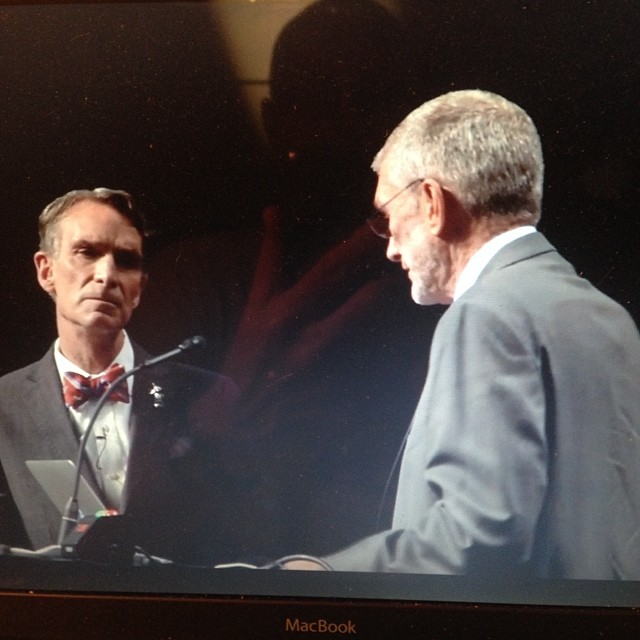
Bill Nye listens carefully as Ken Ham makes the claim that the Bible is a better source of fact than material science

Bill Nye listens carefully as Ken Ham makes the claim that the Bible is a better source of fact than material science

It appeared from watching the “debate” between creationist Ken Ham and scientist Bill Nye that Ham wanted desperately to prove science wrong about everything.

But a funny thing happened on the way to the conclusion of the so-called debate. Ham never mustered the ability to answer simple questions that would have proved creationism has any sort of relationship with science. His entire contention rested on the contention that the Bible must be understood “naturally” in order to understand the world. That is, the parts in the Bible Ken Ham judges to be crucial to a literal interpretation of scripture must be abided to the letter. The other parts, such as the “poetry” of Psalms, according to Ham, actually have no real bearing on the role of the Bible as science. Wow. That’s a whopper.

Yet that is the biblical foundation of Ken Ham’s creationist worldview. It begins with a denial of a significant portion of the Bible’s verity. Creationism literally starts with the assertion that not all the Bible can be trusted as fact.

And that’s just the starting point of a confused, frustrating and inaccurate worldview. Ken Ham seems to misunderstand and completely disregard the nature of what Christians call the New Testament. In fact he makes very few references to Jesus in any of his assertions about creation.

He certainly never mentions the methods by which Jesus himself taught by using organic metaphors. In simpler terms, Jesus used symbols from nature to illustrate spiritual principles. That way everyday people could comprehend what he was trying to teach about the nature of God.

But Ken Ham can’t seem to grasp or embrace that style of teaching, about nature, or about science. He prefers instead the literal view of scripture. His motive appears to be focused on leaving no room for interpretation. He is a zealot about that.

Of course that is the very same legalistic approach used by the Pharisees, leaders of the faith in Jesus’ day. He branded them a “brood of vipers” in clear reference to the Genesis depiction of Satan as a serpent.

You don’t have to take that reference literally to get the message. Jesus would not have liked Ken Ham. Jesus would have knocked the Creation Museum to the ground because it is a crass attempt to control the faith and belief of people through legalistic force and deception.

So the truth speaks for itself. Ken Ham is at odds with Jesus Christ, God’s only Son. Ken Ham considers Jesus’ method of teaching with metaphors inferior to his own brand of truth based on narrow interpretations of a book written 2000 years ago, conveyed originally as oral tradition and translated multiple times.

The simpler, more clear understanding that Jesus gave to all those who would listen is not good enough for Ken Ham. Jesus would gladly have accepted the findings of science.

Jesus said God is nature, and nature is God. All things worthy of consideration can be discerned through that simple statement. Anything else is fiction, or worse, a lie about the Word of God. And God is never happy about that.

On why we should all read about faith and what it means to the world

Lutheran School of Theology Chicago

Lutheran School of Theology Chicago

By Christopher Cudworth

Sitting in the admissions office of the Lutheran School of Theology in Chicago felt right.

A little more than two years ago a young man that had served as our church Youth Pastor had invited me to visit the school. “I think you’d like it,” he told me.

Our conversations as he prepared to leave his position at the church and begin studies to become a Lutheran pastor had centered on ministry to high school students, yet over coffee one morning the topics widened. I explained the process of writing my book, “The Genesis Fix: A Repair Manual for Faith in the Modern Age,” and how it changed the way I viewed writing about, and reading about, faith in the world.

The experience of trying to get an agent for the book had taught me a few things. The theme was the same with every contact. “You’re not a minister. You’re not a college professor. What credibility do you have to write such a book?”

Credibility is important. It gives people a foundation upon which to trust what you write. The process of earning credibility can also challenge the manner in which you arrive at your conclusions.

Regarding Masters

The message stuck with me. Despite the fact that I had spent 7 years researching and refining the book, it was true. I was not technically qualified to write it. Not in the eyes of those who make such decisions anyway.

It’s not enough that your friends call you “courageous” for taking on biblical literalism as a worldview. You must vet your viewpoints in the theological world before tearing away the dogmatic garments of the modern day Pharisees who stand in opposition to so much practical truth.

Simple truths and basic contradictions

Yet it’s a simple fact really. Biblical literalists stand in opposition to the teaching methods of Jesus Christ, who consistently used organic metaphors to convey spiritual truths through parables designed to bring the common mind to faith in God. Ignoring that principle is basically a slap in the face to Jesus. It’s like telling him, “You don’t know what you’re doing. Don’t you know that God’s Word must be taking literally or it has no meaning at all?”

While classic, the old ways of thinking may not be sufficient for a new world. Nor have they ever been.

While classic, the old ways of thinking may not be sufficient for a new world. Nor have they ever been.

Actually the community of believers who take the Bible literally never actually get close to discussing the teaching methods of Jesus. They’re stuck way back in Genesis and a literal 7 days, an Adam and Eve that were transmogrified from the dust of the Earth and a Serpent or Snake who tricks Eve and then Adam into disobeying God’s warning not to eat from the Tree of Knowledge. Of course we all know the story. Adam and Eve fall for the Serpent’s logic, thereby causing the Fall of Man.

Bad Beginnings? 

Original Sin is the pet concept that emerges from that creation story. But that quick-take worldview ignores a key aspect of the tale. What we miss by taking the story literally is the Serpent’s methodology in tricking Adam and Eve. In a crafty use of the first brand of scripture known to Man, the Serpent engages Eve in legalistic use of God’s own words to undermine her trust in God. Here is how the ploy works:

Christianity is not entirely clear on what the "serpent" really is, or looks like. So how can we take such a creation story literally?

Christianity is not entirely clear on what the “serpent” really is, or looks like. So how can we take such a creation story literally?

The Serpent’s Deception
3but from the fruit of the tree which is in the middle of the garden, God has said, ‘You shall not eat from it or touch it, or you will die.'” 4The serpent said to the woman, “You surely will not die! 5“For God knows that in the day you eat from it your eyes will be opened, and you will be like God, knowing good and evil.”…

How very similar is this exchange to the passage in Matthew 15 in which Jesus engages the Pharisees over the issue of turning the Word of God into a legalistic trap:

1Then some Pharisees and teachers of the law came to Jesus from Jerusalem and asked, 2“Why do your disciples break the tradition of the elders? They don’t wash their hands before they eat!” 3Jesus replied, “And why do you break the command of God for the sake of your tradition?

The comparison between literalism and legalism is given a direct connection to the Serpent in the Book of Genesis in Matthew 23:33, “You snakes! You brood of vipers! How will you escape being condemned to hell?”

It is a sad fact that today’s adherents to biblical literalism are playing the same game that Pharisees played with Jesus so long ago. Yet the pain and misdirection caused by today’s brand of scriptural literalism is just as potent as that depicted in Genesis with deception by the serpent, and just as power-mongering as the Pharisees of the New Testament.

And that is the point from my motivation to attend a school of theology emanates. I believe the most important thing in the world right now is to counter biblical literalism and all its awful consequences. Literal interpretation of the Bible is being used to persecute gays, to resist legitimate science, to argue against the theory of evolution and to undermine political and ethical justice on a broad spectrum of issues.

Reason and Reasons
It’s not about a mid-career change for me, or anything prosaic as that. It’s about finding ways to make the world a better place. Martin Luther changed the world by pointing out the very simple fact that we are saved first and foremost by grace. The new reformation should finish the job of removing all barriers from our acceptance of grace.

Yet we also need to define what it means to exist within and attend to the Kingdom of God. How we understand the nature of that “kingdom” is crucial to our stewardship of creation. The dangerously ironic consequence of a worldview founded on biblical literalism is the attitude that nature and all of creation is essentially a disposable tool of God, one that has no purpose other than our own somewhat greedy sustenance and no other significance than as a temporal stage between Creation and Armageddon.

Challenges

We can do better than old ships and sails of theology. And we should.

We can do better than old ships and sails of theology. And we should.

We need to challenge this fatalistic worldview at its very roots. That begins with the misinterpretation of Genesis as a literal document. Yet it also extends to our regard of scripture as a wholly inerrant document. It simply isn’t, that way. Any faith dependent on that premise is brittle, frail and sad, thus requiring a defensive posture to sustain.

The book of Romans 1:20 contains a telling point of scripture, one that reveals the idea of organic fundamentalism, the key understanding that nature itself, and our metaphorical understanding of it, holds keys to our comprehension of God and all that we read in scripture:

Romans20 For since the creation of the world God’s invisible qualities—his eternal power and divine nature—have been clearly seen, being understood from what has been made,  so that people are without excuse.

Nowhere in this passage, or any other in the Bible for that matter, does it say that we must take a literal approach to conceptions of God. In fact as demonstrated by Jesus himself, we are to do the opposite.

Recall that literalism and legalism produced the approach that one could earn the way into heaven through God works doled out by the church and vetted by leaders who earned earthly power through the system set up by the brand of Pharisees leading the Catholic church at the time.

Then along came Martin Luther, who saw through the giant ruse of literalism and legalism, and who launched a Reformation that transformed the faith, made it new again. We can view this passage in a fresh light in contradiction to the brand of literalism now vexing the world.

Nature and eternity are foundations of the Bible

There is more to the theological landscape than meets the eye. Creativity, not just creation, is part of scripture. Click for larger view.

Ephesians 8 For it is by grace you have been saved, through faith —and this is not from yourselves, it is the gift of God— 9 not by works,  so that no one can boast.

For there are many who “boast” that their literalistic view of the bible constitutes the “works” of real Christianity. Yet we also know that God’s invisible qualities are visible in Nature, and through the Word, and that there is no excuse for ignoring these greater, most important facets of faith realized.

And that is why the pursuit of truth is so important to me, and why sitting in the office of the Lutheran School of Theology in Chicago felt so very good, and so very real. Because each Reformation has to start somewhere. We all play a part in the heart of faith.

If Bill Nye the Science Guy debates Ken Ham over evolution and Genesis, things could get sticky as a spider web

By Christopher Cudworth

argiope6252a“Will you walk into my parlour?” said the Spider to the Fly,
‘Tis the prettiest little parlour that ever you did spy;
The way into my parlour is up a winding stair,
And I’ve a many curious things to shew when you are there.”

“Oh no, no,” said the little Fly, “to ask me is in vain,
For who goes up your winding stair
-can ne’er come down again.”

It’s a classic tale of deceit for advantage.  The spider uses an inviting scenario to invite the fly to the table, when in fact the intent is to make the fly a meal.

So goes the proposed debate between Bill Nye the Science Guy and Ken Ham, the leader of a group that calls itself “Answers In Genesis.”

We must start with the name of the organization to see how confusing this debate will likely be, or could become.

No Scientific Answers in Genesis

Evolution explains the structure and function of all living things. Genesis does not. It only deals with purpose.

Evolution explains the structure and function of all living things. Genesis does not. It only deals with purpose.

See, when it comes to science, there are no answers in the book of Genesis. None. The only references to the character and structure of living things are made in broad generalities, that various “kinds” of creatures walk, crawl and swim on the earth. It does not categorize them or describe them beyond a preschool level of understanding nature and all its workings.

So the supposition that Genesis somehow holds all the answers to the manner in which the world works and all its complexity is a bold farce.

People Walking With Dinosaurs

How bold? The Creation Museum that has been generated from the teachings of Answers in Genesis insists that people walked the earth at the same time as long-extinct forms of dinosaurs. Achingly sad attempts have been made to prove this fact, including the contention that fossilized dinosaur prints in a bed of Texas rock were actually made by humans. The explanation for the supposedly human footprints alongside the dinosaur tracks is found in the mere fact that mud collapses on its edges in many conditions. But the fantasy and appeal of humans and dinosaurs walking together was so strong that folks like the Answers In Genesis people tried to make a big deal out of it.

That is because there is a major clique of people who cannot see the world through anything other than an anachronistic lens in which the Bible is to be taken literally. This cabal is so desperate to find evidence to support their backwards-thinking theories of creationism and intelligent design, the merest conundrum of science sends them scurrying to catalog the fact that “science is wrong.”

The beauty of science is that makes right from many wrongs

Science is always wrong. That’s the beauty of it. Science is cannibalistic in its willingness to disprove theories and replace them with better ones. But that’s what makes science work in the world. If it cannot be repeatedly demonstrated through experimentation, or documented to be verifiable through supporting evidence, it does not stand up as science.

That’s a harsh reality. Science deals in harsh realities. It makes right from many wrongs, whereas religion takes the attitude that three wrongs can never make a right.

Different priorities

The harsh reality that Answers in Genesis emphasizes (and considers paramount and superior to the priorities of science) is the harsh reality of divine salvation.

Ken Ham may care deeply about your soul, and he may indeed worry that anything that appears to contradict the Word of God may prevent you from making that vital connection with God. But Ken Ham makes the rude assumption that only a literal take on the Bible has verity.

The priorities of Jesus

Jesus revealed spiritual truths by using organic symbols from nature as metaphors.

Jesus revealed spiritual truths by using organic symbols from nature as metaphors.

In fact in reading the Bible we find that Jesus himself taught by using metaphorical symbols from nature to convey spiritual principles that his audience might otherwise fail to grasp if they were not presented in a form that allowed them to conceive and visualize the truth he sought them to grasp. In my book The Genesis Fix, I call this method of teaching “organic fundamentalism,” and its practice is found not only in the parables of Jesus, but throughout the Bible from Genesis to Revelation. Here’s how it works:

True simplicity of faith comes in having the liberty and latitude to discover what scripture means to say rather than accepting a merely literal interpretation of a religious text. We might call this metaphorical tangibility; that is, approaching life and wisdom with an eye toward its unifying symbolism. This is the common denominator in biblical knowledge. Organic fundamentalism isn’t just a “here or there” phenomenon in the bible based on texts selected to make a case in favor of naturalism as a foundation for truth. Scriptural knowledge is consistently (even persistently) delivered to us through use of metonymy from nature to describe the abiding principles of God. Organic fundamentalism founded on observational naturalism is plainly the root source of biblical knowledge and the primary tool for understanding concepts of God. 

At odds with Christ

Ken Ham can't see the trees for the forest.

Ken Ham can’t see the trees for the forest.

So this raises the question of whether Ken Ham’s worldview has any verity at all if in fact his seemingly simple explanations of nature are in fact not in accordance with the teaching methods of Jesus Christ. I believe Jesus would have labeled Ken Ham another brand of Pharisee, someone so caught up in legalism and the hunger for power over the Word that he has lost sight of the forest for the trees. He is, in other words, a modern day zealot in search of a position in this life, not the Holy Man he claims to be.

A nasty web of religious words

When Billy Nye debates Ken Ham he will first have to sort through the many webs and fabrications of “fact” that Answers In Genesis has woven to ensnare scientists in a religious, not a scientific debate. The complicating factor is that when the version of religion is even wrong, you are in a very sticky situation. Bill Nye may well find himself having to correct Ken Ham on his religious facts in order to debate his ostensibly scientific contentions that creationism is real and true.

It isn’t, of course, and Jesus never would have demanded that it be so. Most certainly he would have appreciated the spider and the fly allegory in the poem that starts out this essay. Jesus often found himself in situations where supposedly scholarly religious leaders tried to entrap him with their words. Jesus usually deferred them by answering back with questions that were equally unanswerable and that illustrated the falsity of the original question.

This column of limestone in an Iowa forest perfectly illustrates the enormous timeline it took for oceans to lay down layers of silt that turned into stone, and the many years of hydrology and erosion it took to become a column before us.

This column of limestone in an Iowa forest perfectly illustrates the enormous timeline it took for oceans to lay down layers of silt that turned into stone, and the many years of hydrology and erosion it took to become a column before us.

Bill Nye the Science Guy could learn a few things from Jesus before he debates Ken Ham the Creation Guy. As he argues in favor of evolutionary theory, and how evolution explains the world, he may find himself mostly tugging away at the sticky questions Ken Ham throws at him about how science is frequently wrong. That would be missing the point entirely, because the point of this argument is that science actually works in a practical sense. It is the foundation of medicine and a thousand other practical applications without which the world could not operate.

So here’s the irony: Bill Nye would be wise to learn from Jesus about how to argue with a religious zealot if he doesn’t want to get stuck in a web of wordy deceit.

genesiscover1.jpg

How preteens evolve into thinking human beings

photoAt some early age it entered my head that perhaps everyone around me was in on a secret. That I was the only one that thought as I do, and that even my parents were putting me on, big time.

I worried that I was not a “normal” person.

It happened again to some extent when I was 13 years old. That’s the age when your interests begin to collide with the world, and that’s a dual problem because your interests when you are in middle school tend to be really intense, sometimes nerdy and ridiculously easy to ridicule.

My interests happened to be all over the board, from art to nature, but one avocation got me in trouble with my friends who all seemed to think birdwatching was stupid, silly and less than manly. They made up bird names with obscene roots and laughed when I told them I’d identified a certain species of importance to me.

Resilience

To my everlasting credit, I never let the teasing stop me from pursuing any of my interests, even at the vulnerable age of 13. Now the same people who used to ridicule will call with a “bird question” when something unexpected shows up at their feeder, or they see a bald eagle along the river. The enthusiasm they now show for such things is a much-delayed apology for the abuse long ago.

As an adult I was asked to teach Sunday School for the middle schoolers because no one else wanted to take on the task. I liked it. Working with a series of teacher-partners over a 12-year period, it was fascinating to see the variability in maturity and self-awareness among preteens.

Sleepy minds

Many Sunday mornings they’d arrive sullen and bored, aching to get back to their sleepy beds where the rest of the world could not reach them. But reach them I did.

The church absentmindedly neglected to shove some curriculum my way for years and years. The parents did not complain about my teaching so everyone must have thought it was working out okay.

Little did they know that Sunday School was a perfect place to get those preteens thinking about what matters in life beyond the Bible. Sure, we always talked about scripture in a roundabout way. I’d always have an idea to discuss and would bring them around to the topic by asking what they’d done during the week and even how they felt about it. They deserved that attention. The minds of preteens seem to be largely ignored by this world, as if they have nothing of value to say about it. But the world would be wrong about that. It always has.

The example of Jesus

You may recall that it was a preteen Jesus (about age 12) who stayed behind at a temple when he was supposed to be following his parents back home after a visit to the city. This is what transpired:

46 After three days they found him in the temple courts, sitting among the teachers, listening to them and asking them questions. 47 Everyone who heard him was amazed at his understanding and his answers. 48 When his parents saw him, they were astonished. His mother said to him, “Son, why have you treated us like this? Your father and I have been anxiously searching for you.”

49 “Why were you searching for me?” he asked. “Didn’t you know I had to be in my Father’s house?”[a] 50 But they did not understand what he was saying to them.

51 Then he went down to Nazareth with them and was obedient to them. But his mother treasured all these things in her heart. 52 And Jesus grew in wisdom and stature, and in favor with God and man.

Echoes of Christ

In many ways that scene was replayed among the preteens who entered the middle school Sunday School class. They had ideas. They wanted answers. They asked questions and to the best of my ability I answered their questions or encouraged them to find answers, and at all costs.

That church did not preach tolerance for science, yet several of my former students went on to become chemical engineers and biologists and other occupations whose educational processes effectively denied what that simpleton religious worldview maintained.

Rational faith

You may ask why I remained a member so long (25 years) and I can answer that my rational faith survived outside of that venue, but was sustained by the fellowship that came through membership. I am now a member of a church that respects rational thought and yet embraces full discipleship as a matter of practice. In other words, a church that actually teaches what the Bible says to do. Instead of denial like the Pharisees and legalistic practices, my current church loves this world with all its heart, as an expression of creation, but not as an exclusive Creation that cannot be understood or appreciated by the human mind.

That’s what I taught all those years, and what it taught me in return was that the middle school, preteen mind appreciates honesty and respect. If you don’t give pat answers, it doesn’t feel like you’re patting them on the head, telling them to go away and quit thinking. For themselves.

Leadership 

One year I had as students three young women that each vied for the title of Valedictorian at their respective high schools. Keeping them engaged was not that difficult, but keeping the rest of the class in pace with their challenging minds was interesting at times.

Yet it happened. The other kids knew and appreciated true leadership and intellect when they saw it. The girls in return were not disrespectful of their peers. Even those who were brought to the church by bus from underprivileged families participated in the discussions. I often thought about how much those women brought to the table, and the fact that women were not allowed to assume positions of full leadership at that church. It bothered me. So I ignored that example and let them be leaders.

It was proof to me that the Kingdom of God, if that’s what you call it, can embrace the rich in mind and the poor in spirit alike. The principle benefit was, in the end, an open regard for the preteen mind that perhaps they would never have experienced if shielded from the concepts we discussed in biblical context. Those were evolution as well as salvation. I told them there was no reason why the Bible and science could not be reconciled. I told them Jesus was the original naturalist. He used organic symbols in his parables to convey spiritual principles. Later I wrote a book and continue a blog about that subject and more.

Other subjects

We talked about fame and deception, hope and depression. We talked about their lives and encouraged them to keep the confidence of others. Basic human respect was at play at all times.

And we talked about Jesus. Not the Jesus of the Sunday School curriculum that sails around the landscape working miracles. We talked about the Jesus who cried and prayed in the Garden of Gethsemane, abandoned by his friends. We considered what that meant to be alone, to feel alone.

Then we talked about what it meant to be normal in this world. To have fears and feelings that you poorly understood. To be worried about what others thought about you and about how adults don’t have all the answers. Those were just some of the things discussed with those preteens. They just wanted to know what it meant to be normal, and what it meant if you chose to depart from those norms on your own.

Jesus was a helluva an example on what it meant to go your own way. It has costs, but sometimes its worth it. Not being normal, that is.

A Duck Dynasty we could do without

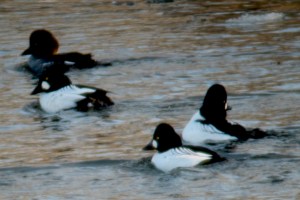
Common Goldeneye ducks in a group of 3 males and one female.

My brother and I often trespassed in our backwoods exploits. On a particular fall day we entered a private marsh near the entrance. It was there that a peat mining operation stored a rickety-looking crane. It stood awkwardly by a galvanized metal quonset building covering a concrete slab.

The peat miners worked the far northern end of a property called Nelson Lake Marsh. There were long shallow pits where the peat had been stripped away and sold. They rolled the crane in and out of the marsh on a raised gravel bed fortified by metal strips to keep the weight of the heavy machine evenly distributed. The huge metal treads of the crane clanked and rolled as it worked, an archaic and somewhat anachronistic operation it was.

The peatmining road followed the foot of a shallow hill on the west side of the marsh. That hill was covered by a stand of burr oak trees, beneath which grew verdant wildflowers in spring. This was a former savanna habitat, not timbered in more than 150 years. The trees growing there were thick and gnarly. From a distance they formed a thick dark wall behind the long course of cattails reaching north to south.

As my brother and I walked the road to the main body of water, we kept an eye out for the property owners, who would likely throw us out if we were caught. It was close to a mile’s walk along the west woods to reach the point where a small wooden shack stood among the cattails. From there you could see a series of well-constructed duck blinds along the south side of the lake, which swung to a southwesterly direction, almost as if the wind had suddenly come up and blown it that way.

The wind could be fierce over the lake on the wrong day. But on an early October day with sunlight popping the last of the green grasses into high relief a light breeze was fine company.

Duck heads on a wall

We reached the wooden shack to find a pair of shallow boats resting upright, drying from their duty on the previous day’s fall duck hunt. Inside the cabin we found 10-12 duck heads nailed to the wall. These were indicators of what had been shot on the lake so far that fall.

There were wood duck and gadwall, mallard and pintail and even a black and white scaup head. My brother and I studied the duck heads closely. Our access to real creatures was prized. My brother was a trapper and fisherman, and we both birdwatched. But neither of us was a duck hunter. We didn’t own guns.

Fall focus on ducks

We carried binoculars instead. Everywhere we went.

Our birding life lists grew rapidly. Sites such as Nelson Lake Marsh were treasures of yet undiscovered species, including American and Least Bittern, Sora and Virginia Rail. The rare sighting of a yellow-headed blackbird this far east in Illinois was also treasured.

But in fall we focused on the ducks. There were mergansers; Hooded and common, and redhead, canvasback, ruddy ducks, baldpate (wigeon) black duck, shoveler and two kinds of teal, blue-wined and green-winged. More than 20 species of ducks passed through in migration.

I also recall a green-winged teal head nailed to the boat house wall as well. The tiny cinnamon head had an emerald eye patch lined with yellow. The colors were riveting, even more beautiful up close than either my brother or I could imagine. That is why we loved birds. The diversity.

If duck gizzards could talk

Later in my birding career I studied field biology in college. We learned how to do taxidermy on ducks. We also learned that many species of waterfowl were suffering a malady that turned their gizzards green with poison. The lead shot used by hunters was being ingested and it sat in their crops until the lead leached into their bodies. Lead poisoning.

It was the first time I realized that a seemingly innocent American past-time likc duck hunting could have such an insidious consequence. It was also entirely preventable but for the selfish priority that lead shot gave hunters better aim. It enabled them to kill more ducks. As it turned out, that fact was true, twice over.

I saw the consequences of lead shot up close, and first hand. Perhaps it even made them fly slower, making them easier targets for hunters. It was sad to realize that lead poisoning made ducks sick and countless of them must have died slowly and silently, collapsed in the marsh where they would not be found. But they might be eaten by other creatures, a fox or coyote perhaps, who would also slowly absorb the perils of lead poisoning.

Critical disadvantages

Life and death works through critical disadvantages, and nature too. On both the biological and social level, it is the slightest disadvantage that can cause destruction of an individual. If the disadvantage is broad enough t0 impact an entire population, the whole species can suffer and even disappear.

If that disadvantage is forcibly or even casually imposed among creatures aware of its presence, but disavowed of even casual concern, it is certainly not a just or human level of behavior. In fact it is plainly immoral to cause suffering to fellow human beings, then claim it is your right.

Suffering that is caused unwittingly or by neglect is no better than that which is intentional. We should recall from the Bible the passage in which Jesus lectures a group of people who are asking questions about how to treat others. 37 “Then the righteous will answer him, ‘Lord, when did we see you hungry and feed you, or thirsty and give you something to drink? 38 When did we see you a stranger and invite you in, or needing clothes and clothe you? 39 When did we see you sick or in prison and go to visit you?’

40 “The King will reply, ‘Truly I tell you, whatever you did for one of the least of these brothers and sisters of mine, you did for me.’

So much human suffering is the product of force of habit or traditions that favor one element of society or another. We’ve been through that with slavery in America, which bled into racial discrimination that continues to this day. We’ve seen it in centuries of persecution toward the Jews on basis of egregious interpretation of the Bible that makes them scapegoats for the death of Yeshua (or Jesus). First it made the Jews target practice before the Crusades. Then it contributed to the mindset of Holocaust.

Poison parallels

The allegory of poison shot is therefore profound. Prejudice and discrimination are essentially the lead shot of society. They may not cause death and disadvantage right away, but they can. And when left “out there” they are a slow and deadly poison to the soul and body of others.

The unrecognized tragedy of this poison is that the lead shot of prejudice essentially kills both the hunter and the hunted. It kills the hunter through accumulation of hatred, which rots the soul. It kills the hunted by penetrating the body and mind, killing people from the inside out.

So when people like Phil Robertson of the television show Duck Dynasty go shooting their mouths off with the lead shot of discrimination, hatred, intolerance and prejudice, it poisons our whole society. That type of poison, even disguised as free speech or religious liberty, is ultimately ingested by innocents where it rots their proverbial gizzards from the inside out.

Lack of progress

On both an allegorical and practical basis, it is interesting to note that the use of lead shot in America has still not been banned altogether. We’ve long known that lead kills. Lead paint is banned from use and yet children still ingest the stuff in old homes and cleanup can be costly. There are some that speculate that it was lead pipes that contributed to the fall of the Roman Empire. 

Lead shot

We should ban lead shot completely. Yet the gun lobby has successfully protected against banning lead shot. It’s as if the freedom to shoot straight should trump any ill consequences and poison that lead ammo brings upon the environment. It’s really a sad, sick commentary on priorities that a tradition known to be dangerous should be protected by those who selfishly profit from it.

That is the real Duck Dynasty at work in America. It’s a different kind of Duck Dynasty than a bunch of charming rednecks squawking and then praying their way through life as they get rich off the cumulative ignorance of others. It all transpires with a wink and a nod behind the scenes. And it has to stop.

Money and free speech

Free speech is all too often about money. That’s what the real Duck Dynasty is all about.

When Phil Robertson rips homosexuality from a position of moneyed prominence, he is abusing the right to free speech by poisoning the environment for others. That truly is the type of talk that rots the nation from the inside out. And just as lead shot rots the gizzards of the wild ducks upon which men like Phil Robertson have made fortunes, his toxic words lurk in the environment and poison the parlance upon which we all depend for survival. You need to understand that people gobble this stuff willingly, as if it were the food of the Gods. Fame is the toxic spoon of culture.

The fact that people like Sarah Palin call such toxic words “free speech” and complain publicly about restrictions on what amounts to hate language is a sign of the level of poison to which our nation has too long been accustomed. It’s almost as if Palin is saying, “If you don’t like our beliefs, then you’d better duck, because we’re going to shoot off our mouths and engage in hateful language no matter who it hurts.”

You can read it either way. “Lead poisoning” can be read as “lead” or “led.” When it comes from leaders who don’t understand the toxic shots they take at society, it kills.

Endangered species, endangered souls

Lead shot is now, finally, being banned in many parts of the country because it kills more than ducks. Even endangered California Condors wind up ingesting lead shot, poisoning themselves as result.

Our allegory comes full circle, you see. Even a seemingly innocent guilty pleasure like a Duck Dynasty comes with risks when you ignore it’s full portent. The things we casually consume really can hurt us as a nation.

Yet some people will tell you that such “political correctness” goes too far, or that the “Nanny State” is to be avoided at all costs. But those are the rationalizations of the privileged, and also the cloying attempt of the weak-minded to align themselves with people in positions of power. We need to demand better from ourselves. But you can always expect a threat and a fight in return for any attempt at wiser morals and accountability.

Guns pointed at me

But let us pause for a moment, and consider a subtle variation on the theme. Because all perspectives deserve consideration.

For example, my own intersection with duck hunting took some strange turns over the years, and it taught me a few things.

I recall walking the Nelson Lake March property once it was purchased by the country. Much of the land surrounding the near shore of the march had been purchased except east hill and the south shore where the duck blinds remained. That meant in fall there was still legal hunting. I could easily hear the repeated shotgun pops from the reed-stuffed blinds on the far shore. Sure, it was a romantic scene, and I never had anything against the hunters. Some days I thought it would be fun to join them.

But once I heard shot plopping in the cattails around me, it made me wonder how much longer the tradition of hunting the lake could safely carry on.

There were also hunters who perched on a hill on the north side of lake where the property was still being farms. Once the corn or beans were harvested, hunters would set up jump blinds and shoot ducks that lifted off the lake into the north wind.

The low land below that hill was by them owned by the county. As I walked through an area where glacial seeps made great habitat for rail and snipe, a pair of hunters sat sullenly in their camouflage gear above me, staring at me with a barely concealed rage. In their eyes I was invading their turf, getting between them and the ducks and geese they hoped to shoot.

It was a strange and awkward situation, because they had every right to be where they were, but so did I. That had an odd requirement to shoot straight up to avoid knocking out ducks that landed on public property. But the situation did not last long. Just a couple seasons.

Soon enough the county bought that farm as well, then the south shore. All that was left to hunt was one last bastion, a farm on the east side of the marsh.

And sure enough, one morning I was walking that side of the park looking for birds when a voice rose from the thickets above me. “Get the F*** off my land,” the voice demanded. “Before I shoot your F****** head off.”

Transitions

The park line was in that area was still ill-defined, so I moved quickly toward the lake, walking backwards as the hunter pointed his gun muzzle in my direction. I’m sure some people might have approved him shooting me in the chest at that moment.

All I could think was that the Lord’s Prayer tells us to forgive our trespassers, as we forgive those who trespass against us.

It was a bitter and difficult moment, because I empathized with the duck hunters at that point. I always had. A longstanding tradition was slowly being erased. You can hardly blame the hunting community for being a bit peeved in having its shooting rights slowly taken away.

But it came down to a numbers game. Either the marsh and all its inhabitants could be protected for environmental reasons and the public good, or it could remain a private reserve owned and used by a lucky few. The public good ultimately won out. Now thousands of people per year visit what has become Dick Young Forest Preserve, named for the man who patiently chronicled its rare plant communities. A team of us birders conducted surveys for a decade to fill in the picture of wildlife and birds seen on the site. It is one of the most popular recreation areas in Kane County, Illinois. So the common good has been served.

Changing traditions

Sure, in some ways it hurt to lose the old ways. We romanticize them. But in some cases, lose them we must.

That may someday also mean a permanent ban on lead shot to keep animals from being poisoned. And on a cultural level it may mean demanding that people temper the impact of their poison language, for the times really are changing, and for the better.

The dynasty of prejudice and selfish discourse has a long history, but it has been a dynasty long enough. The words of Phil Robertson are the echo of a poison interpretation of the Bible that refuses to recognize that we no longer take significant parts of the Bible literally, and that it should not be regarded as infallibly composed or regarded as literal truth. It the Duck Dynasty still believes that, then it deserves to fall.

Society is about much. much more than nailing duck heads to the wall.
 

Pope Francis and the Brand New Day

By Christopher Cudworth

vatican1381780031

Pope Francis seems to be saying to the world, “Hold on a moment. I’ve got something to say…”

With the advent of a new Pope, all of Catholicdom held its breath a few months ago. Now that Pope Francis is taking names and kicking ass on practical and theological issues, even people outside the Catholic faith are breathing a sigh of relief that it’s not just business as usual in the biggest Christian organization on earth.

Of course Catholicism makes some legitimate claims to the origins and sustenance of Christianity as a whole. The whole Roman Catholic history serves as one big pipeline back to the days when early Christians first struggled for survival in the face of political oppression, then duked it out over what the faith should really mean and finally got the stamp of approval from Constantine and a success line of rulers and kings all the way through to the modern age.

Cocky Catholics? 

But along the way, Catholicism got a little cocky and a little arch in its practices. Catholics persecuted a fair share of people over the ages, and got a few things wrong about the cosmos too. Remember Copernicus and Galileo? Neither were accepted as practical authorities on cosmological matters.

A few Crusades and an Inquisition or two later, Catholicism grew into a faith that tolerated little dissent. It took one of their own priests, Martin Luther, to bust open the bible and bring back the true meaning of faith through grace to the Christian world.

Open and shut cases

The gates of Catholicism have still slammed shut on some issues. Recent popes did little to get the rampant issue of priestly abuse of children under control.

Then along comes Pope Francis. What a surprise. He started off with an equivocal but intriguing statement about homosexuality (“Who am I to judge?) and proceeded to demand that his own hierarchy live the faith by dumping a higher-up in the faith for living high on the Christian hog.

The general message of Pope Francis has been something Jesus might have said. “Don’t be like the Pharisees.”

In other words, Pope Francis is calling all Catholics to consider what their faith is really all about. Caring for the poor. Looking out for the disadvantaged.

Hell, Pope Francis even has the guts to throw a gut-check to the primary religion in America, which is capitalism.

Here’s what he said:

Just as the commandment “Thou shalt not kill” sets a clear limit in order to safeguard the value of human life, today we also have to say “thou shalt not” to an economy of exclusion and inequality. Such an economy kills. How can it be that it is not a news item when an elderly homeless person dies of exposure, but it is news when the stock market loses two points? This is a case of exclusion. Can we continue to stand by when food is thrown away while people are starving? This is a case of inequality. Today everything comes under the laws of competition and the survival of the fittest, where the powerful feed upon the powerless. As a consequence, masses of people find themselves excluded and marginalized: without work, without possibilities, without any means of escape.”

Slapdowns

It is somewhat stunning as well to see the term “survival of the fittest” daringly inserted into a religious argument for social justice. Do you get what that means? Pope Francis essentially acknowledges the practical truth of evolution with such a statement. In that regard his slap at the hindquarters of capitalism is also a slap in the face to evangelicals who can’t come to grips with the science that drives our understanding of the world.

The Pope just yanked the respective chains of economic and religious zealots. Do you get what’s going on here.

The time has come for a new Reformation. The time has come to question all the dogma and complacency driving our current religious dialogue. The Pope is using a mixed martial arts approach to theological discourse to challenge those who think they can get away with the same stupid shit they’ve been pulling for the last 30 years.

His real statement is this: “Your time is up. You’ve had your say. The world is ready for a brand new day. Get out of the way.”

Hurrah for Pope Francis. He may not be perfect, and he would be the first it seems to admit that. But he may be what Catholicism needs, and by proxy the rest of the world might take notice.