My brother and I often trespassed in our backwoods exploits. On a particular fall day we entered a private marsh near the entrance. It was there that a peat mining operation stored a rickety-looking crane. It stood awkwardly by a galvanized metal quonset building covering a concrete slab.
The peat miners worked the far northern end of a property called Nelson Lake Marsh. There were long shallow pits where the peat had been stripped away and sold. They rolled the crane in and out of the marsh on a raised gravel bed fortified by metal strips to keep the weight of the heavy machine evenly distributed. The huge metal treads of the crane clanked and rolled as it worked, an archaic and somewhat anachronistic operation it was.
The peatmining road followed the foot of a shallow hill on the west side of the marsh. That hill was covered by a stand of burr oak trees, beneath which grew verdant wildflowers in spring. This was a former savanna habitat, not timbered in more than 150 years. The trees growing there were thick and gnarly. From a distance they formed a thick dark wall behind the long course of cattails reaching north to south.
As my brother and I walked the road to the main body of water, we kept an eye out for the property owners, who would likely throw us out if we were caught. It was close to a mile’s walk along the west woods to reach the point where a small wooden shack stood among the cattails. From there you could see a series of well-constructed duck blinds along the south side of the lake, which swung to a southwesterly direction, almost as if the wind had suddenly come up and blown it that way.
The wind could be fierce over the lake on the wrong day. But on an early October day with sunlight popping the last of the green grasses into high relief a light breeze was fine company.
Duck heads on a wall
We reached the wooden shack to find a pair of shallow boats resting upright, drying from their duty on the previous day’s fall duck hunt. Inside the cabin we found 10-12 duck heads nailed to the wall. These were indicators of what had been shot on the lake so far that fall.
There were wood duck and gadwall, mallard and pintail and even a black and white scaup head. My brother and I studied the duck heads closely. Our access to real creatures was prized. My brother was a trapper and fisherman, and we both birdwatched. But neither of us was a duck hunter. We didn’t own guns.
Fall focus on ducks
We carried binoculars instead. Everywhere we went.
Our birding life lists grew rapidly. Sites such as Nelson Lake Marsh were treasures of yet undiscovered species, including American and Least Bittern, Sora and Virginia Rail. The rare sighting of a yellow-headed blackbird this far east in Illinois was also treasured.
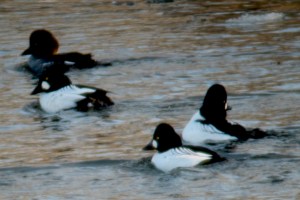
But in fall we focused on the ducks. There were mergansers; Hooded and common, and redhead, canvasback, ruddy ducks, baldpate (wigeon) black duck, shoveler and two kinds of teal, blue-wined and green-winged. More than 20 species of ducks passed through in migration.
I also recall a green-winged teal head nailed to the boat house wall as well. The tiny cinnamon head had an emerald eye patch lined with yellow. The colors were riveting, even more beautiful up close than either my brother or I could imagine. That is why we loved birds. The diversity.
If duck gizzards could talk
Later in my birding career I studied field biology in college. We learned how to do taxidermy on ducks. We also learned that many species of waterfowl were suffering a malady that turned their gizzards green with poison. The lead shot used by hunters was being ingested and it sat in their crops until the lead leached into their bodies. Lead poisoning.
It was the first time I realized that a seemingly innocent American past-time likc duck hunting could have such an insidious consequence. It was also entirely preventable but for the selfish priority that lead shot gave hunters better aim. It enabled them to kill more ducks. As it turned out, that fact was true, twice over.
I saw the consequences of lead shot up close, and first hand. Perhaps it even made them fly slower, making them easier targets for hunters. It was sad to realize that lead poisoning made ducks sick and countless of them must have died slowly and silently, collapsed in the marsh where they would not be found. But they might be eaten by other creatures, a fox or coyote perhaps, who would also slowly absorb the perils of lead poisoning.
Critical disadvantages
Life and death works through critical disadvantages, and nature too. On both the biological and social level, it is the slightest disadvantage that can cause destruction of an individual. If the disadvantage is broad enough t0 impact an entire population, the whole species can suffer and even disappear.
If that disadvantage is forcibly or even casually imposed among creatures aware of its presence, but disavowed of even casual concern, it is certainly not a just or human level of behavior. In fact it is plainly immoral to cause suffering to fellow human beings, then claim it is your right.
Suffering that is caused unwittingly or by neglect is no better than that which is intentional. We should recall from the Bible the passage in which Jesus lectures a group of people who are asking questions about how to treat others. 37 “Then the righteous will answer him, ‘Lord, when did we see you hungry and feed you, or thirsty and give you something to drink? 38 When did we see you a stranger and invite you in, or needing clothes and clothe you? 39 When did we see you sick or in prison and go to visit you?’
40 “The King will reply, ‘Truly I tell you, whatever you did for one of the least of these brothers and sisters of mine, you did for me.’
So much human suffering is the product of force of habit or traditions that favor one element of society or another. We’ve been through that with slavery in America, which bled into racial discrimination that continues to this day. We’ve seen it in centuries of persecution toward the Jews on basis of egregious interpretation of the Bible that makes them scapegoats for the death of Yeshua (or Jesus). First it made the Jews target practice before the Crusades. Then it contributed to the mindset of Holocaust.
Poison parallels
The allegory of poison shot is therefore profound. Prejudice and discrimination are essentially the lead shot of society. They may not cause death and disadvantage right away, but they can. And when left “out there” they are a slow and deadly poison to the soul and body of others.
The unrecognized tragedy of this poison is that the lead shot of prejudice essentially kills both the hunter and the hunted. It kills the hunter through accumulation of hatred, which rots the soul. It kills the hunted by penetrating the body and mind, killing people from the inside out.
So when people like Phil Robertson of the television show Duck Dynasty go shooting their mouths off with the lead shot of discrimination, hatred, intolerance and prejudice, it poisons our whole society. That type of poison, even disguised as free speech or religious liberty, is ultimately ingested by innocents where it rots their proverbial gizzards from the inside out.
Lack of progress
On both an allegorical and practical basis, it is interesting to note that the use of lead shot in America has still not been banned altogether. We’ve long known that lead kills. Lead paint is banned from use and yet children still ingest the stuff in old homes and cleanup can be costly. There are some that speculate that it was lead pipes that contributed to the fall of the Roman Empire.
Lead shot
We should ban lead shot completely. Yet the gun lobby has successfully protected against banning lead shot. It’s as if the freedom to shoot straight should trump any ill consequences and poison that lead ammo brings upon the environment. It’s really a sad, sick commentary on priorities that a tradition known to be dangerous should be protected by those who selfishly profit from it.
That is the real Duck Dynasty at work in America. It’s a different kind of Duck Dynasty than a bunch of charming rednecks squawking and then praying their way through life as they get rich off the cumulative ignorance of others. It all transpires with a wink and a nod behind the scenes. And it has to stop.
Money and free speech
Free speech is all too often about money. That’s what the real Duck Dynasty is all about.
When Phil Robertson rips homosexuality from a position of moneyed prominence, he is abusing the right to free speech by poisoning the environment for others. That truly is the type of talk that rots the nation from the inside out. And just as lead shot rots the gizzards of the wild ducks upon which men like Phil Robertson have made fortunes, his toxic words lurk in the environment and poison the parlance upon which we all depend for survival. You need to understand that people gobble this stuff willingly, as if it were the food of the Gods. Fame is the toxic spoon of culture.
The fact that people like Sarah Palin call such toxic words “free speech” and complain publicly about restrictions on what amounts to hate language is a sign of the level of poison to which our nation has too long been accustomed. It’s almost as if Palin is saying, “If you don’t like our beliefs, then you’d better duck, because we’re going to shoot off our mouths and engage in hateful language no matter who it hurts.”
You can read it either way. “Lead poisoning” can be read as “lead” or “led.” When it comes from leaders who don’t understand the toxic shots they take at society, it kills.
Endangered species, endangered souls
Lead shot is now, finally, being banned in many parts of the country because it kills more than ducks. Even endangered California Condors wind up ingesting lead shot, poisoning themselves as result.
Our allegory comes full circle, you see. Even a seemingly innocent guilty pleasure like a Duck Dynasty comes with risks when you ignore it’s full portent. The things we casually consume really can hurt us as a nation.
Yet some people will tell you that such “political correctness” goes too far, or that the “Nanny State” is to be avoided at all costs. But those are the rationalizations of the privileged, and also the cloying attempt of the weak-minded to align themselves with people in positions of power. We need to demand better from ourselves. But you can always expect a threat and a fight in return for any attempt at wiser morals and accountability.
Guns pointed at me
But let us pause for a moment, and consider a subtle variation on the theme. Because all perspectives deserve consideration.
For example, my own intersection with duck hunting took some strange turns over the years, and it taught me a few things.
I recall walking the Nelson Lake March property once it was purchased by the country. Much of the land surrounding the near shore of the march had been purchased except east hill and the south shore where the duck blinds remained. That meant in fall there was still legal hunting. I could easily hear the repeated shotgun pops from the reed-stuffed blinds on the far shore. Sure, it was a romantic scene, and I never had anything against the hunters. Some days I thought it would be fun to join them.
But once I heard shot plopping in the cattails around me, it made me wonder how much longer the tradition of hunting the lake could safely carry on.
There were also hunters who perched on a hill on the north side of lake where the property was still being farms. Once the corn or beans were harvested, hunters would set up jump blinds and shoot ducks that lifted off the lake into the north wind.
The low land below that hill was by them owned by the county. As I walked through an area where glacial seeps made great habitat for rail and snipe, a pair of hunters sat sullenly in their camouflage gear above me, staring at me with a barely concealed rage. In their eyes I was invading their turf, getting between them and the ducks and geese they hoped to shoot.
It was a strange and awkward situation, because they had every right to be where they were, but so did I. That had an odd requirement to shoot straight up to avoid knocking out ducks that landed on public property. But the situation did not last long. Just a couple seasons.
Soon enough the county bought that farm as well, then the south shore. All that was left to hunt was one last bastion, a farm on the east side of the marsh.
And sure enough, one morning I was walking that side of the park looking for birds when a voice rose from the thickets above me. “Get the F*** off my land,” the voice demanded. “Before I shoot your F****** head off.”
Transitions
The park line was in that area was still ill-defined, so I moved quickly toward the lake, walking backwards as the hunter pointed his gun muzzle in my direction. I’m sure some people might have approved him shooting me in the chest at that moment.
All I could think was that the Lord’s Prayer tells us to forgive our trespassers, as we forgive those who trespass against us.
It was a bitter and difficult moment, because I empathized with the duck hunters at that point. I always had. A longstanding tradition was slowly being erased. You can hardly blame the hunting community for being a bit peeved in having its shooting rights slowly taken away.
But it came down to a numbers game. Either the marsh and all its inhabitants could be protected for environmental reasons and the public good, or it could remain a private reserve owned and used by a lucky few. The public good ultimately won out. Now thousands of people per year visit what has become Dick Young Forest Preserve, named for the man who patiently chronicled its rare plant communities. A team of us birders conducted surveys for a decade to fill in the picture of wildlife and birds seen on the site. It is one of the most popular recreation areas in Kane County, Illinois. So the common good has been served.
Changing traditions
Sure, in some ways it hurt to lose the old ways. We romanticize them. But in some cases, lose them we must.
That may someday also mean a permanent ban on lead shot to keep animals from being poisoned. And on a cultural level it may mean demanding that people temper the impact of their poison language, for the times really are changing, and for the better.
The dynasty of prejudice and selfish discourse has a long history, but it has been a dynasty long enough. The words of Phil Robertson are the echo of a poison interpretation of the Bible that refuses to recognize that we no longer take significant parts of the Bible literally, and that it should not be regarded as infallibly composed or regarded as literal truth. It the Duck Dynasty still believes that, then it deserves to fall.
Society is about much. much more than nailing duck heads to the wall.
 At some early age it entered my head that perhaps everyone around me was in on a secret. That I was the only one that thought as I do, and that even my parents were putting me on, big time.

 Genesisfix's Blog