Who is really keeping us safe?

“If you’re not a liberal at twenty, you have no heart, and if you’re not a conservative by the time you are forty, you have no brain.” –Winston Churchill

Winston ChurchillYears ago I read a massive two-volume biography of Winston Churchill. It was with great disappointment that I learned that the author of those first two books had died. The third would have covered the period including World War II, and that would have been fascinating to study the actions and philosophies of the man that ushered Great Britain through the war.

Yet even with Churchill, his strong points as a war leader turned out to be challenges of a sort in the political realm. He was initially defeated for the role of Prime Minister after the war, yet returned to that role again before suffering physical and mental decline that may have resulted from strokes and heart issues.

A wealth of protectors

While obviously a man to admire, Winston Churchill’s determination that conservatism was the ultimate form of philosophical sophistication may have been formed more from his upbringing in a wealthy English family than his own evolution as a military man and spokesman. He was great at both those things, but there is an abiding factor to how these were developed and sustained that made it possible for Churchill to think like a conservative at all.

That factor was the presence and alliance of both the United States and the Soviet Union in World War II. Without that partnership, Great Britain would have been sunk under the pressures of Germany to take over much of Europe.

It was the liberal support of America’s Democratic President Franklin Roosevelt and the hard right determination of Joseph Stalin that fought back Germany’s considerable will to conquer and subjugate. That enabled Churchill to essentially occupy an important middle ground from which he could flexibly consider and pursue his necessary options. That is conservative in the good sense of the word, in being considerate.

Modern times

Fast forward to the current world perspective in which we live. America’s President Barack Obama has behaved as a noted centrist on the world stage. And like Churchill, there have been wins and losses, risks and seeming triumphs associated with that centrist position. Obama has been the considerate if quietly brusque leader, not prone to launch off new wars, yet capable of effecting deadly drone strikes that many people protest as cruel and miscalculated.

Such are the risks of all world leaders. The apparently noble fight of America, Britain and the Soviets against the Germans, Italians and Japanese Axis was full of death and destruction. And while Germany clearly committed war crimes, the rest of the fighters were not a group of innocents. America ultimately dropped a massive nuclear weapon on Japan’s big cities, killing thousands of civilians in the process.

During the leadup to that event, America engaged in some rather heinous efforts to protect itself, ushering many of its own citizens of Japanese descent into camps. The object at the time was to “keep us safe” from perceived threats because Japan itself was such a threat.

Fear and strange decisions

Fear drives all kind of strange decisions in this world. And while some of our fears are very real, the collective anxiety of a culture can often be extremely misguided.

Such is the case wth current concerns over America’s possible acceptance of Syrian refugees. While France opens its borders willingly to Syrian refugees even on the heels of the terrorist attacks on its own soil, America’s arch-conservative population wants to ban them from entry into the country. All of this is based on the idea that terrorists will somehow disguise themselves as refugees and come to this country to kill Americans.

Raging debates

Having engaged in considerable political debate with a number of anxious conservatives on social media, a few simple things have emerged in the argument. 1) They don’t trust Obama or the government 2) They don’t trust the government or Obama 3) They really don’t trust either Obama or the government. That’s the substance of their arguments.

In the process of defending those arguments they also engage in considerable name-calling while simultaneously denying that the Bush administration or any conservative before him had anything to do with creating the terrorist problem in the Middle East. We all know that started with the Reagan administration, was fostered by the Bush relationships with the Saudis, and carried on with the patsy treatment of the bin Laden family right through the 9/11 terrorist attacks when our first priority was flying remnants of that family out of the United States when all other flights were suddenly banned. Conservatives also created the Saddam Hussein we overthrew, and set up the Shah of Iran that led to that country being so pissed off at the Western World.

Yet somehow it’s all Obama’s fault that we have problems in the Middle East.

Brotherly love 

Of course, Jeb Bush, the equally inept brother of George W. Bush, is now running for President of the United States. And like any conservative worth his radical salt he has publicly claimed that his brother “kept us safe.”

So for the sake of analysis, we should examine what he might mean by that statement. The expectations of conservatives about what “keeps us safe” clearly breaks down into categories that were demonstrated by the Bush administration’s actions in the Middle East. And we’ll get to those in a minute.

But first we must admit there was little resistance by the Democratic Left to any of Bush’s policies overseas. That was a sick and sad chapter in our political history as well. Either by choice or by fear, the Left stood down under considerable pressure from conservative dominance of all three branches of government. That included the power of the Presidency, a willing Congress and Senate and even the Supreme Court that handed Bush surveillance powers that broke every rule in the Constitution about personal privacy.

So Bush and Cheney were given free license to engage in a series of cynical acts of aggression designed, in their minds, to “keep us safe” from terrorism. These included:

  1. Bomb first, ask no questions later. When faced with threats, conservatives love to bomb things because it makes them feel as if they are taking action against that threat. Of course, civilian casualties resulting from those bombings inflamed hatred for the United States as innocents perished. But that’s the apparent price of thoughtless war. “Collateral damage” they call it. The ultimate euphemism of course. Conservatives bomb, and then move on without a second thought about what the real effects of such bombings could be in terms of perception among enemies or friends.
  2. Torture is acceptable. Arguments in favor of torturing Iraqis and potential terrorist focused on the fact that such tactics were necessary to extract information that could “keep America safe.” That connection between information and actionable intelligence really never happened in any substantial way. And yet the apparent thought that our supposed enemies were being tortured made a certain segment of our society feel happy because we were “doing something” about terrorism. Never mind that many of the people we tortured and even killed through torture and mistreatment were in fact completely innocent.
  3. Spying on your own people is desirable. How ironic it is that the political force in America that claims to hate government most and wants to reduce its influence in our lives should choose to open a surveillance program that brought government into the very conversations we all hold over our telephones and cell phones. It seems a common phenomenon that the things conservatives most hate in others they ultimately become themselves. It happens on the social front when people who claim to stand for family values turn out to be serial wife cheaters or sexual predators. This repression haunts the conservative party like a ghost of unvirtuous fact.
  4. Always blame the other side. For all these insane actions and remorseless activities, conservatives have developed denial of responsibility for the evil outcomes into a very fine art. The virtual memo that says “never admit you were wrong” has been hard-wired into the consciousness of political, military and civilian conservatives. In fact, it is perhaps the greatest social conspiracy ever contrived as a political strategy. Its level of secrecy is protected by a devotion to denial and an entire lack of accountability. It is thus quite  breathtaking in its scope and effect on civil discourse. Its main mouthpiece, of course, is Fox News, whose claims of being “fair and balanced” as a “news organization” are the absolute expression of the virtue of lying with a smile on your face and putting tits above the fold as a distraction of the very audience you intend to recruit.

There’s a reason for all this aggression, repression and secession going on within the conservative cult in America. Only when a conservative breaks completely free of the party entirely, which means they can never go back, do we hear an ounce of truth and admission about what really goes on behind the scenes. The recent inadvertent confession of a certain Congressman on the real reasons for the Benghazi investigation of former Secretary of State Hillary Clinton are just one such example of politically motivated use of government to harangue and discredit anyone that dares resist the conservative cartel in America.

It goes back a ways

John_F_KennedyResistance to this secret society of Conservatism with a Capital A (and its apparent arm, the CIA) is what got President Kennedy killed back in the 1960s. So the phenomena of killing threats to the cabal is not new.Kennedy was no saint, that’s for sure. But what he also represented as a political liberalism that some perceived as a threat to the security of America. But again, the considerations shown by John F. Kennedy in negotiations with the Soviets in the Cuba Missile Crisis are likely what prevented nuclear war. In other words, his small “c” conservatism kept us safe, just like Winston Churchill’s small “c” conservatism helped guide the Allies through World War II. It is this conservatism to which I believe Winston Churchill is referring in the quote above this column.

But it keeps happening that large “C” Conservatism is trying to kill its perceived enemies. And true to form, the conservative cabal went after Bill Clinton over engagement in a harmless blow job. The ensuing scandal turned into a political spectacle that distracted from Clinton’s ability to do his job, and keep us safe.

At that time, Clinton wanted to take action against bin Laden and potential terrorists in the Middle East, but was discouraged from doing so because it would appear he was attempting to “wag the dog” and escape accusations and impeachment over his extramarital affair. We seriously need to ask what would have kept us more safe in that scenario, the Starr Report or actually paying attention to real threats to our security. Capital A Conservatives clearly chose the former over the latter. America has paid the price ever since for this selfish, politically motivated debacle.

Fear, loathing and power

Paul Ryan

New House Speaker Paul Ryan

So you see, the goal of conservatism is never really to keep us safe. It is to gain and keep power, and that is all. Conservatives use fear to accomplish that mission all the time. That is why the call to war is so strong among them. War creates a deep tide fear in the populace, accentuated by methods such as “terror alerts” that the Bush administration turned on and off as needed to sway political will and push the perception of power in their direction. These are all tricks to get people to fall in line. Authoritarian thinkers on both the proactive and responsive side love these methods because it gives them a sense of control in otherwise chaotic circumstances. Of course it is all a ruse, but that does not matter.

FlagWaiverIndeed, Conservatives with a capital “C” want Americans to behave like Pavlov’s dogs in response to the call for war and acceptance of violence as status quo. They wave flags as patriots in fear until the very meaning of the flag is all worn out. Our flag has come to represent a national attitude of fear and a worn out ideology as a result.

Witness the marketing methods of the NRA, which flouts fear about race and crime as reasons to arm American on claims that more guns will “keep us safe.” Again, these are lies of massive proportions. More Americans have died from gun violence on American soil that all the soldiers ever killed in foreign wars. This is not “keeping us safe.”

Money kills


In the end, the sad thing about all this fear and terror and power is that it is all about money. Conservatives simply love money and all that it gives them. That’s why so many conservative whine about high tax rates and complain about giving their dollars through any social programs that might help the poor or elderly. This is the brand of conservatism that has evolved in America; selfishness as a life philosophy. It stands in direct opposition to the Christian call for charity and even giving away all you have to serve God and Christ. But modern conservatives (oxymoron intended) ignore all that real Christian stuff. That part is old-fashioned to them.

And we must return to the fact that top level Conservatives have always liked war because it enriches them. Former Vice President Dick Cheney used the Iraq War to increase the value of companies like Halliburton in which he has long held financial interests. The snarling visage of the man who almost singlehandedly leveraged America’s fortunes into his own while ruining our reputation overseas is like the Ghost of Ebenezer Scrooge, who without ever having gone through the happy change that made him into an advocate for the Christmas Spirit acts instead like the Grinch Who Stole America.

No Churchill

dick-cheneyCheney was no Churchill, let’s all agree on that. He seems to have envisioned himself that way, but where he falls short is in the ability to recognize the advantage of being a smart conservative with a small “c.” That is one who knows that conservatism actually involves consideration. Cheney appears to have none of that capacity, and as a result his version of “keeping us safe” turned the Middle East into a morass of angry terrorist hornets hoping to break free and sting the invader of their nest.

So let’s stop pretending that stirring up the hornet’s nest in the Middle East with bombings, torture and boots on the ground is a conservative strategy at all. It is not a conservative strategy, and it does not keep us safe.

And as for hornet’s back home, we’ve already got a system in place to detect their angry buzz. Typically they can’t keep quiet. Not if we open our eyes and ears and pay attention. And let’s not ignore those clear warnings this time, as Bush did back when he and Cheney were plotting to take over the entire Middle East to steal the oil and get some archly conservative kicks. That was stupid. And we’re getting stung as a result.

Ken Ham the Creationist versus Bill Nye the Science Guy proved a lot about how wrong Ken Ham has the Bible

By Christopher Cudworth

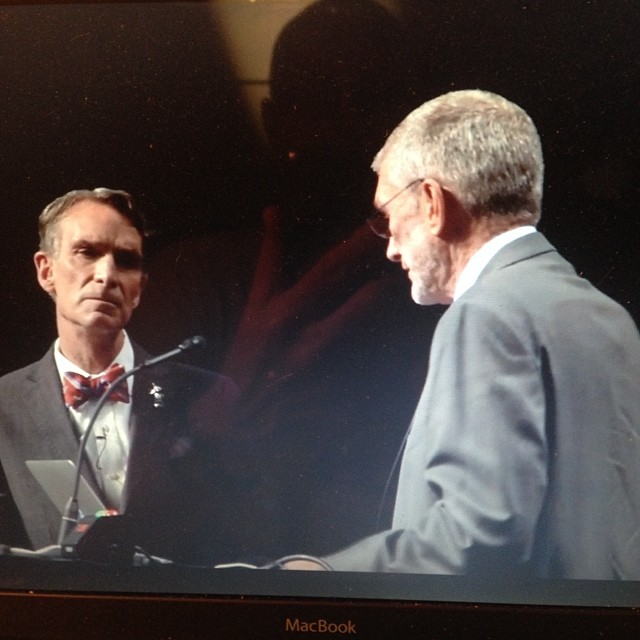
Bill Nye listens carefully as Ken Ham makes the claim that the Bible is a better source of fact than material science

Bill Nye listens carefully as Ken Ham makes the claim that the Bible is a better source of fact than material science

It appeared from watching the “debate” between creationist Ken Ham and scientist Bill Nye that Ham wanted desperately to prove science wrong about everything.

But a funny thing happened on the way to the conclusion of the so-called debate. Ham never mustered the ability to answer simple questions that would have proved creationism has any sort of relationship with science. His entire contention rested on the contention that the Bible must be understood “naturally” in order to understand the world. That is, the parts in the Bible Ken Ham judges to be crucial to a literal interpretation of scripture must be abided to the letter. The other parts, such as the “poetry” of Psalms, according to Ham, actually have no real bearing on the role of the Bible as science. Wow. That’s a whopper.

Yet that is the biblical foundation of Ken Ham’s creationist worldview. It begins with a denial of a significant portion of the Bible’s verity. Creationism literally starts with the assertion that not all the Bible can be trusted as fact.

And that’s just the starting point of a confused, frustrating and inaccurate worldview. Ken Ham seems to misunderstand and completely disregard the nature of what Christians call the New Testament. In fact he makes very few references to Jesus in any of his assertions about creation.

He certainly never mentions the methods by which Jesus himself taught by using organic metaphors. In simpler terms, Jesus used symbols from nature to illustrate spiritual principles. That way everyday people could comprehend what he was trying to teach about the nature of God.

But Ken Ham can’t seem to grasp or embrace that style of teaching, about nature, or about science. He prefers instead the literal view of scripture. His motive appears to be focused on leaving no room for interpretation. He is a zealot about that.

Of course that is the very same legalistic approach used by the Pharisees, leaders of the faith in Jesus’ day. He branded them a “brood of vipers” in clear reference to the Genesis depiction of Satan as a serpent.

You don’t have to take that reference literally to get the message. Jesus would not have liked Ken Ham. Jesus would have knocked the Creation Museum to the ground because it is a crass attempt to control the faith and belief of people through legalistic force and deception.

So the truth speaks for itself. Ken Ham is at odds with Jesus Christ, God’s only Son. Ken Ham considers Jesus’ method of teaching with metaphors inferior to his own brand of truth based on narrow interpretations of a book written 2000 years ago, conveyed originally as oral tradition and translated multiple times.

The simpler, more clear understanding that Jesus gave to all those who would listen is not good enough for Ken Ham. Jesus would gladly have accepted the findings of science.

Jesus said God is nature, and nature is God. All things worthy of consideration can be discerned through that simple statement. Anything else is fiction, or worse, a lie about the Word of God. And God is never happy about that.

How preteens evolve into thinking human beings

photoAt some early age it entered my head that perhaps everyone around me was in on a secret. That I was the only one that thought as I do, and that even my parents were putting me on, big time.

I worried that I was not a “normal” person.

It happened again to some extent when I was 13 years old. That’s the age when your interests begin to collide with the world, and that’s a dual problem because your interests when you are in middle school tend to be really intense, sometimes nerdy and ridiculously easy to ridicule.

My interests happened to be all over the board, from art to nature, but one avocation got me in trouble with my friends who all seemed to think birdwatching was stupid, silly and less than manly. They made up bird names with obscene roots and laughed when I told them I’d identified a certain species of importance to me.

Resilience

To my everlasting credit, I never let the teasing stop me from pursuing any of my interests, even at the vulnerable age of 13. Now the same people who used to ridicule will call with a “bird question” when something unexpected shows up at their feeder, or they see a bald eagle along the river. The enthusiasm they now show for such things is a much-delayed apology for the abuse long ago.

As an adult I was asked to teach Sunday School for the middle schoolers because no one else wanted to take on the task. I liked it. Working with a series of teacher-partners over a 12-year period, it was fascinating to see the variability in maturity and self-awareness among preteens.

Sleepy minds

Many Sunday mornings they’d arrive sullen and bored, aching to get back to their sleepy beds where the rest of the world could not reach them. But reach them I did.

The church absentmindedly neglected to shove some curriculum my way for years and years. The parents did not complain about my teaching so everyone must have thought it was working out okay.

Little did they know that Sunday School was a perfect place to get those preteens thinking about what matters in life beyond the Bible. Sure, we always talked about scripture in a roundabout way. I’d always have an idea to discuss and would bring them around to the topic by asking what they’d done during the week and even how they felt about it. They deserved that attention. The minds of preteens seem to be largely ignored by this world, as if they have nothing of value to say about it. But the world would be wrong about that. It always has.

The example of Jesus

You may recall that it was a preteen Jesus (about age 12) who stayed behind at a temple when he was supposed to be following his parents back home after a visit to the city. This is what transpired:

46 After three days they found him in the temple courts, sitting among the teachers, listening to them and asking them questions. 47 Everyone who heard him was amazed at his understanding and his answers. 48 When his parents saw him, they were astonished. His mother said to him, “Son, why have you treated us like this? Your father and I have been anxiously searching for you.”

49 “Why were you searching for me?” he asked. “Didn’t you know I had to be in my Father’s house?”[a] 50 But they did not understand what he was saying to them.

51 Then he went down to Nazareth with them and was obedient to them. But his mother treasured all these things in her heart. 52 And Jesus grew in wisdom and stature, and in favor with God and man.

Echoes of Christ

In many ways that scene was replayed among the preteens who entered the middle school Sunday School class. They had ideas. They wanted answers. They asked questions and to the best of my ability I answered their questions or encouraged them to find answers, and at all costs.

That church did not preach tolerance for science, yet several of my former students went on to become chemical engineers and biologists and other occupations whose educational processes effectively denied what that simpleton religious worldview maintained.

Rational faith

You may ask why I remained a member so long (25 years) and I can answer that my rational faith survived outside of that venue, but was sustained by the fellowship that came through membership. I am now a member of a church that respects rational thought and yet embraces full discipleship as a matter of practice. In other words, a church that actually teaches what the Bible says to do. Instead of denial like the Pharisees and legalistic practices, my current church loves this world with all its heart, as an expression of creation, but not as an exclusive Creation that cannot be understood or appreciated by the human mind.

That’s what I taught all those years, and what it taught me in return was that the middle school, preteen mind appreciates honesty and respect. If you don’t give pat answers, it doesn’t feel like you’re patting them on the head, telling them to go away and quit thinking. For themselves.

Leadership 

One year I had as students three young women that each vied for the title of Valedictorian at their respective high schools. Keeping them engaged was not that difficult, but keeping the rest of the class in pace with their challenging minds was interesting at times.

Yet it happened. The other kids knew and appreciated true leadership and intellect when they saw it. The girls in return were not disrespectful of their peers. Even those who were brought to the church by bus from underprivileged families participated in the discussions. I often thought about how much those women brought to the table, and the fact that women were not allowed to assume positions of full leadership at that church. It bothered me. So I ignored that example and let them be leaders.

It was proof to me that the Kingdom of God, if that’s what you call it, can embrace the rich in mind and the poor in spirit alike. The principle benefit was, in the end, an open regard for the preteen mind that perhaps they would never have experienced if shielded from the concepts we discussed in biblical context. Those were evolution as well as salvation. I told them there was no reason why the Bible and science could not be reconciled. I told them Jesus was the original naturalist. He used organic symbols in his parables to convey spiritual principles. Later I wrote a book and continue a blog about that subject and more.

Other subjects

We talked about fame and deception, hope and depression. We talked about their lives and encouraged them to keep the confidence of others. Basic human respect was at play at all times.

And we talked about Jesus. Not the Jesus of the Sunday School curriculum that sails around the landscape working miracles. We talked about the Jesus who cried and prayed in the Garden of Gethsemane, abandoned by his friends. We considered what that meant to be alone, to feel alone.

Then we talked about what it meant to be normal in this world. To have fears and feelings that you poorly understood. To be worried about what others thought about you and about how adults don’t have all the answers. Those were just some of the things discussed with those preteens. They just wanted to know what it meant to be normal, and what it meant if you chose to depart from those norms on your own.

Jesus was a helluva an example on what it meant to go your own way. It has costs, but sometimes its worth it. Not being normal, that is.

Who are my mother and brothers?

Mark 3:33 New International Version (NIV) 33 “Who are my mother and my brothers?” he asked.

By Christopher Cudworth

It is not often preached from the pulpit that Jesus so profoundly emphasized the isolation of the human condition. In 50 years of cognizant Christian worship, I have not heard this isolation emphasized with much clarity or conviction. It is too lonely a piece of scripture upon which to focus. It can frighten believers and frighten away possible converts.

The power to stand alone is important, but not the point of Christianity.

The power to stand alone is important, but not the point of Christianity.

Yet the Bible clearly shows that Jesus, and God especially, want us to know that to be human is ultimately to be alone.

Part of the plan?

Of course that is what Christian fellowship is designed to conquer. And the Kingdom of God is created here on earth to prevent this form of isolation. From others. Even from oneself.

Yet the undeniable message of Mark 3:33 is this: Even your family and friends can and will let you down. God alone is the ultimate solace.

This isolating message is likely ignored in the Christian church because it flies too near the methods used by cults to trap people into wicked devotion. The famously devious method of some network marketing organizations is to have you try to sell and recruit your friends into the organization. But people are repelled by such efforts. Those who see the folly and the scam are legitimately repulsed. Yet a desperate soul often tarries on, convinced perhaps of possible wealth if only friends and family really understood the potential in the scheme.

The ultimate effect of network marketing schemes is that they can divest people of their human network. Then the “organization” or whatever you want to call it (some call it “my business”) has you dead to rights. Because once you have scared off your friends and family, the network marketing organization (or a cult) sets out to replace that network with whatever they tell you is vital and true.

Who are my mother and my brothers? 

How does that compare to Christianity? To the example set by Jesus in saying, “Who are my mother and my brothers?”

We can take another example from the Bible to examine the issue of isolation. Just before he was taken into captivity by a calculating band of priests from the very faith he had come to fulfill, Jesus went into the Garden of Gethsemane to pray.

Mark 14:32
Gethsemane ] They went to a place called Gethsemane, and Jesus said to his disciples, “Sit here while I pray.”

Of course we know how that segment of the story comes out. His disciples, who are depicted in the Bible as often failing in tasks of devotion and understanding, cannot stay awake while Jesus goes to pray. They fall asleep and when Jesus returns, having prayed to understand the very life he would soon give away as redemption for all, finds his devoted friends asleep on the job.

The deeper meaning of disappointment

It happens often to all of us. People disappoint us. We disappoint other people. And look at the word structure of that word, “disappoint.” To dis-appoint is to disassociate, or to send away either by intent or by mistake.

Jesus tries to warn us that disappointment is a big part of the human condition. Our failures are characterized by many as our sins, or our almost predestined capacity to sin.

Sin is the ultimate isolation from God. It is what separated the proverbial Adam and Eve from God in the Garden of Eden. Another garden. Another time. The garden is supposed to be a place of consideration and worship, our connection to stewardship and creation. And yet here we have two biting examples in the Bible where a garden is a rife example of disappointment. God disappointed in Adam and Eve. Jesus disappointed in his disciples.

And what are we to make of the idea that the world can be such a disappointing place?

Friendship and fellowship

This message seems to run counter from the idea that our fellowship here on earth can be a salve for the soul. Well, it is not wise to give up on friendship and love so easily, now is it? Our relationships are clearly of great value in this world. Love is built around and in them. Our families are designed, both in faith and through nature, to be a sustaining force in this world. The friends we gather around us and trust are people in whom we find joy and support.

None of those truths is undermined by the example Jesus makes in both his statement about his mother and brothers or his disappointment in his disciples. Jesus is master not only of this world in the spiritual sense, but also of necessary hyperbole. His teachings are full of striking examples that cut through our perceptions of what human relationships really are, and what they offer.

Salvation

Our disappointment is our salvation, you see. Friends and family can and do disappoint us, just as we sometimes disappoint them. It is the isolating nature of the human condition to disappoint those we need and love the most.

But the real message of disappointment and resultant isolation is that God provides a model of unifying faith. Because to love is to forgive, even when our friends and family doubt in us, and disappoint. We trust in God because God trusts in us to make choices that reach across that disappointment to heal and forgive. God even asks us to love our enemies. That is a potent message if you want to understand the true “way of the world” through the eyes of God. You cannot ultimately conquer disappointment and isolation if you do not choose to love. You will be alone if you choose not to forgive, or fail in your devotion to a friend.

Yet when hurt comes calling, our natural tendency is to withdraw, pull back, and feel disappointment. We feel it so keenly we can begin to hate. Then we begin to seek targets for our hate because it becomes part of our nature. We look for the disadvantaged and the weak because in our own weakness and fear we want only to feel superior to others, somehow, so that we do not feel put down or pushed away from life itself.

The dangers of prejudice

Those are the foundations of prejudice of course. And of economic inequality, and caring not for the poor. We find the wealthiest among us susceptible to this isolating force of the “other.” Often that sense of disgust toward those we consider inferior becomes magnifying the more life seems to dispense fortune upon us.

Jesus recognized all this potential for prejudice, power and loss of imagination. Because imagining ourselves to be superior to others in any way is the ultimate sin, at least in the eyes of God. That is why Jesus told the wealthy to give away their riches and follow him. That is why it is harder for a camel to pass through the eye of a needle than for a rich person to gain entrance to heaven. Wealth can be an isolating force.

It can, of course, also be an instrument for good. We see many examples of people who use their wealth for good. Even the robber barons of the early 20th century, who built monopolies and wealth beyond imagination through industry did turn around and do great things with their money. Carnegie. Rockefeller. The list goes on, and continues to this day.

So it is not wealth alone that is a sin, but wealth in some way that combines with isolation that God does not appreciate. Jesus broke through social strata and perceptions that people who were disadvantaged or different were somehow victims of their own sin. He also forcefully resisted the practice by priests of his day (and ever after, it seems) to turn scripture into laws that trap and hurt others. Jesus did not tolerate using God’s word for punishment and isolation. He would definitely not approve of the manner in which so many supposed Christians  use scripture to create false social and economic strata today. The practice of using literalism to ostracize gays and women, for example, is abhorrent by nature to Jesus. The idea that the Bible is somehow a scientific text would also be absurd to Jesus, who taught in organic parables using examples from nature to teach spiritual concepts. Jesus was no literalist. He was no fool, in other words. Jesus disliked the actions of fools like that.

And what do we find as a result of such actions today? An increasingly divided faith, in Christianity. It has been that way since the start, it seems, where zealots who wanted a literal earthly kingdom ruled by Jesus were “disappointed” to find that his kingdom was one of spirit, not earthly wealth and power.

The many kinds of wealth, and corruption

Wealth is relative, of course. One of the catchiest devices of certain political parties is to figure out how to make people feel like they have ownership or a stake in the result of an election simply by making people feel like they will “win” somehow if they cast their vote in favor of the party making the promises. Of course, people can often be found voting against their best interests, be they economic or even spiritual, and voting on a one-issue platform that hands over power to people who pretend to care but really do not.

So we see that it is at times the power of isolating people from their best interests that is the most powerful political tool of all. Politics is the ultimate form of network marketing. It is the cult of all human cults.

Cutting through the lies

Jesus cut through the lies to make us understand that disappointment and fear of isolation is our worst enemy. Yet he calls us to stand alone first, to accept and understand that with the love of God, the grace of acceptance, we are never alone.

So have the courage to stand alone, and not be disappointed to the point of isolation when your friends or family fail you, or your work environment seems poison, or the very church that you attend turns out to be a flawed human enterprise. All these things are to be expected. Jesus and God want us not to be surprised by events like these.

Yes, we can still love the world, our friends and ourselves if we understand that the kingdom of God is made from the commitment to love and forgive. Then we will find and know our mother and our brothers, our sisters and our friends. They will be drawn to us by our humility and our example of faith. That is how it is all supposed to work.

The Godly storm of consternation on Republican losses

Did Republican wishes get blown away by God? Painting by Christopher Cudworth

For more than 15 years, my writing partner (www.werunandride.wordpress.com) Monte Wehrkamp and I have exchanged emails over politics, religion and modern culture.

We talked our way through 8 years of a Bush Presidency that shot forth religious triumphalism whenever it did anything, good or bad, on America’s behalf. You could almost feel America sag under the weight of those heavy claims.

Patriot Preachers

Over the years we’ve listened to various TV preachers complain about the supposed downfall of America and the many publicly laments about its causes, especially those they judge to be morally reprehensible. The Reverend Jerry Falwell and the Reverend Pat Robertson in their prime moments have both claimed to be the mouthpiece of God on matters of religious consternation such as abortion, gay rights and evolution, to name a few. These issues they indict as signs of a morally depraved society, therefore deserving of a good whack on the coast by a hurricane sent from God, or an earthquake or two.


Does it work both ways? 

So let’s take them at their word, for a moment, and suppose that God really does use natural disasters to correct moral wrongs in a nation. Who has he thwarted most profoundly, and most recently? Here was my friend Monte’s take on the situation, sent to me via email this past Friday:

“There’s a lot of handwringing going on by Republicans, wondering how it was they lost an election they so thought they were going to win.

Some think Romney did a poor job of letting us get to know him, the person. There have been the typical accusations of Liberal media bias by everyone besides Fox News. Then of course the blame might lie in the conflicting messages regarding immigration, reproductive rights, gender equality, and homosexual unions, and what Americans make of the Republican position on those issues. 

But I think the reason for the Romney loss may be more obvious than that. To the party the tries to embrace “God” more than the Democrats (and heck, even the Taliban, for that matter), I would like to suggest that God, Hissownself, is the reason Romney lost.

Do not forget that the Republican Convention was washed out in the early days by a hurricane named Isaac, who rose from the sea and flooded asunder the introduction of Romney, the candidate. The subsequent rearranging of the program for the TV audience meant the highlight of the convention fell upon a senile, rambling, incoherent, spaghetti western actor talking to an empty chair. That certainly sounded like an act of God. Or someone talking to God. Only God did not appear to be listening. 

And then, during the critical election period, another hurricane – nay, a super-frankenstorm  named Sandy roared up the coast and threw fury and water upon all those Republicans who would have cast votes for Romney, were they not cowering in shelters or their homes.

So in the beginning, and at the end, God’s wrath upon Republicans was evident. He sent the Holy Spirit in the form of Isaac and Sandy to do His bidding, and that was to secure President Obama’s second term. Oh, and keep a Democratic majority in the Senate. Knock off a couple House seats as well.

The Republicans should stop for a moment and think about that. I await Pat Robertson’s comments regarding God’s wrath upon the Republicans and why God has felt it necessary to choose a black, socialist Muslim from Kenya over the all-American, magic-underweared, private schooled, Bain Capitalized, Wall Street annointed, 5-point-planned, Tea-Party vetted former Governor, Mitt Romney?”

Good questions all. The answers don’t seem to be clear even to the supposedly God-fearing announcers on Fox News, who certainly appeared like they’d seen a Holy Ghost of some sort when their own station called the race for Obama. Shock and Awe came home to roost.

God beats the crap out of Karl Rove

Karl Rove seemed the most stunned of all, as if the nickname Turd Blossom given to him by former President George W. Bush has literally come true, right there in his pants. Rove spouted excuses like diarrhea, a political scoundrel exposed by the prodigious amounts of closeted money he spent to win the election, only to lose to big, and lose often. And what did Rove have to say about Hurricane Sandy?  To quote the Turd Blossom himself, this is what he said:

“The president was also lucky. This time, the October surprise was not a dirty trick but an act of God. Hurricane Sandy interrupted Mr. Romney’s momentum and allowed Mr. Obama to look presidential and bipartisan.”

Even the candidate himself, Mitt Romney, a devout man by all reports, seemed confounded by God’s abandonment of his campaign in his hour of need. As a story on thinkprogress.org shared, “Mitt Romney reportedly told donors at a Wednesday breakfast that Hurricane Sandy hurt his momentum.”

Thinkprogress.org also reports that MSNBC commentator Chris Matthews also credited the storm with “possibilities for good politics,” though he later apologized.

Rove and Romney never went quite so far as to suggest that the so-called ‘act of God’ in Hurricane Sandy was in fact intentional. But by the line of reasoning given by so many other Republican leaders claiming that God is on their side, perhaps nothing the Republicans could have done would have helped them win this election. The handprints of God Himself were all over this race, dumping buckets of rain and throwing gale-force winds at everything the Republicans did.

Getting real

Honestly, none of us rational types really thinks God threw those storms at the Republicans. A mature faith knows that it is our response and support for each other in the face of such threats that truly defines the kingdom of God. What we witnessed instead was the will of an American people suspicious and fed up with  the false righteousness of Republicans convinced they can do no wrong. Because the Romney campaign barely disguised the fact that they would double down on the policies implemented by George W. Bush, tossing our weight and defense budget around in foreign policy while gutting the help and human services of domestic policies back home. Everyone sensed that this was a far worse prescription for disaster than the organization challenges of figuring out how our health care system can work more compassionately and efficiently. That and taxing the rich were the only two things the Republicans had to complain about leading up to November 6, 2012. They knew in their guts their own policies were the cause for the Great Recession and resultant slow growth of the economy.

So it really was like God calling their bluff on the Big Lie that Republicans offered the better alternative. Sorry GOP boys and girls. You were not David to Obama’s Goliath. More like Noah being puked out of the whale. You have not learned your lesson yet. Your skin is still bleached white and you have to learn to pay attention to God’s real orders, like loving your enemies, before you’ll be allowed to inherit the kingdom of God here on earth. Which you call America.

It certainly is interesting to note from a biblical perspective that very few Republicans have offered to don the sackcloth and engage in real repentance before the Old Testament God they like to enlist whenever it suits their political aims. Taken at their own word, it would appear that the latter day Republicans only believe in a God of justice when that God abides by their politically selfish desires.

But as they recently learned, that kind of God is tough to rely upon. Especially in an election year.


Bird migration from the perspective of creationism and intelligent design


Did birds walk or fly to Noah’s Ark. Or run?

Birds are clearly sinners. Of the worst kind.

Otherwise, why would birds be forced every fall to fly thousands of miles south to warmer climes, only to fly back again in the spring?

According to a literal interpretation of the Bible, God has always punished animals for their sinful nature. For example, Genesis 3:14: “So the LORD God said to the serpent, “Because you have done this, “Cursed are you above all livestock and all wild animals! You will crawl on your belly and you will eat dust all the days of your life.”

Well, it seems that serpents or snakes have gotten off easy, doesn’t it? And given that the serpent represents Satan himself in this passage, how much worse must birds be compared to the plight of serpents?

If we take the Bible literally, God does seem to have a rather low opinion of birds in general. Matthew 6:25-34 “Therefore I tell you, do not worry about your life, what you will eat or drink; or about your body, what you will wear. Is not life more than food, and the body more than clothes? Look at the birds of the air; they do not sow or reap or store away in barns, and yet your heavenly Father feeds them. Are you not much more valuable than they? Can any one of you by worrying add a single hour to your life ? …

God also reportedly wiped out all the species of animals in the world, with exception of specimens that supposedly snuck onto the ark.

Genesis 7:23 “Every living thing on the face of the earth was wiped out; people and animals and the creatures that move along the ground and the birds were wiped from the earth. Only Noah was left, and those with him in the ark.”

That would be some 10,000 or so species of birds, including penguins, who must have walked or swam one helluva a long way to make it from the Antarctic to the deserts of the Middle East. That’s where the ark supposedly gathered all the species of animals and insects of the world. Granted, birds are known for the miraculous migratory abilities, but it seems truly unlikely that the flightless Kiwi or the flightless cormorants of the Galapagos archipelago were able to cross oceans and land to walk up onto an ark.

But perhaps creationism is right about these things, and birds really did use their migratory capabilities to travel from all points around the world and end up in a cramped ark with enough insects to eat, nectar to ingest, seeds to consume and gravel to put in their crops so they could digest their food. There must have been mounds of bird poop and guano so deep from 20,000 birds, and yet 7 people on the ark somehow managed to tend to all these species for 40 days and 40 nights and not lose a single bird.

Then when the worldwide flood supposedly subsided, Noah kicked all the birds out of the ark and forced them to walk and fly all the way back to the islands of Madagascar, the ice floes of the arctic, the deep forests of Brazil and Ecuador, the deep jungles of central Africa and the fearsome plains of southern Africa. That was the first bird migration, you see.

According to the Bible and creationism, birds perform one important function in relation to human beings. They eat them when they’ve died. Isaiah 18:6: “They (human enemies) will all be left to the mountain birds of prey and to the wild animals; the birds will feed on them all summer, the wild animals all winter.”

The Bible also blames birds for all sorts of trouble. Luke 8:5 “A farmer went out to sow his seed. As he was scattering the seed, some fell along the path; it was trampled on, and the birds ate it up.”

In the end, birds seem to be little more than a measure of what a man is worth. Matthew 10:31: So don’t be afraid; you are worth more than many sparrows.”

So, it is no wonder that those who believe in the creationist version of bible interpretation hold bird migration in little apparent respect. The Bible hardly mentions migration, and only in reference to flocks of birds, but not their great travels. How disappointing for an arctic term to make such a long annual journey from Arctic to Antarctic and back with not a mention in the Bible?

It is sad the Bible disrespects bird migration so badly. But the creationist worldview insists instead the God throws birds around like seed in a field. They sprout up from nothing, and are not apparently affected in their life cycles or development from one species into another despite mounds of evidence that birds have ancestors in feathered dinosaurs, and that bird migration is a natural and evolutionary response to climactic changes brought on by the seasons.

No, creationism doesn’t need all that supposedly scientific mumbo-jumbo to explain bird migration. See, it all started when all those birds had to crawl, walk, fly, hop, swim and otherwise hump along to the ark. Then they had to do it all over again to get back to their native habitats, finding plenty of food along the way despite the horrid devastation of a worldwide flood. Apparently fully developed species of jungle flowers cropped up along the path of tropical hummingbirds and fruit eaters.

Giant Skuas must have fed on carrion, and the vultures might have had a field day in the days following the great flood. But then the other birds had to breed like crazy to provide enough food for their ravenous cousins. Relax, it’s all part of God’s plan.

And if you want to brand God’s plan by calling it “intelligent design,” we can suppose that will work just as well to explain the intricacies of bird migration. Intelligent design says that nothing in nature happens without God’s hand getting involved. But God would have to be a major control freak and just a bit callous to send a band of hummingbirds across the Gulf of Mexico into a tropical storm that blasts them all down into a salty brine where they become food for oceangoers. That’s not intelligent design. That’s stupid design. But perhaps we need a new brand of science called Stupid Design Theory to explain all the waste and death God seems to foist on birds each year during migration. Add in bird strikes on windows, millions of birds killed on urban structures like skyscrapers, birds killed by cats and dogs and birds simply falling out of the air dead from exhaustion. All quite intelligent, wouldn’t you say?

So when you walk out in the height of autumn bird migration, do not think that you are witnessing one of the miracles of evolutionary adaptation. Those birds are all practicing their journeys in case God gets pissed off all over again and decides to break His promise as stated in Genesis 9:13: “I have set my rainbow in the clouds, and it will be the sign of the covenant between me and the earth.” Then the rest of us will get no warning…but two of every type of 10,000 species of birds on earth will begin a long journey back to the New Ark, wherever that may wind up (perhaps in South Florida where there are plenty of cruise ships, although their safety records of late are not so good) to climb on board for another re-creation of creation. God might love a little deja vu. The Left Behind people seem to think so. Is the Rapture nothing more than a spiritual migration for human beings? Starts to make you think, now doesn’t it?

Yes, creationism is a wonderful worldview because it explains bird migration so easily. Forget about birds navigating by the stars or landmarks. Forget about the heroic efforts of modern day scientists to teach populations of cranes to learn new migration routes. And especially, forget about all those fall warblers timing their passage cleanly with their insect food sources in the advent of fall, or all those ducks winging their way south on November breezes. Don’t worry your little heads about bird migration at all. God has it all figured out. Birds are just pawns in the paw of the universe.

Now go out and elect a God-fearing politician. They really do know what’s best for you, and science to boot.

Is the reason you vote Republican because your religion has failed society?

This election year millions of ostensibly Pro-Life Christians will vote Republican because they feel that Republican politicians represent the best opportunity to strike down legalized abortions.

Of course Republicans line up like sheep to claim the Pro-Life mantle. Some indeed do try to pass legislation to overturn existing laws resulting from court rulings such as Roe vs. Wade, which delivered protection for legalized abortions in the United States.

Religion in the public sector

For perspective on the use of religion as a foundation for political alliance and public policy, you may recall that many people of conservative faith originally threw their hopes behind a largely politicized attempt to bar teaching of evolution in public schools in the Scopes Monkey Trial of 1925. A teacher named John Scopes defied the Butler act, a Tennessee law prohibiting public teachers from denying the literalist interpretation of the biblical account of man’s origin. Scopes was actually convicted of defying the law, but was let go on a technicality.

What that story illustrates is not a flaw in the judicial system or public policy, but the eventual and necessary failure of a segment of society to impose a religious view on the society as a whole. States across the country now advocate teaching of evolutionary theory because it is founded on real, discoverable science, not just a religious view dependent on a narrow interpretation of scripture. Evolutionary theory is also (not coincidentally) supported and complimented by myriad other scientific facts and theories. Evolutionary theory has led to important discoveries in sciences ranging from medicine to genetics to astrophysics. It is an important theory not just because of what it says, but because it works. Just as importantly, the theory itself continues to evolve, because that is the heart of science, not a fixed, one-time snapshot, as if life were a Polaroid picture.

Creationism, by contrast, is essentially the practice of denying science to support an anachronistic worldview. It is nothing but a Polaroid picture of the process of creation. And like many early Polaroids, its picture of the world is mostly black and white and not very clear. In sum, creationism is a negative theory whose only contribution to the world is the surety it provides to its adherents.

Sum-negative thinking

The same sort of sum-negative-thinking theory is at work in efforts to ban abortion in America. Years before abortion was legalized, millions of women engaged in the practice on their own or through black market providers delivering abortion services. Abortion was not invented after it was legalized. Instead it was legalized to make the practice safer for women in need of abortions for legitimate reasons, including protection of a woman’s health in at-risk pregnancies, termination of pregnancies caused by rape and yes, selective choice to terminate unwanted pregnancies.

That last phrase is what causes abortion opponents the most pain. The religious view that life begins at conception––itself an evolving contention––is used to contend that all forms of abortion are a type of murder.

Here is where the Pro-Life movement begins to resemble the creationist argument in its religious framework. The Bible makes no specific reference to abortion anywhere in its text. The 10 Commandments do say “Thou shalt not kill” but again, the interpretation of that commandment is short on actual, specific substance with regards to abortion, except when supported by scripture such as Psalm 139:13, which reads “for you created my inmost being; you knit me together in my mother’s womb.” (NIV)

That very elegant passage makes a great case for protection of life in the womb from conception. You can see how that image would move and motivate people to advocate for protection of life and the banning of abortion.

But here we are faced with a difficult question. If the religious case for protection of life is so compelling, why hasn’t religion been able to convince our nation and the world that abortion is not a good choice for women?

Religion’s failures do not make good public policy

The answer is that religion has failed miserably in its chartered role of reaching the world through its ministries. This fact relates to its failure to make relevant sense of its message in several key respects.

The first of these is that the most conservative forms of religion fail to reconcile scripture to any form of modern knowledge, especially the sciences that informs and improve our daily lives. In that context, the continuing effort by literalist sects to impose teaching of creationism undermines the credibility of religion as a whole in the public sector. How can we trust what religion says on any practical issue if a big chunk of the faith is living in a dream world where something always has to come from nothing, and never changes?

Secondly, large segments of the Christian faith also take a contrary view toward practical solutions such as birth control that would prevent the need for abortion. This sort of denial is cruel, aggressively naive and irresponsible, yet the largest bloc Christian faith in the world would deny its believers birth control under any circumstances. How interesting that more than 90% of Catholic women ignore this “law” imposed by the church.

Then think about what the Catholic church actually advocates for a method of birth control. The so-called Rhythm Method suggests that couples conspire to engage in “natural” birth control by timing their copulation to avoid impregnation. What a cynical “solution,” for it actually advises lying about the reasons for sex!

There are many examples in the bible in which Christ states that the intent of an oath or an act is as much a sin as the actual act. The idea of trying to avoid pregnancy and essentially “trick God” through use of the rhythm method sounds much like that moment when Adam and Eve were caught sneaking around the garden after they ate of the fruit of the Tree of Knowledge and figured out they were naked. God didn’t like that little ruse, so the Creator surely must not like the Catholic Church encouraging its members to engage in procreative trickery.

The Catholic Church does not have a very good record in many such areas of theology, having actively persecuted scientists like Galileo for discovering that the earth was not the center of the universe, and others for teaching that the earth was round. These were practical realities that eventually revolutionized the Christian worldview, but not with much help from the Pope, who also threatened the life of Martin Luther for contending that it was not good works but grace alone that earned the believer salvation. Religion has a pretty sorry track record when it comes to figuring out the truth when it conflicts with some literal interpretation of scripture.

Old habits and infallibility

Yet we live in a time where many Christian believers persist in old religious habits and claims of infallibility (especially Leviticus and other texts of law) that have long been ignored, proven wrong or debunked through scriptural scholarship and newly inspired interpretation of holy texts. That process continues as faith evolves, as it always has since Jesus Christ himself came along to deliver the knockout blow to the love of law over the opportunity for fulfillment, salvation and life through redemption from sin.

Pay attention to what was just said. The love of law is not where Christians should reside, in whole. Jesus taught that the law of God is best understood through tools of parable, metaphor and experience, which when used together give us greater perspective on the will of God. He also chastised the religious leaders of his day for turning scripture into law, and turning the lives of believers into unholy efforts to justify themselves before the church or before God.

That also means that Christians should not try to turn their personal faith into the strict law of the land. Because as soon as you begin defining the core of your faith through the imposition of law, especially in the public sector, you have failed God in the commission of faith. Obviously your efforts have not been good enough on behalf of God to reach the people whom you seek to reach through law and politics.

If that sound harsh or accusatory, the truth really does hurt sometimes. But truly, nothing is so cleanly evident than the failure of religion when it claims to be the salvation of the world but fails in some grandiose and crucial way.

In politicians, not God, we trust?

Instead of taking direct responsibility for the failure of faith to convince people of those moral objectives some believers who high, they crawl instead to politicians in positions of public power, convincing them that the most important goal of the republic is to impose Christian law on a secular society. This is the exact same thing Christians find so abhorrent in the Muslim world when religious law is imposed in place of democracy.

The cynical sideline to all this has been the efforts of groups from the Christian Coalition to the Moral Majority working to install politicians who favor religious law over public law, thereby creating a virtual theocracy. This is done in spite of the fact that our own Constitution guarantees freedom from religion as well as freedom of religion.

But when religion fails as it has on the abortion issue to convince people of its brand of morality, it is too hard for believers to admit or accept.

So you get pompously righteous politicians pumping their fists, proclaiming they are “on the side of God” while  saying “We want to ban abortion!”

And why? Because it will get them elected and bring in campaign contributions. And yes, if they build enough consensus in America for their various pet “religious causes”, they may indeed seek to impose their religious worldview on the nation by banning abortion, teaching of evolution and taking away equal rights for gays and women and people of color. Well, America by definition and Constitution is supposed to provide equal rights for all, not just the religious citizens of the republic. Yet the Republican platform has determined that’s not good enough. They’ve made up their own agenda for America, supposedly in the name of God.

Failure twice over

We’ll state it plainly to make the matter clear. It is never right to use politics to compensate for the failures of religion. For religion to refuse to acknowledge its own failures and then blame America for persecuting the Christian faith is the ultimate hypocrisy. But that is the Republican platform these days, and it should be seen for what it is: A failure wrapped in political lies in an attempt to grab power.

So you should ask yourself: Is the reason you vote Republican because your religion has failed society? If so, then you should go to your church, not the voting booth as the means to effect change in society. Because if you really trust God, why do you need to rely on politicians to accomplish your aims?

A new perspective on the Greatest Generation

The Greatest Generation may be yet to come.

The popular American narrative relative to World War II is that the United States dedicated its troops and might to defeat fascism. We helped lead the Allies to victory over Germany, Italy and Japan.

There is little doubt and volumes written about the merits of that war, and the credit for winning it is given to what is now called The Greatest Generation, known for their sacrifice of life and dedication to a vital cause.

One could argue that necessity breeds heroes, just as it is the mother of invention. When the need arises, Americans are well known as first responders (or as in the case of World War II, best responders.) We shook our fists in murderous fury at the perpetrators of 9/11, yet the people we initially chose to celebrate were indeed, the first responders.

Historical bookends

Those two moments in American history, World War II (1941) and 9/11 (2001) are bridged by a period in American history some self-described patriots would vehemently prefer to forget. We are talking now about the evolution of dissent and protest that began in the 1960s. The social liberations that took place were the result of very public protests against America’s trenchant racism, sexism and discrimination of all kinds. We are about to explore whether the 1960s were also about America’s inability to wrestle with its own insecurities, its penchant for fear-mongering and a nation’s seemingly godly but ultimately misguided tradition of boasting Christian-only values.

Let’s talk about what really happened in the 1960s

We must commence with some basic facts that are demonstrably true as proven through time.

The first is that racism in America persisted even after the nation’s nobly grand effort to stop fascism abroad through the battles of World War II. So while we must thank the generation that fought that war, we must also acknowledge our nation’s failure to liberate our own citizens even as we stood proud in protecting the world. Sadly, America’s own values did little to bring the needed changes about. That meant leaders such as Martin Luther King, Jr., were forced to take great risks using the words of the bible against people wielding the same book in support of racism–to point out how badly America had failed in its responsibilities toward its own people, millions of whom did not enjoy even the basic rights of citizenship, much less equal opportunity.

It is interesting indeed that in classrooms across America during the 1950s and 60s, millions of schoolchildren were required to recite a Pledge of Allegiance that ends with the words “…with liberty and justice for all” Millions of those kids grew up to take the actual meaning of that pledge seriously, piling into the streets to demand liberty for people of all races and backgrounds. That same generation of people also turned its sights on an unjust war in Vietnam, a violent venture that was initially engaged in fear over communism, and that ultimately evolved into a consuming effort to prove that the military-industrial complex was right in its motives, tactics and increasing commitments of expense and reputation. Thus the Vietnam war was executed to the precise prediction of one Dwight D. Eisenhower– himself an heroic general in World War II–who had warned against the dangers of the military-industrial complex, and what it could do to America.

So we see that the arc of the 1960s was not all about liberal values, nor sexual liberation and freedom from responsibilities. The 1960s were about a generation taking its pledge to the flag and the America for which it stands quite seriously. But instead of being acknowledged for this effort, and its pursuant victories for civil rights and all that has come to represent in freedom for America, the 1960s are maligned by some as a period of social decay and destruction of American values.

Nothing could be further from the truth. The 1960s not actually represented America’s second major attempt to eradicate its brand of internal (racist) fascism, the first attempt being our own Civil War, by a new generation discovering that ideals really mattered.

America had President Kennedy inspiring the nation to fly to the moon, and to “ask not what your country can do for you, but what you can do for the country.” Well, what better answer to that question than to stand up for liberty and justice for all. But it appears not everyone believed in those virtues as they were written, or spoken. The represented an inconvenience to a status quo that was seemingly desperate to maintain its self depicted superiority. Thus the tone was set for a struggle over what America represents. That struggle would produce not only violence, but economic and social upheaval.

Turncoats try to kill actual American ideals

Of course Kennedy was murdered in cold blood on that November day in 1963, sending the country into a spiral of introspection and self-recrimination. Some fingers pointed out dark quarters in our nation’s own infrastructure, and many still speculate that figures tied to the military-industrial complex carried out the hit on Kennedy, who actually had the nerve to negotiate a temporary backdoor peace with Kruschev and the Soviet Union, thereby averting a potentially catastrophic nuclear war.

But it may also have been simple lust for political power that killed Kennedy, for some posit that it was LBJ himself that masterminded the unthinkable violence and intrigue of the JFK assassination. That would mean it was an inside job. So many circumstances around the treatment of JFKs body after the assassination and the lone video record of the incident tend to raise more questions than they answer. But even these questions begin to help us arrive at our main point. Because after the JFK murder came the assassination of Bobby Kennedy and Martin Luther King, Jr.? Are we to assume this was all just coincidence? The odds are too far against it.

Fortunately the 1960s were a time of idealism as well as the enactment of the painfully evident cynicism that rained death on the decade. There certainly were an abundance of people who thought they knew better the direction the country should take. Conflicted men like J. Edgar Hoover, who could not confront his own identity with any degree of honesty, and so pursued anyone who breathed a sniff of truth while evidencing flaws of their own. Hoover had the goods on Kennedy, for sure, a devout philanderer if there ever was one. But Hoover had the goods on everyone, and that turned into a corruption of its own sort. But that is how America operated then and likely continues to operate in many respects today. As a nation we simply cannot bear to unearth the fascism that undermines our own government. There are people who make millions and billions of dollars off the murderous guarantees of military profiteering, violent deregulation of markets, insider trading, health care exploitation and limitless extraction of resources without tax or compensation to the nation. That is the inside game. But it all starts with flawed personalities and frankly, a form of psychopathy that at once disgusts and seems to fascinate Americans just the same.

The byproducts of exceptionalism

Our collective psychopathy is why America raced off to fight a war in Afghanistan Iraq rather than face up to its own tortured foreign policies that once funded the very people we now had to go kill. Saddam Hussein. Osama bin Laden. Manuel Noriega. All these people, like it or not, were once “friends” who became enemies once they recognized the hypocritical state of American virtue.

And just look what the nation has chosen to do: fight the so-called War on Terror. As one pundit expertly put it, how can you fight a war on terror when war itself is terror? We require double-speak to cover up our patent greed and imperialistic desires. But the purported protectors of American integrity like to point to a phantom ideal called American Exceptionalism as the reason why we should be able to do what we want, when we want, to whomever we want.

Our trickle-down brand of exceptionalism resulted in Iraqi citizens being hung up on metal bed frames and tortured with electrocution, because we needed to know more about who our enemies are. It is a vicious cycle, and a selfish game for selfish gain.

Time to look within

Well, it seems like we should start to look within, does it not? Is that not what the Judeo-Christian God tells us to do. Secular humanists seem to know more of such inner light as those who claim to be on the side of religion. So let us take a look inside America to see what we can find out about concepts like The Greatest Generation. How we once fought for good, and how we do that at home as well as abroad.

For starters, America can’t seem to get around to admitting our own flaws, and that causes us to lash out in anger at those who point them out for us. America goes out out of its way to invent enemies when we can’t find them organically. The CIA is good at that, for example. They’ve created four decades of boogeymen to fight on behalf of America because it feeds their system of beliefs, which are the same arcane, ascetic and conservatively-inspired beliefs that told us America was perfectly in the right while chasing all over Vietnam shooting and bombing human victims while defoliating millions of acres of land using a chemical we called Agent Orange. Or was it Clockwork Orange? It’s so easy to confuse the two.

It’s really only a question of scale, which is how people behaving like self-justified thugs see fit to castigate and kill those we fear for being ideologically different (and sometimes defiant) of American aims. As if our aims were the only aims that matter.

That’s what some people in America genuinely believe: that only their beliefs matter. But that is precisely why racism has been allowed to persist for so long in America. Those of us raised by the parents from the Greatest Generation do recall, however, the often “colorful” yet uncomfortable jokes about niggers and spics and chinks and fags. These are all dehumanizing terms, and their horrific power remains intact today, obscured perhaps by political correctness, the liberal attempt at correcting the problem without truly recognizing what the problem is. Which is the fact that some people refuse to change and will use any means possible to prevent you from making them change. It is all a self-protective device to feel superior to someone, somehow.

Deconstructing American exceptionalism

That is ultimately what so-called American Exceptionalism is all about, for it has become a political ideology expressed in conservative, and not progressive terms. Therefore it is has become less and less about America’s tradition of charity and leadership in the world and has become more about our will to imperial doctrine. And that’s a shame, because it is true that America often leads the way in freedom and democracy.

But we lost focus somewhere along the way, and waltzed into Iraq (for just one example) under the banner of American exceptionalism while completely failing to anticipate what it really takes to accomplish democracy, much less protect that country’s antiquities or its people. In fact we rather grossly set about plundering Iraq’s oil resources under a thinly guised contract that said they should pay us back for invading their country. We did them a favor, we assured them. But it’s always about the aims, folks. Which is another word for money.

Killing our own, and not just euphemistically

Even at home, we aim to kill our own. There’s even been a slogan invented to describe that phenomenon. And listen to it: Guns don’t kill people. People kill people. Have you ever heard such pathetic double-speak? As if guns were ever invented to do anything but kill. The fact that they are used for sport is but a valorous distraction. Remember that when protestors against the Vietnam War swarmed the campus at Kent State, they encountered fearful yet gun-bearing militia, who shot four students dead. And what did it prove. That guns don’t kill people? That is a dark-hearted farce.

We know that the NRA holds enormous sway in American politics whilst hiding behind an interpretation (a rather liberal one, ironically) of the Second Amendment that blatantly ignores the phrase “well-regulated” in relation to the term “militia.” This is known as selective intelligence. Or perhaps that’s too forgiving a term. You could substitute “stupidity” for intelligence and get the same result. That’s how euphemism works.

We should also point up the fact that the NRA was instituted in the same year as the Klu Klux Klan. That is likely no coincidence. It illustrates that any organization with a conflict of aims at its heart does require considerable force to uphold, and look at how those two organizations have managed to survive, and even thrive. The KKK has long used God to justify its racism while the NRA choose to ignore the term “well-regulated” whilst promoting its considerable lust for term “militia.” Both organizations have made claims to stand for what’s right in America.

Is idealism dead? And if so, who killed it?

The 1960s did expose the ugly sides of such organizations, but there’s one hard, fast rule in politics: Ugliness never quits. And so the NRA and KKK, and organizations like them, right on up to far right political parties in many instances, have plotted and planned in concert for four decades, carefully conducting back door meetings to establish allies with religious factions whose interpretations of scripture are conveniently hateful, discriminatory and conflicted. And so the claim to God, Country and Flag has been co-opted to the controlling interests of our most fearful factions in America.

A word about the power of words

America has become a nation where politics is being used increasingly to enforce the aims of those who bear the most fearful, controlling and self-righteous aims. It is not surprise then, that they have become most cunning and deceptive in their use of words.

We need only look at the term Citizens United, the euphemistic organization that took its case to the Supreme Court in a fight to establish the right of corporate personhood. Some portray the case as an heroic act to protect free speech in America, when in fact action essentially sold out the value of free speech to giant, moneyed and often faceless conglomerates with no responsibility to reveal their motives or identify. Citizens United was essentially the legacy of J. Edgar Hoover, writ large. But how is that the rights of individual citizenship, which were written into the Constitution and protected by the courts for more than 200 years, were suddenly erased in a period of a few months. It is because a group of activist judges beholden to such interests felt they were suddenly much wiser than the Founders were about what it means to be human.

A great generation, in deed. 

And that puts an exclamation point on the real purpose of the 1960s, and how that period was a step in the right direction for America. But that step has since been waylaid by jealous, angry souls who cannot admit they have flaws, and thus cast aspersions and project their own worst tendencies into all they distrust for questioning, and thus refining, the real legacy of America.

We should remember perhaps the ideal so familiar to Christians that the divine force we call God seems to see value in our personal and collective trials, and that Christ and Ghandi and every moral being who ever walked the earth do too.

But for America, it is up to us to recognize that the foundation of this nation is not based on one religion or one creed, but on tolerance, acceptance and equal rights for all those who believe in honest, forthright aims. The Greatest Generation is the one that upholds those virtues. It may be seen that a current generation succeeds in fulfilling that dream, or it may be that a future generation will earn the right to be called our greatest yet, by having learned to appreciate in full that citizenship, and individuality, and equality in the laws of the republic shall forever be the highest aims of human endeavor.

Now that will be a great generation. In deed.

Have we had enough of Superhero Comicbook Jesus?

Personally, I’m sick of Superhero Comic Jesus.

Perhaps you’re sick of him too. The Jesus who is depicted as a comic superhero destined to come rolling back to earth when heaven supposedly sucks up the good people and leaves the bad people behind. Because it seems that same sort of Jesus also serves as shepard for the bigoted, moneygrubbing, biblical literalists who think their brand of faith is question-proof. It’s a very vengeful cycle, you see; setting up victims and knocking them down. Arguing theology with that crowd is like arguing who is the stronger superhero, Spiderman or Superman, Batman or the Avengers? It isn’t really theology we’re talking about, you see, but a new sort of myth-making that tries to put Jesus on par with our post-Modern theories of what the human race needs to survive.

Here are the plain facts––minus the comic book dress-up clothes.

When you read the Bible with any sort of rational consideration, the Superhero Comicbook Jesus does not appear to exist. Yet that Jesus appears to reign over so much of America. He is the type of superhero that ardent Comicbook believers want taught in our public schools. The Superhero Comicbook Jesus can’t be defeated by evolution or even global warming, because those things are temporal and earthly, and everyone with any sense knows that even we human beings are more superhero than that! We’re Specially Created, the Favorites of God! We have no earthly connection to apes or insects or genetic histories, and don’t try to tell us that we do! Noah is our only real ancestor, if you take the Bible at its word. Well, we can add in Adam too, but only if you want to align yourself with a superhero prone to the fatal flaw of eating Forbidden Fruit. That was Kryptonite for Adam and Eve, you know.

Then along comes Superhero Comicbook Jesus. To rescue us average human superheroes from all our fatal flaws! Hooray! He’s the Jesus we all know and trust!

Boy, I’m sick and tired of that Jesus. And perhaps you getting a little of sick of Superhero Comicbook Jesus too.

Jesus the Comicbook Superhero just seems so, unrelatable. It’s a little hard to imagine ourselves performing miracles anything like the Superhero Comicbook Jesus, feeding the 5000 and all. So many of us don’t really try to be miraculous in any way. We leave the miracles to others, even though God himself asks us to give of ourselves in ways that really are miraculous. That is, giving ourselves away that we might be a blessing to others. Forgiving our enemies. Sacrificing wealth for spiritual virtue. And yes, even supporting social policy that might help others, controversial though it might be. Birth control. Social welfare. Racial and social tolerance. All these things are supported when you read the Bible in its fullness through tangible interpretation in which parables and metaphors are understood to help us understand the whole truth of scripture, not just its Sunday School basics. That is how Jesus taught, and that is how he admonished his own disciples to understand his teachings. Otherwise he called them stupid and without understanding. Nothing superhero about that. Just the basic facts.

Instead many people gravitate to a faith tradition that relies on a Superhero version of Jesus to convince people that the Bible is infallible, inerrant and literal in every sense. That is an armor of perception for fans of the Superhero Comicbook Jesus. The triune claims of infallibility, inerrancy and literalistic interpretation stand against any question of truth or authority. But they are a brittle armor.

The real Jesus was the first to question authority and point out the fallibility of radically conservative interpretation of scripture, especially the dangers and misappropriations of literalist and legalistic application of scripture truth to daily life. He called the Pharisees a “brood of vipers” for hiding behind the rock of radically conservative views.

But to the point: the Bible clearly predicts the rise of the Superhero Comicbook Jesus. It even tells why.

In the following bible text ascribed to St. Paul in 2 Timothy: 4 we find the master letter-writer doing a marvelous job of summing up the dangers of turning Jesus into a Comicbook Superhero around which great urban myths can be built. Paul warns that faith can easily be waylaid to doctrine. These would include pursuit of personal wealth in the name of Christ, speculation about the End Times and leveraging of faith for political power.

That is exactly what’s happening in leading evangelical communities today. But Paul warned us:

“In the presence of God and of Christ Jesus, who will judge the living and the dead, and in view of his appearing and his kingdom, I give you this charge: Preach the Word; be prepared in season and out of season; correct, rebuke and encourage–with great patience and careful instruction. For the time will come when men will not put up with sound doctrine. Instead, to suit their own desires, they will gather around them a great number of teachers to say what their itching ears want to hear. They will turn their ears away from the truth and turn aside to myths. But you, keep your head in all situations, endure hardship, do the work of an evangelist, discharge all the duties of your ministry.”

Here we find Paul challenging believers to rebuke those who turn faith into law, and thus a brutal, literalistic caricature of itself. Paul encourages people of true Christian faith to patiently and persistently fight back against this brand of legalism that dominated even early believers.

Paul, while no perfect human being, suffered at the hands of those within the very own faith tradition he helped to start, and also suffered the pain of the secular world around him that distrusted his ministry because it stood against the politics of the day.

Paul was of course a contradictory character, and this inner conflict sometimes resulted in philosophical rifts in the service of God. In Titus 2:9-10 we find Paul advising slaves to “be subject to their masters in everything, to try to please them, not to talk back to them, and not to steal from them, but to show that they can be fully trusted, so that in every way they will make the teaching about God our Savior attractive.”

Then in Titus 2: 11, Paul states: “For the grace of God that brings salvation has appeared to all men.”

Is the future promise of salvation enough to justify human slavery here on earth? Paul seems in error on this one, but his judgment was produced in context of societal norms of his day. We might expect better from the Word of God, but of course some might rationalize these conflicts by insisting that slavery is an apt symbol for holy servitude. But tell that to people in bondage or slavery today. Are we to ignore their plight? Not in the name of God, we’re not. There are other examples in the bible where human understanding of social equality (women’s rights) or biology (sexual diversity and orientation) fall short in standards of behavior and scientific knowledge that evolved in 2000 years. We also know that the earth is neither flat or the center of the universe, yet somehow the human race has managed to overcome these viewpoints that were once promoted through anachronistic interpretations of scripture. But we do not depend on them today, and we are the better for it.

Paul’s abiding tolerance toward slavery is unfortunately a brand of Superhero theology, in which the misfortunes of others are somehow judged to be the product of inferior makeup, intellect or approval by God. But that attitude essentially imbues the more fortunate with a brand of “superpowers.” Hence our societal worshipping of the very rich. They can seem like Superheroes to those who aren’t rolling the dough.

Superhero mythology also disconnects faith from the temporal reality that people of every race, gender and sexual orientation are to be seen as equal in the eyes of God. Just as no one deserves to be a slave, no one deserves to feel scorn or discrimination for the color of their skin, their sexual orientation or the fact that they were born transgender. Despite what some people insist, the Bible does not support this type of discrimination. Otherwise we are playing the role of gods ourselves, using the Bible as justification for our singular or collective prejudices. This Superhero Comicbook version of faith is both discriminatory and insidious, for it ascribes at some point a hierarchy to those who claim to be destined to own and run the very faith to which all people are called.

Timothy 4 warns us that prejudice and runaway desires for power and authority are bound to come along. It is thus our duty as Christians to challenge and rebuke the Superhero psychology of literalistic faith, through which evangelists claim the very authority of God, to dispense or withhold at will, inject in politics or education, and to judge those it deems worthy of discrimination, without question or trial, nor rational appeal to human virtue.

The more humble, earthly relevant Jesus is not so much Superhero Comicbook character as genuine friend in time of need. He seeks the humble and protects the needy and powerless through the moral character and actions of those who abide by his Word. Our Friend in God Jesus cherishes the earth itself, for he taught through parables based on its rhythms and profundity, and is therefore never in contradiction with natural law or even the science upon which human beings build a celebrated and sustainable world. We also find the miraculous through science, inspiring us to both respect and explore the world in which we live, without fear or trepidation of discovering anything that God cannot explain, if we but allow scripture room for its metaphorical grace.

We don’t need a Jesus who flies around the sky shooting lightning bolts and threatening the damned. We need a Jesus who is by our side advising us on how to do good to others, who recognizes that we are intimately connected to the kingdoms of plants and animals, and who urges us to respect them as genuine products of an eternally evolving creation. We need a Jesus who urges us to restore and renew our world even as we extract and expand its resources for our use. Most of all we need a Jesus who is not vengeful or conflicted––as so many Superheroes seem to be––but who guides us to attitudes of humility, forgiveness and encouragement of these same qualities in others so that we can build a more civil society. Peace on earth. Goodwill to all people.

That is a Jesus who has escaped the comic book fantasies of those who propagate their own literalistic myths to satisfy millions of ears itching for news of power and authority, who would also gladly vote or give money to those who promise shares of that same power and authority if elected as earthly Superheroes with all the rewards and attention it accords.

But that’s not how God calls us to love and reflection of His image.

In the end, even Paul seems to have redeemed himself on the issue of slavery. In the tiny book (letter) of Philemon he pleas to a slave owner on behalf of Onesimus, “Perhaps the reason he was separated from you for a little while was that you might have him back for good––no longer a slave, but better than a slave, as a dear brother.”

Those are the words not of a Superhero Comicbook character, but of one loving human being to another. We could use a lot more of the latter than the former to make the world a better place.

Drought, God and Human Enterprise

Emerald beetle on dry ground

Drought over much of America has parched the soil

The problem Christians face in consideration of natural disasters such as drought, floods, tsunamis, earthquakes, tornadoes and fires is that Christianity itself seems conflicted about so-called “acts of God.”

Even insurance companies bent on actuarial accuracy have been known to use the phrase “act of God” to describe weather and other natural phenomena gone out of control.

The current challenge over much of North America is drought. It appears that among all dangerous results of climactic conditions, drought may be the most pernicious of all when it comes to the ability of the human race to address its impact on agriculture and other enterprise.

We take for granted that it will rain sooner or later. But in an economy teetering from the effects of human foul play and political stupidity, a natural disaster such as drought can prove to be a tipping point. The Depression of the 1930s and the Dust Bowl proved that point. We apparently have not learned much from the experience. Industrialized farming, while something of a miraculous invention, still cannot make up for the fact of no rain. Crops still need water, and irrigation cannot currently compensate for millions of acres of parched corn and beans.

So where is God in all this? Surely there are plenty of farmers and perhaps a few corn and bean speculators praying for rain so that some sort of crop emerges from the summer of 2012. Yet there may be just as many commodity speculators praying against rain so that their margins or profits or product estimates will prove true so that they can somehow corner the market and get rich as royal thieves.

Does God listen to their prayers as well? Does God answer prayers for wealth, especially ill-begotten wealth that would be the result of human suffering?

If we take the world at face value we might surmise that God does answer the prayers of the evil as well as the good. With wealth rising to the top of American society at previously unseen rates, one thinks of Bible passages such as these: “Will not all of them taunt him with ridicule and scorn, saying, “‘Woe to him who piles up stolen goods and makes himself wealthy by extortion! How long must this go on?” Habakkuk 2:5-7.

Well, woe is relative, and the rich sometimes don’t seem to feel it, or much of anything with regards to other human beings. They even suppose to feel favored by God.

While much of middle-class America has been struggling along since the economy ratcheted up to a crash under the watch of George W. Bush, the wealthy largely rebounded from stock market losses and are doing just fine, thank you. So where is God’s justice in these circumstances?

It has always been that way. And it will always be that way. Achieving justice in this world often requires much effort and human enterprise, for evil in this world is industrious, greedy and pathologically uncaring. That certainly does not mean that all wealthy people are evil. But it does mean that those who are can do great harm.

But nature can be just as capricious. The world is designed, if you want to call it that, to operate on random forces that include natural disasters and even evolutionary twists of fate. So the drought of 2012 is neither unimaginable to God, or unexpected. Some people automatically throw stones at the nation for its supposed sins, accusing America of “tolerating” a list of ostensibly evil activities ranging from abortion to homosexuality, promiscuity to lack of church attendance. Yet it’s funny how seldom those same prophets seem to admonish America for its inequality in wealth, its obsession with violence and its disenfranchisement of the needy and poor. Those themes are much more prevalent in the Bible, yet the crowd that likes to say that God is punishing America for its sins almost always ignores the sins of power. The reason? Too often the supposed prophets are in political alliance with the rich and powerful, thus compromising their ability to speak for God.

It seems that same bible-thumping crowd likes to deny the random fact of evolution, preferring to insist that God is in control of every moment and event in time, like some OCD control freak of a deity. But that worldview does not square with the reality of free will in the world, or the fact that human beings are free to choose in belief in God and Christ. God may indeed be “in control,” but we make our own choices about what elements of God’s universe we seek to embrace, evil or good.

So we persist in a dysfunctional relationship with the influence of God in the world, throwing faith at the idea that it will someday rain while denying that it might be our own, human activities that could be contributing to the current drought.

Indeed, global climate change is the product of human beings burning fossil fuels at alarming rates. Yet the people who favor a nation bowing down to the interests of the very wealthy, and industrialists to boot, insist that holding polluters accountable will harm our economy. How ironic. It’s almost like they can’t see the forest for the trees. Hence the organic symbolism is doubly lost.

That is so narrow-minded as to deny the very existence of God, who the Bible says favors the actions of the just and prudent among us.

So these are the lessons of Drought, God and Human Enterprise. Without recognizing the consequences of our own behavior, God cannot (and will not) help us solve any of the problems we face, be they natural or manmade disasters. Our preparedness and humility in the face of such circumstances may help us attain the collaboration and response necessary to prevent the inevitable natural disaster from becoming fatal to ourselves. If you read the Bible carefully, that is most of what God has done for the human race through great leaders.

God despises however, those who act in His name for gain in personal wealth and power, especially through extortion, calculated speculation and manipulation of people through deceptive words. One cannot help but realize that an evil game is being played by people who deny the massive evidence from science that global warming is real, and that natural disasters, including drought, may be worsened by our own aggressive folly. That is true also of pollution by pesticides, heavy metals, atmospheric degradation and even genetically modified crops and animals. Simply put: We’re messing around for profit and in the process may be losing our grip, and our souls.